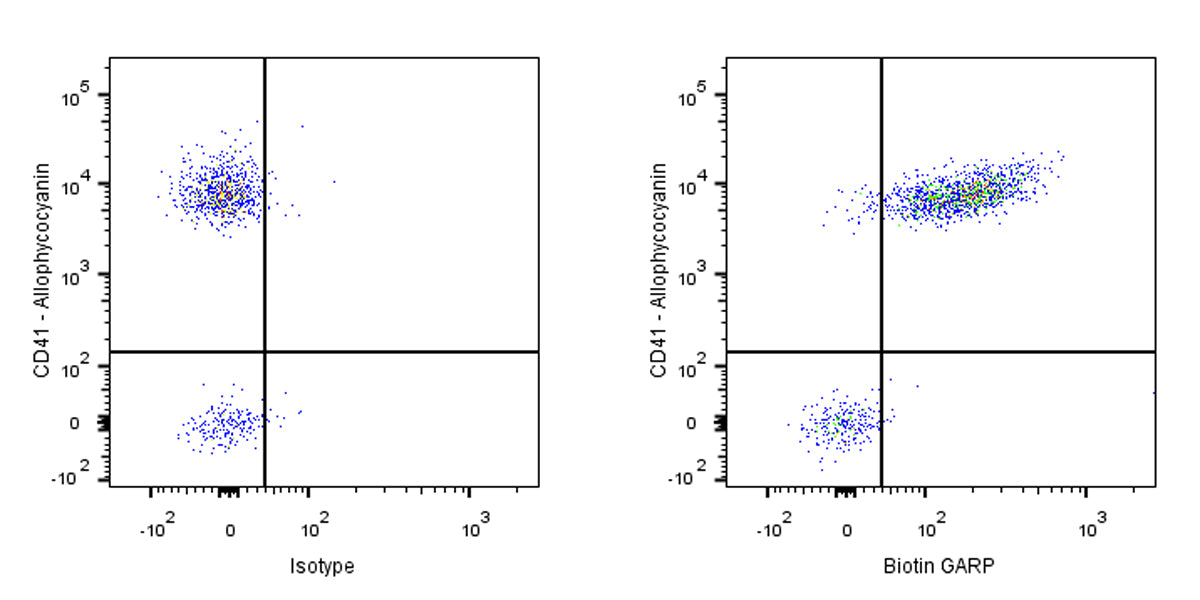
Flow cytometric analysis of Human GARP expression on human peripheral blood leukocytes. Human peripheral blood leukocytes were stained with APC Mouse Anti-Human CD41 antibody and either Biotin Mouse IgG2b, κ Isotype Control (Left panel) or SDT Biotin Mouse Anti- Human GARP antibody (Right panel) at 5 μl/test followed by Sav-PE. Flow cytometry and data analysis were performed using BD FACSymphony™ A1 and FlowJo™ software.
Biotin Mouse Anti-Human GARP Antibody (S-3497)
Biotin Mouse Anti-Human GARP Antibody (S-3497)
Price:
Regular price
$90 USD
Regular price
Sale price
$90 USD
Unit price
per
For shipping services or bulk orders, you may request a quotation.
Secure checkout with

View full details
Product Details
Product Details
Product Specification
| Host | Mouse |
| Antigen | GARP |
| Synonyms | Transforming growth factor beta activator LRRC32; Garpin; Glycoprotein A repetitions predominant (GARP); Leucine-rich repeat-containing protein 32; D11S833E; LRRC32 |
| Location | Cell membrane |
| Accession | Q14392 |
| Clone Number | S-3497 |
| Antibody Type | Mouse mAb |
| Isotype | IgG2b,k |
| Application | FCM |
| Reactivity | Hu |
| Positive Sample | human peripheral blood leukocytes |
| Purification | Protein A |
| Concentration | 0.2 mg/ml |
| Conjugation | Biotin |
| Physical Appearance | Liquid |
| Storage Buffer | PBS pH7.4, 0.03% Proclin 300 |
| Stability & Storage | 12 months from date of receipt / reconstitution, 2 to 8 °C as supplied |
Dilution
| application | dilution | species |
| FCM | 5μl per million cells in 100μl volume | Hu |
Background
GARP, or Glycoprotein A Repetitions Predominant, is a transmembrane protein that acts as a critical docking receptor for latent TGF-β on the surface of activated regulatory T cells and platelets, where its 20 leucine-rich repeats form a horseshoe-shaped solenoid that both stabilizes the cytokine in an inactive conformation and licenses subsequent release through integrin-mediated deformation, thereby positioning GARP as a central checkpoint in immune tolerance and a prime therapeutic target in cancer, autoimmunity and fibrosis.
Picture
Picture
FC