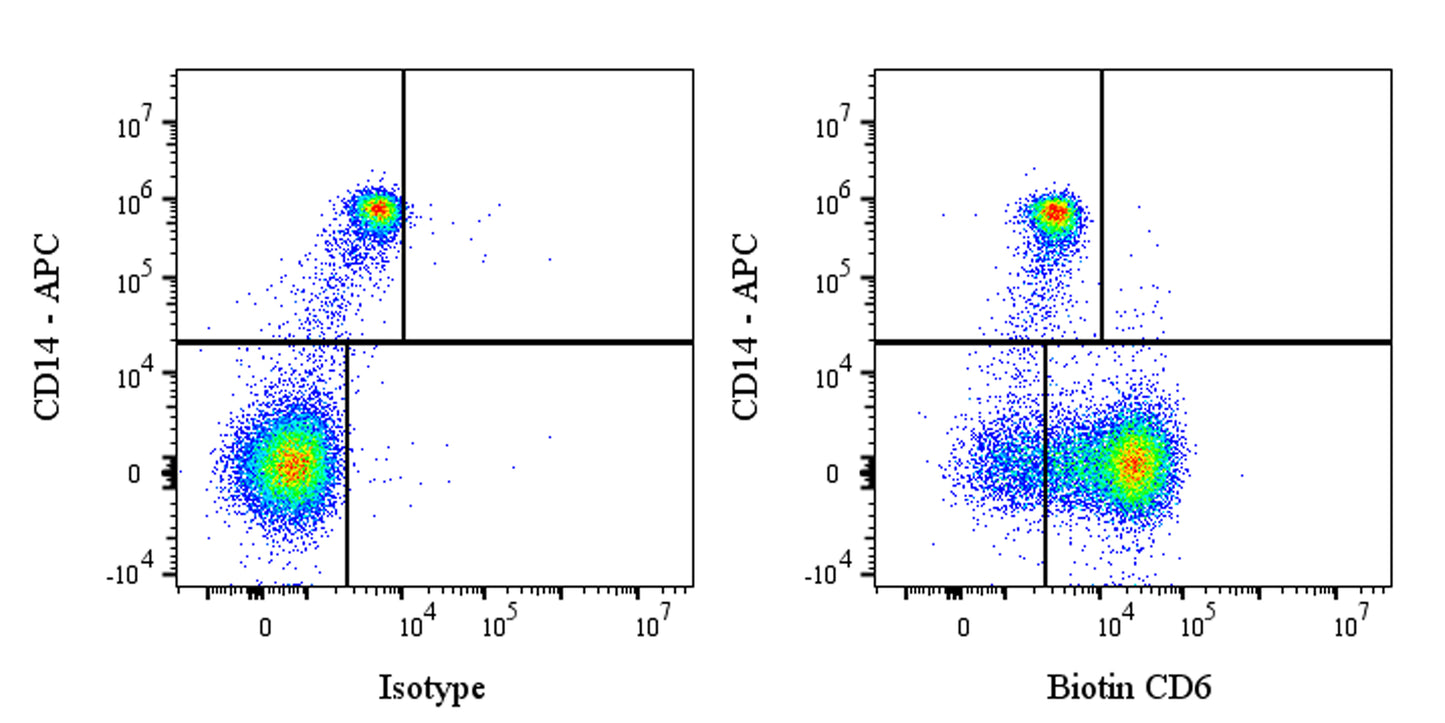
Flow cytometric analysis of human CD6 expression on human PBMC (human peripheral blood mononuclear cell). Human PBMC were stained with APC Mouse Anti-Human CD14 Antibody and either Biotin Mouse IgG2b, κ Isotype Control (left panel) or SDT Biotin Mouse Anti-Human CD6 Antibody (right panel) at 5 μl/test followed by Sav-iFluor 488. Flow cytometry and data analysis were performed using Agilent NovoCyte Quanteon and FlowJo™ software.
Biotin Mouse Anti-Human CD6 Antibody (S-688-33)
Biotin Mouse Anti-Human CD6 Antibody (S-688-33)
Price:
Regular price
$185 USD
Regular price
Sale price
$185 USD
Unit price
per
For shipping services or bulk orders, you may request a quotation.
Secure checkout with

View full details
Product Details
Product Details
Product Specification
| Host | Mouse |
| Antigen | CD6 |
| Synonyms | T-cell differentiation antigen CD6; T12; TP120; mTOR |
| Immunogen | Recombinant Protein |
| Location | Cell membrane |
| Accession | P30203 |
| Clone Number | S-688-33 |
| Antibody Type | Mouse mAb |
| Isotype | IgG2b,k |
| Application | FCM |
| Reactivity | Hu |
| Positive Sample | human PBMC |
| Purification | Protein A |
| Concentration | 0.2 mg/ml |
| Conjugation | Biotin |
| Physical Appearance | Liquid |
| Storage Buffer | PBS pH7.4, 0.03% Proclin 300 |
| Stability & Storage | 12 months from date of receipt / reconstitution, 2 to 8 °C as supplied |
Dilution
| application | dilution | species |
| FCM | 5μl per million cells in 100μl volume | Hu |
Background
CD6 is a type I transmembrane glycoprotein with a molecular mass of 105–130 kDa. It is composed of an extracellular region with three tandem scavenger receptor cysteine-rich (SRCR) domains, a transmembrane region, and a cytoplasmic tail with several phosphorylatable residues suitable for intracellular signal transduction. CD6 associates with the TCR/CD3 complex and plays a role in stabilizing adhesive contacts with antigen-presenting cells (APCs), modulating subsequent TCR/CD3 intracellular signals that drive proliferative and differentiation responses. CD6 also interacts with several ligands, including CD166/ALCAM, CD318/CDCP1, and galectins 1 and 3. These interactions are important for various T cell physiological processes such as thymocyte development, T-APC immunological synapse stabilization, and T cell transmigration to inflamed tissues. Moreover, CD6 has been implicated in various autoimmune diseases. It was identified as a susceptibility locus in multiple sclerosis and Behcet's disease. The role of CD6 in autoimmune diseases may specifically reflect its interaction with CD318, which is expressed on key tissue cells in these diseases.
Picture
Picture
FC