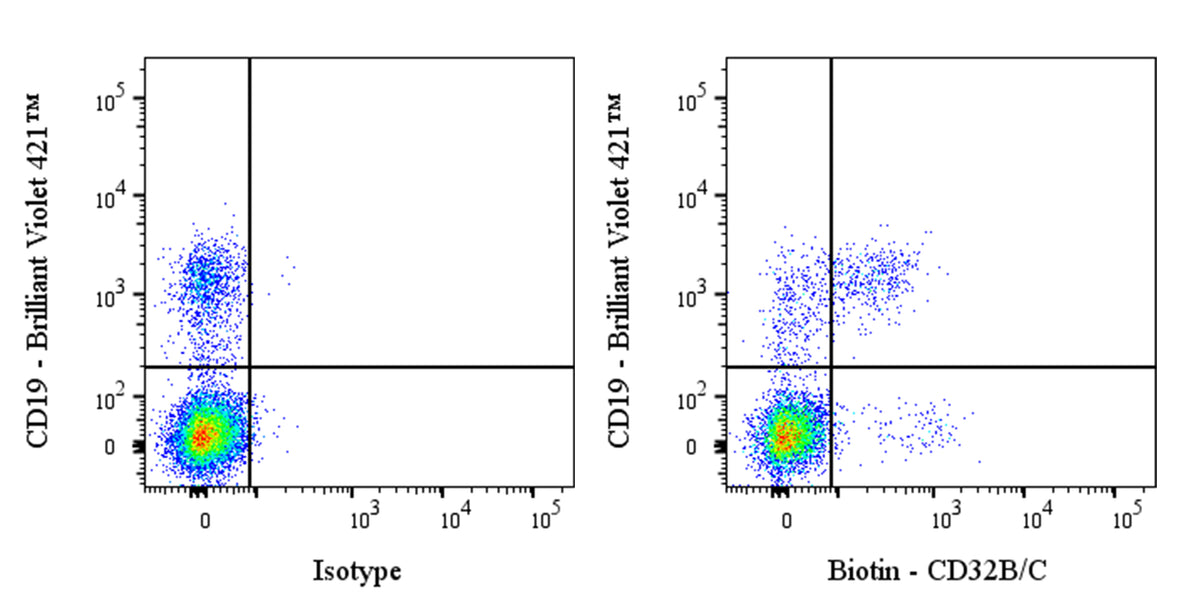
Flow cytometric analysis of human CD32b/c expression on human peripheral blood lymphocytes. Human lymphocytes were stained with Brilliant Violet 421™ Mouse Anti-Human CD19 Antibody and either Biotin IgG1, k Isotype Control (left panel) or SDT Biotin Mouse Anti-Human CD32b/c Antibody (right panel) at 5 μl/test followed by Sav-iFluor 488. Total viable cells, as determined by Fixable Viability Dye 662 (S0D0016), were used for analysis. Flow cytometry and data analysis were performed using BD FACSymphony™ A1 and FlowJo™ software.
Biotin Mouse Anti-Human CD32b/c Antibody (S-3015)
Biotin Mouse Anti-Human CD32b/c Antibody (S-3015)
Price:
Regular price
$120 USD
Regular price
Sale price
$120 USD
Unit price
per
For shipping services or bulk orders, you may request a quotation.
Secure checkout with

View full details
Product Details
Product Details
Product Specification
| Host | Mouse |
| Antigen | CD32b/c |
| Synonyms | FCGR2B, FCgRIIB, FCGR2C, FCRIIC, IGFR2, CD32B, CD32C, FCG2, FCGR2, IGFR2, FcRII-c, CDW32 |
| Location | Cell membrane |
| Accession | P31994、 P31995 |
| Clone Number | S-3015 |
| Antibody Type | Mouse mAb |
| Isotype | IgG1,k |
| Application | FCM |
| Reactivity | Hu |
| Positive Sample | Human Peripheral Blood lymphocytes |
| Purification | Protein G |
| Concentration | 0.2 mg/ml |
| Conjugation | Biotin |
| Physical Appearance | Liquid |
| Storage Buffer | PBS pH7.4, 0.03% Proclin 300 |
| Stability & Storage | 12 months from date of receipt / reconstitution, 2 to 8 °C as supplied |
Dilution
| application | dilution | species |
| FCM | 5μl per million cells in 100μl volume | Hu |
Background
CD32b/c, namely FcγRIIb and FcγRIIc (low-affinity IgG Fc receptors IIb and IIc), are critical immunoregulatory receptors located on the surface of immune cells such as B cells, monocytes/macrophages, dendritic cells, and neutrophils. Belonging to the immunoglobulin superfamily, they transmit inhibitory (FcγRIIb) or activating (FcγRIIc) signals by recognizing and binding the Fc portion of antibodies, thereby finely balancing humoral immunity and inflammatory responses. FcγRIIb serves as the primary inhibitory receptor on B cells, delivering negative feedback signals via its intracellular immunoreceptor tyrosine-based inhibitory motif (ITIM) to suppress B-cell overactivation and antibody production, which is essential for maintaining self-tolerance. In contrast, FcγRIIc is expressed in a subset of the population and carries an immunoreceptor tyrosine-based activation motif (ITAM), which recruits Syk kinase to propagate activating signals and amplify immune responses. Dysfunction of CD32b/c is closely linked to autoimmune diseases (e.g., systemic lupus erythematosus), infection susceptibility, and tumor immune evasion. For instance, agonistic antibodies or bispecific antibodies targeting FcγRIIb have emerged as potential therapeutics to enhance antibody-dependent cellular phagocytosis (ADCP) or inhibit autoreactive B cells, highlighting their significant translational value in clinical applications.
Picture
Picture
FC