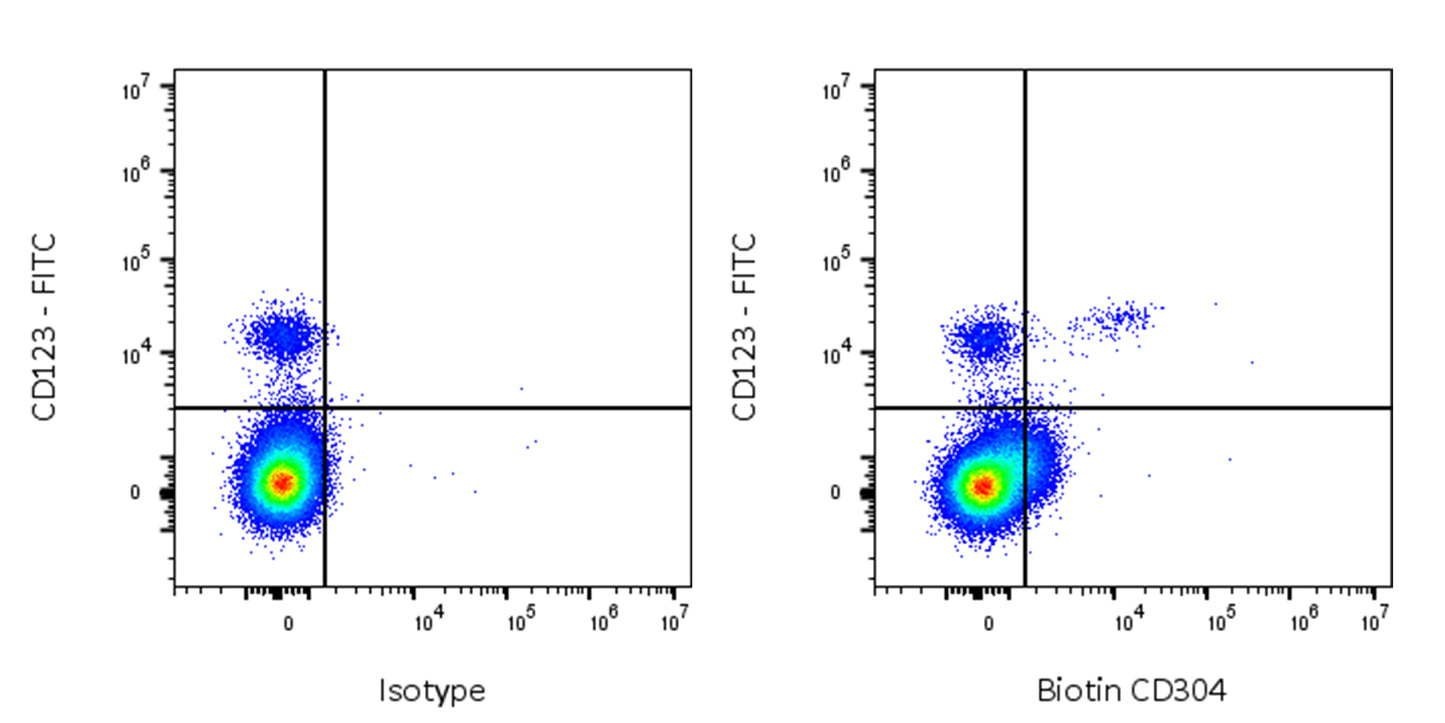
Flow cytometric analysis of human PBMC (human peripheral blood mononuclear cells) were stained with FITC Mouse Anti-Human CD123 Antibody and either Biotin Mouse IgG2a,k Isotype Control (left panel) or Biotin Mouse anti-Human CD304 antibody at 5μl/test (right panel) followed by Sav-PE. Total viable cells, as determined by Fixable Viability Dye 452 (S0D0021), were used for analysis. Flow cytometry and data analysis were performed using Agilent NovoCyte Quanteon and FlowJo™ software.
Biotin Mouse Anti-Human CD304 Antibody (S-R695)
Biotin Mouse Anti-Human CD304 Antibody (S-R695)
Price:
Regular price
$35 USD
Regular price
Sale price
$35 USD
Unit price
per
For shipping services or bulk orders, you may request a quotation.
Secure checkout with

View full details
Product Details
Product Details
Product Specification
| Host | Mouse |
| Antigen | CD304 |
| Synonyms | Neuropilin-1; Vascular endothelial cell growth factor 165 receptor; NRP; VEGF165R; NRP1 |
| Location | Cytoplasm, Mitochondrion, Cell membrane |
| Accession | O14786 |
| Clone Number | S-R695 |
| Antibody Type | Mouse mAb |
| Isotype | IgG2a,k |
| Application | FCM |
| Reactivity | Hu |
| Positive Sample | Human PBMC |
| Purification | Protein A |
| Concentration | 0.2 mg/ml |
| Conjugation | Biotin |
| Physical Appearance | Liquid |
| Storage Buffer | PBS pH7.4, 0.03% Proclin 300 |
| Stability & Storage | 12 months from date of receipt / reconstitution, 2 to 8 °C as supplied |
Dilution
| application | dilution | species |
| FCM | 5μl per million cells in 100μl volume | Hu |
Background
CD304, also known as neuropilin-1 (NRP-1) or BDCA-4, is a type I transmembrane protein that plays crucial roles in various biological processes. It is a non-tyrosine kinase C-type lectin receptor, first identified on the cell membrane of plasmacytoid dendritic cells (pDCs). CD304 is involved in neuronal guidance during embryogenesis, angiogenesis, and immune responses. It serves as a co-receptor for vascular endothelial growth factor (VEGF) and members of the semaphorin family, interacting with plexins and VEGF receptors on neurons and endothelial cells . In the immune system, CD304 is expressed on natural Treg cells and may contribute to immunosuppression and tumor growth regulation . Additionally, CD304 is a valuable marker for distinguishing residual disease in B-cell acute lymphoblastic leukemia (B-ALL) and is widely used in minimal residual disease (MRD) detection.
Picture
Picture
FC