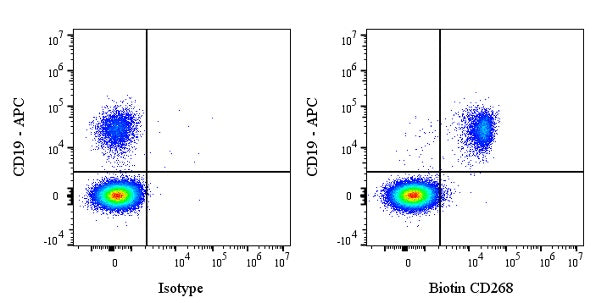
Flow cytometric analysis of human CD268 expression on human PBMC (human peripheral blood mononuclear cell). Human PBMC were stained with APC Mouse Anti-Human CD19 Antibody and either Biotin Mouse IgG1, κ Isotype Control (left panel) or SDT Biotin Mouse Anti-Human CD268 Antibody (right panel) at 5 μl/test followed by Sav-iFluor 488. Flow cytometry and data analysis were performed using Agilent NovoCyte Quanteon and FlowJo™ software.
Biotin Mouse Anti-Human CD268 (BAFF Receptor) Antibody (11C1)
Biotin Mouse Anti-Human CD268 (BAFF Receptor) Antibody (11C1)
Price:
Regular price
$200 USD
Regular price
Sale price
$200 USD
Unit price
per
For shipping services or bulk orders, you may request a quotation.
Secure checkout with

View full details
Product Details
Product Details
Product Specification
| Host | Mouse |
| Antigen | CD268 (BAFF Receptor) |
| Synonyms | Tumor necrosis factor receptor superfamily member 13C; B-cell-activating factor receptor; BAFF receptor (BAFF-R); BLyS receptor 3; BAFFR; BR3; TNFRSF13C |
| Location | Membrane |
| Accession | Q96RJ3 |
| Clone Number | 11C1 |
| Antibody Type | Mouse mAb |
| Isotype | IgG1,k |
| Application | FCM |
| Reactivity | Hu |
| Positive Sample | Human PBMC |
| Purification | Protein G |
| Concentration | 0.2 mg/ml |
| Conjugation | Biotin |
| Physical Appearance | Liquid |
| Storage Buffer | PBS pH7.4, 0.03% Proclin 300 |
| Stability & Storage | 12 months from date of receipt / reconstitution, 2 to 8 °C as supplied |
Dilution
| application | dilution | species |
| FCM | 5μl per million cells in 100μl volume | Hu |
Background
CD268, also known as the B-cell Activating Factor Receptor (BAFF-R or BR3), is a type III transmembrane protein belonging to the tumor necrosis factor receptor (TNFR) superfamily that plays a pivotal role in B lymphocyte biology by serving as the primary high-affinity receptor for BAFF (BLyS). Predominantly expressed on the surface of mature and transitional B cells, CD268 is essential for B cell survival, maturation from the transitional to the follicular stage, and the maintenance of peripheral B cell homeostasis through the activation of key signaling pathways such as NF-κB (both canonical and non-canonical), PI3K/Akt, and MAPK. Upon binding to its ligand BAFF, CD268 prevents apoptosis by upregulating anti-apoptotic proteins like Bcl-2 and Mcl-1, thereby ensuring the longevity of the B cell pool; conversely, defects or deficiencies in CD268 signaling lead to a severe reduction in mature B cell numbers and impaired humoral immunity. Due to its critical function in B cell survival, CD268 is a significant therapeutic target in autoimmune diseases characterized by B cell hyperactivity, such as systemic lupus erythematosus (SLE) and rheumatoid arthritis, as well as in B cell malignancies, where blocking this receptor can effectively induce the depletion of pathogenic or malignant B cells.
Picture
Picture
FC