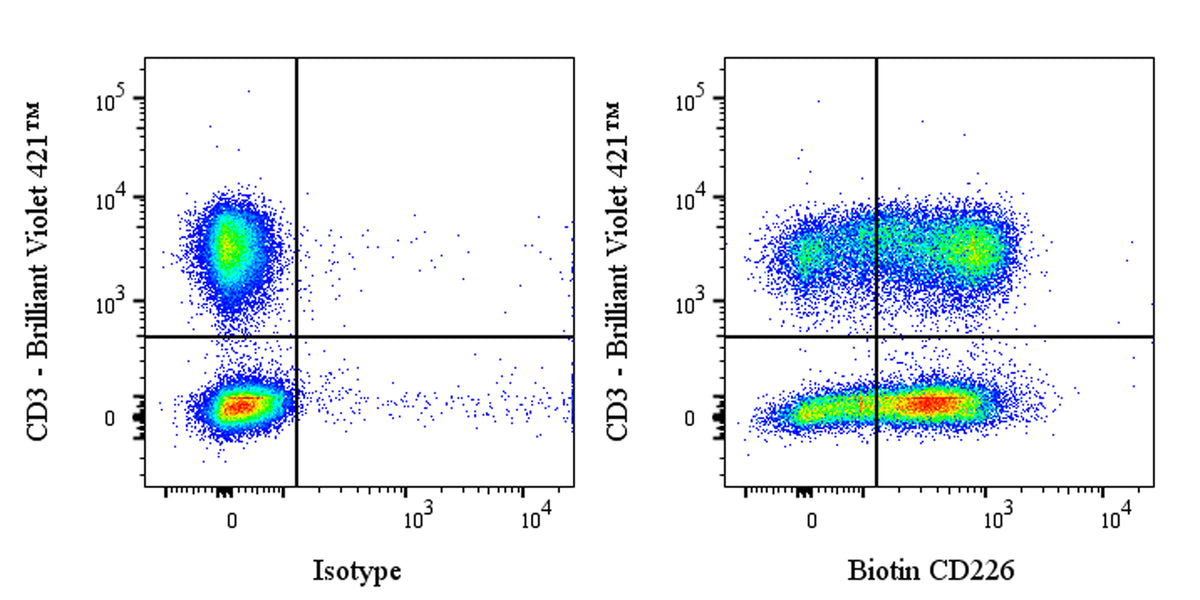
Flow cytometric analysis of human CD226 expression on human PBMCs (human peripheral blood mononuclear cells). Human PBMCs were stained with Brilliant Violet 421™ Mouse Anti-Human CD3 Antibody and either Biotin Mouse IgG1, k Isotype Control (left panel) or SDT Biotin Mouse Anti-Human CD226 Antibody (right panel) at 5 μl/test followed by Sav-iFluor 488. Flow cytometry and data analysis were performed using BD FACSymphony™ A1 and FlowJo™ software.
Biotin Mouse Anti-Human CD226 Antibody (DX11)
Biotin Mouse Anti-Human CD226 Antibody (DX11)
Price:
Regular price
$70 USD
Regular price
Sale price
$70 USD
Unit price
per
For shipping services or bulk orders, you may request a quotation.
Secure checkout with

View full details
Product Details
Product Details
Product Specification
| Host | Mouse |
| Antigen | CD226 |
| Synonyms | CD226 antigen; DNAX accessory molecule 1 (DNAM-1); DNAM1 |
| Location | Cell membrane |
| Accession | Q15762 |
| Clone Number | DX11 |
| Antibody Type | Mouse mAb |
| Isotype | IgG1,k |
| Isotype Control | S0B5431 |
| Application | FCM |
| Reactivity | Hu |
| Positive Sample | Human PBMC |
| Purification | Protein G |
| Concentration | 0.2 mg/ml |
| Conjugation | Biotin |
| Physical Appearance | Liquid |
| Storage Buffer | PBS pH7.4, 0.09% sodium azide |
| Stability & Storage | 12 months from date of receipt / reconstitution, 2 to 8 °C as supplied |
Dilution
| application | dilution | species |
| FCM | 5μl per million cells in 100μl volume | Hu |
Background
CD226, also known as DNAX accessory molecule-1 (DNAM-1), PTA-1, or TLiSA1, is a transmembrane glycoprotein and a member of the immunoglobulin superfamily. It is expressed on the surface of natural killer (NK) cells, T cells, B cells, monocytes, and platelets. CD226 plays a crucial role in mediating cell adhesion, particularly between platelets and megakaryocytic cells to vascular endothelial cells, and it is also involved in the maturation of megakaryocytic cells. Structurally, CD226 contains two immunoglobulin-like V-set domains and has multiple glycosylation sites in its extracellular region. Its ligands include CD155 (PVR) and CD112, which are widely expressed on various cell types, including tumor cells, making CD226 an important factor in immune responses against cancer. Additionally, genetic variants of CD226 have been associated with autoimmune diseases such as type 1 diabetes and rheumatoid arthritis.
Picture
Picture
FC