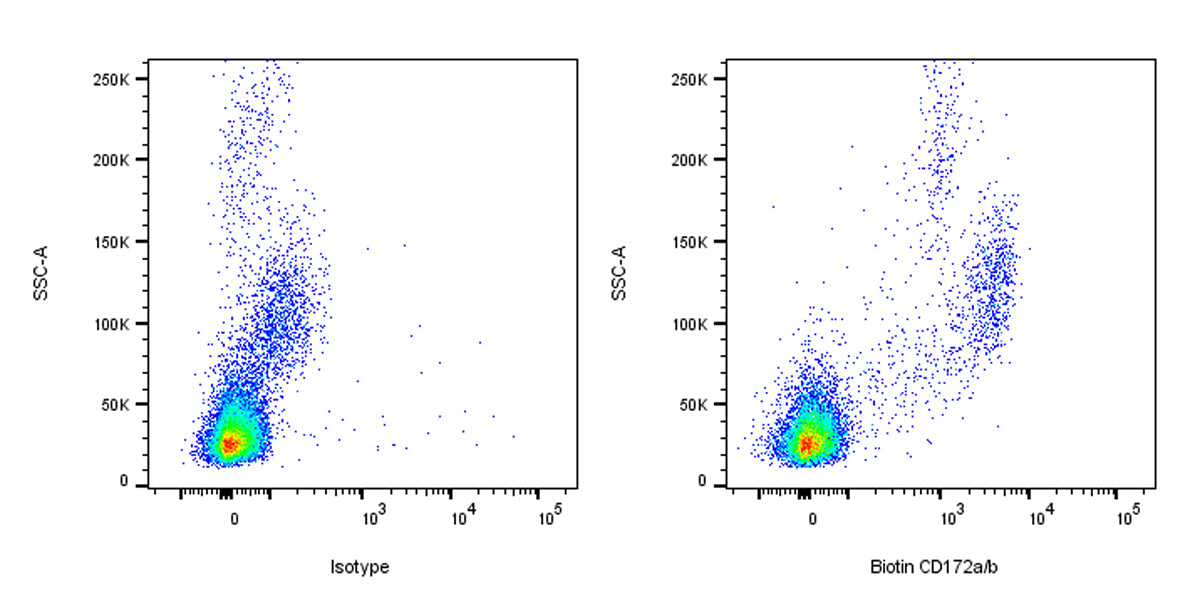
Flow cytometric analysis of Human CD172a/b expression on human peripheral blood leukocytes. Human peripheral blood leukocytes were stained with either Biotin Mouse IgG1, κ Isotype Control (Left panel) or SDT Biotin Mouse Anti-Human CD172a/b Antibody (Right panel) at 5 μl/test followed by Sav-iFluor 488. Flow cytometry and data analysis were performed using BD FACSymphony™ A1 and FlowJo™ software.
Biotin Mouse Anti-Human CD172a/b Antibody (S-3431)
Biotin Mouse Anti-Human CD172a/b Antibody (S-3431)
Price:
Regular price
$60 USD
Regular price
Sale price
$60 USD
Unit price
per
For shipping services or bulk orders, you may request a quotation.
Secure checkout with

View full details
Product Details
Product Details
Product Specification
| Host | Mouse |
| Antigen | CD172a/b |
| Synonyms | SHP substrate 1; SHPS-1; CD172 antigen-like family member A; Inhibitory receptor SHPS-1; Macrophage fusion receptor; MyD-1 antigen; p84; SIRPA; BIT; MFR; MYD1; PTPNS1; SHPS1; SIRP; Signal-regulatory protein beta-1; SIRP-beta-1; CD172 antigen-like family member B; SIRPB1 |
| Location | Cell membrane |
| Accession | O00241、P78324 |
| Clone Number | S-3431 |
| Antibody Type | Mouse mAb |
| Isotype | IgG1,k |
| Application | FCM |
| Reactivity | Hu |
| Positive Sample | Human peripheral blood leukocytes |
| Purification | Protein G |
| Concentration | 0.2 mg/ml |
| Conjugation | Biotin |
| Physical Appearance | Liquid |
| Storage Buffer | PBS pH7.4, 0.03% Proclin 300 |
| Stability & Storage | 12 months from date of receipt / reconstitution, 2 to 8 °C as supplied |
Dilution
| application | dilution | species |
| FCM | 5μl per million cells in 100μl volume | Hu |
Background
CD172a (SIRPα) and CD172b (SIRPβ1) are paired immunoglobulin-superfamily transmembrane glycoproteins that regulate myeloid-cell activation: CD172a binds CD47 to deliver inhibitory “don’t-eat-me” signals via SHP-1/2 phosphatases, controlling phagocytosis and dendritic-cell homeostasis, whereas CD172b lacks CD47 affinity and instead partners with the adaptor DAP12 to recruit SYK kinase and provide activating cues during innate immune responses.
Picture
Picture
FC