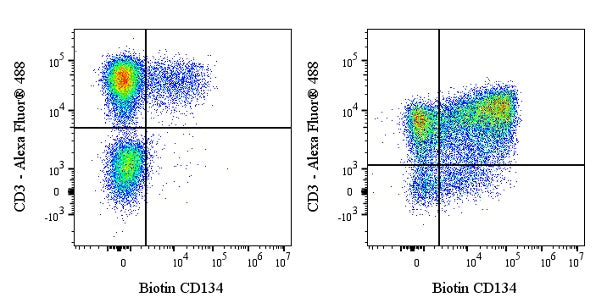
Human peripheral blood mononuclear cells were stimulated with 10 μg/ml phytohemagglutinin (PHA) (right panel) or unstimulated (left panel) were stained with Alexa Fluor® 488 Mouse Anti-Human CD3 and SDT Biotin Mouse Anti-Human CD134 Antibody at 5 μl/test followed by Sav-PE. Flow cytometry and data analysis were performed using Agilent NovoCyte Quanteon and FlowJo™ software.
Biotin Mouse Anti-Human CD134 Antibody (ACT35)
Biotin Mouse Anti-Human CD134 Antibody (ACT35)
Price:
Regular price
$110 USD
Regular price
Sale price
$110 USD
Unit price
per
For shipping services or bulk orders, you may request a quotation.
Secure checkout with

View full details
Product Details
Product Details
Product Specification
| Host | Mouse |
| Antigen | CD134 |
| Location | Membrane |
| Accession | P43489 |
| Clone Number | ACT35 |
| Antibody Type | Mouse mAb |
| Isotype Control | S0B5431 |
| Application | FCM |
| Reactivity | Hu |
| Positive Sample | PHA treated Human PBMC |
| Purification | Protein G |
| Concentration | 0.2 mg/ml |
| Conjugation | Biotin |
| Physical Appearance | Liquid |
| Storage Buffer | PBS pH7.4, 0.09% sodium azide |
| Stability & Storage | 12 months from date of receipt / reconstitution, 2 to 8 °C as supplied |
Dilution
| application | dilution | species |
| FCM | 5μl per million cells in 100μl volume | Hu |
Background
CD134, also known as OX40 or TNFRSF4, is a co-stimulatory molecule belonging to the tumor necrosis factor receptor superfamily. It is primarily expressed on activated CD4+ and CD8+ T cells, as well as other immune cells like natural killer (NK) cells and dendritic cells. CD134 plays a crucial role in enhancing T-cell proliferation, cytokine production, and survival by interacting with its ligand, CD134L (OX40L), which is mainly expressed on antigen-presenting cells (APCs) such as dendritic cells and macrophages. This interaction promotes T-cell-mediated immune responses and helps maintain memory T cells, making CD134 an important target for immunotherapy. In cancer treatment, agonistic antibodies targeting CD134 have been shown to enhance anti-tumor immunity by boosting T-cell activity and overcoming immune suppression.
Picture
Picture
FC