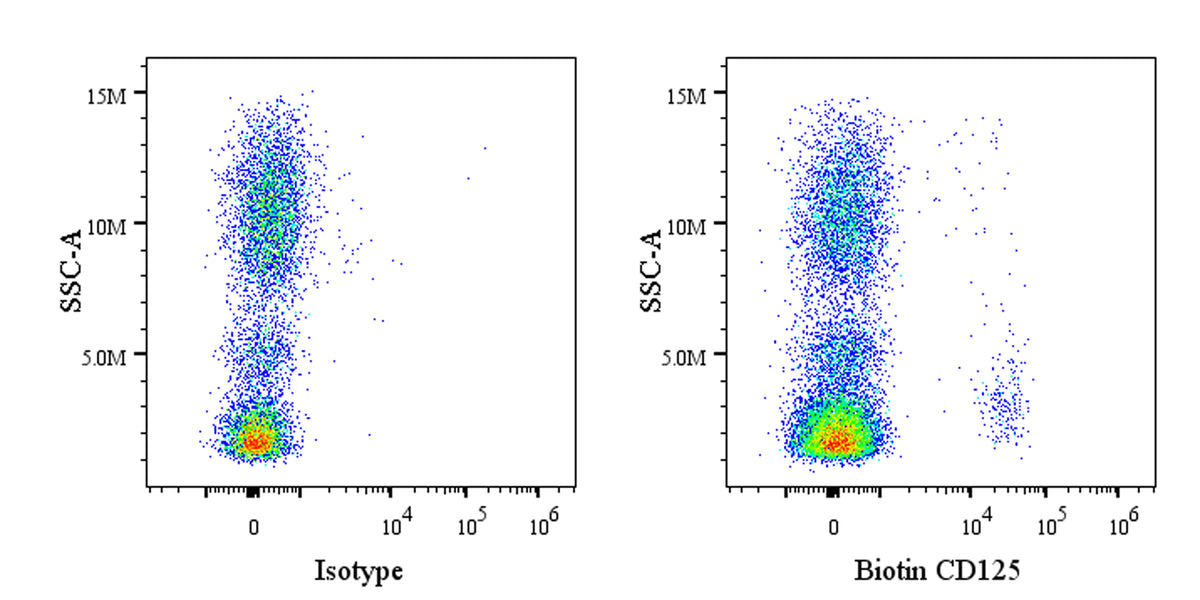
Flow cytometric analysis of human CD125 expression on human peripheral blood cells. Human peripheral blood cells were stained with either Biotin Mouse IgG1, k Isotype Control (left panel) or SDT Biotin Mouse Anti-Human CD125 Antibody (right panel) at 5 μl/test followed by Sav-APC. Flow cytometry and data analysis were performed using BD FACSymphony™ A1 and FlowJo™ software.
Biotin Mouse Anti-Human CD125 Antibody (S-4480)
Biotin Mouse Anti-Human CD125 Antibody (S-4480)
Price:
Regular price
$215 USD
Regular price
Sale price
$215 USD
Unit price
per
For shipping services or bulk orders, you may request a quotation.
Secure checkout with

View full details
Product Details
Product Details
Product Specification
| Host | Mouse |
| Antigen | CD125 |
| Synonyms | Interleukin-5 receptor subunit alpha; IL-5 receptor subunit alpha; IL-5R subunit alpha; IL-5R-alpha; IL-5RAAlternative nameCDw125; IL5R; IL5RA |
| Location | Membrane |
| Accession | Q01344 |
| Clone Number | S-4480 |
| Antibody Type | Mouse mAb |
| Isotype | IgG1,k |
| Isotype Control | S0B5431 |
| Application | FCM |
| Reactivity | Hu |
| Positive Sample | Human peripheral blood cells |
| Purification | Protein G |
| Concentration | 0.2 mg/ml |
| Conjugation | Biotin |
| Physical Appearance | Liquid |
| Storage Buffer | PBS pH7.4, 0.09% sodium azide |
| Stability & Storage | 12 months from date of receipt / reconstitution, 2 to 8 °C as supplied |
Dilution
| application | dilution | species |
| FCM | 5μl per million cells in 100μl volume | Hu |
Background
CD125, also known as the interleukin-4 receptor subunit alpha (IL-4Rα), is a type I transmembrane protein that serves as a critical shared signaling component for both the type I and type II interleukin-4 receptors, thereby playing a pivotal role in regulating immune responses, particularly those associated with Th2-mediated inflammation, allergic reactions, and asthma. As the primary binding subunit for interleukin-4 (IL-4) and interleukin-13 (IL-13), CD125 facilitates the activation of downstream signaling pathways, most notably the JAK-STAT pathway (specifically JAK1/STAT6), which leads to the transcription of genes involved in IgE class switching, eosinophil recruitment, mucus production, and alternative macrophage activation. Structurally, it consists of an extracellular domain responsible for cytokine binding, a single transmembrane helix, and a cytoplasmic tail containing specific motifs that recruit Janus kinases, making it a significant therapeutic target; indeed, monoclonal antibodies such as dupilumab specifically inhibit the interaction of IL-4 and IL-13 with CD125 to effectively treat moderate-to-severe atopic dermatitis, asthma, and chronic rhinosinusitis with nasal polyps by blocking this central axis of type 2 inflammatory signaling.
Picture
Picture
FC