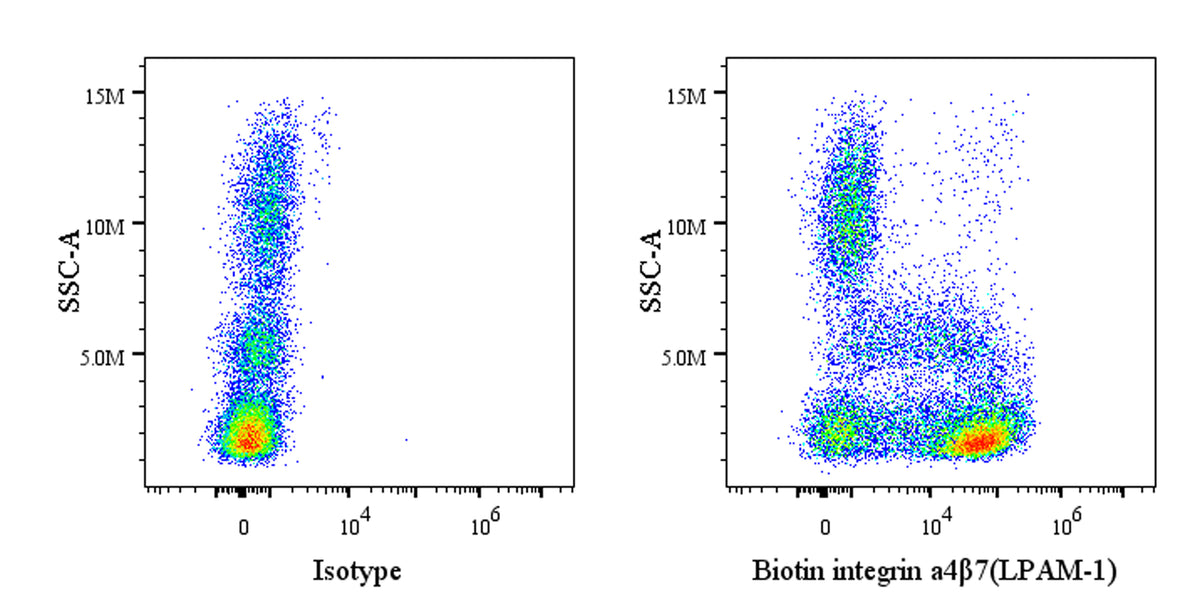
Flow cytometric analysis of Human α4β7 expression on human peripheral blood cells. Human peripheral blood cells were stained with either Biotin Human IgG1 Isotype Control (left panel) or SDT Biotin integrin α4β7 (LPAM-1) Antibody (right panel) at 5 μl/test followed by Sav-PE. Flow cytometry and data analysis were performed using BD FACSymphony™ A1 and FlowJo™ software.
Biotin Human Anti-Human integrin α4β7 (LPAM-1) Antibody (S-4614)
Biotin Human Anti-Human integrin α4β7 (LPAM-1) Antibody (S-4614)
Price:
Regular price
$140 USD
Regular price
Sale price
$140 USD
Unit price
per
For shipping services or bulk orders, you may request a quotation.
Secure checkout with

View full details
Product Details
Product Details
Product Specification
| Host | Human |
| Antigen | Integrin α4β7 (LPAM-1) |
| Synonyms | Integrin alpha-4; CD49 antigen-like family member D; Integrin alpha-IV; VLA-4 subunit alpha; CD49D; ITGA4; Integrin beta-7; Gut homing receptor beta subunit; ITGB7 |
| Accession | P13612、P26010 |
| Clone Number | S-4614 |
| Antibody Type | Recombinant mAb |
| Isotype | IgG1 |
| Application | FCM |
| Reactivity | Hu |
| Positive Sample | Human peripheral blood cells |
| Purification | Protein A |
| Concentration | 0.2 mg/ml |
| Conjugation | Biotin |
| Physical Appearance | Liquid |
| Storage Buffer | PBS pH7.4, 0.09% sodium azide |
| Stability & Storage | 12 months from date of receipt / reconstitution, 2 to 8 °C as supplied |
Dilution
| application | dilution | species |
| FCM | 5μl per million cells in 100μl volume | Hu |
Background
Integrin α4β7 is a heterodimeric transmembrane glycoprotein composed of α4 (CD49d) and β7 (CD29) subunits linked by non-covalent bonds, belonging to the integrin family that primarily mediates cell-cell and cell-matrix adhesion. Its extracellular domain specifically recognizes and binds to ligands, including mucosal addressin cell adhesion molecule-1 (MAdCAM-1) expressed on vascular endothelial cells and the CS-1 fragment of fibronectin. The most critical physiological function of this integrin is to serve as a key "homing molecule" for lymphocyte trafficking to gut-associated lymphoid tissue (GALT) and the intestinal lamina propria—when α4β7 on the surface of naive or memory T cells binds to MAdCAM-1 expressed on high endothelial venules (HEVs) of the intestine, it initiates a cascade of adhesion events, mediating lymphocyte rolling, firm adhesion, and transendothelial migration, thereby guiding these cells to preferentially home to the intestinal mucosal immune system, where it plays an irreplaceable role in maintaining intestinal immune homeostasis and local defense. However, dysregulation of α4β7 function is also closely associated with the pathogenesis of various diseases: in inflammatory bowel diseases (such as Crohn's disease and ulcerative colitis), aberrantly high expression of this integrin on gut-homing lymphocytes drives excessive inflammatory cell infiltration, exacerbating chronic mucosal damage in the intestine. Therefore, it has become an important therapeutic target for these conditions. Anti-α4β7 monoclonal antibodies (such as Vedolizumab), by specifically blocking its binding to MAdCAM-1, can effectively inhibit lymphocyte homing to the gut, thereby achieving selective suppression of local intestinal inflammation in clinical practice without affecting systemic immune function. Additionally, in HIV-1 infection, α4β7 has also been identified as an adhesion receptor for the viral envelope protein gp120, participating in viral dissemination within the intestinal mucosa and the establishment of latent reservoirs.
Picture
Picture
FC