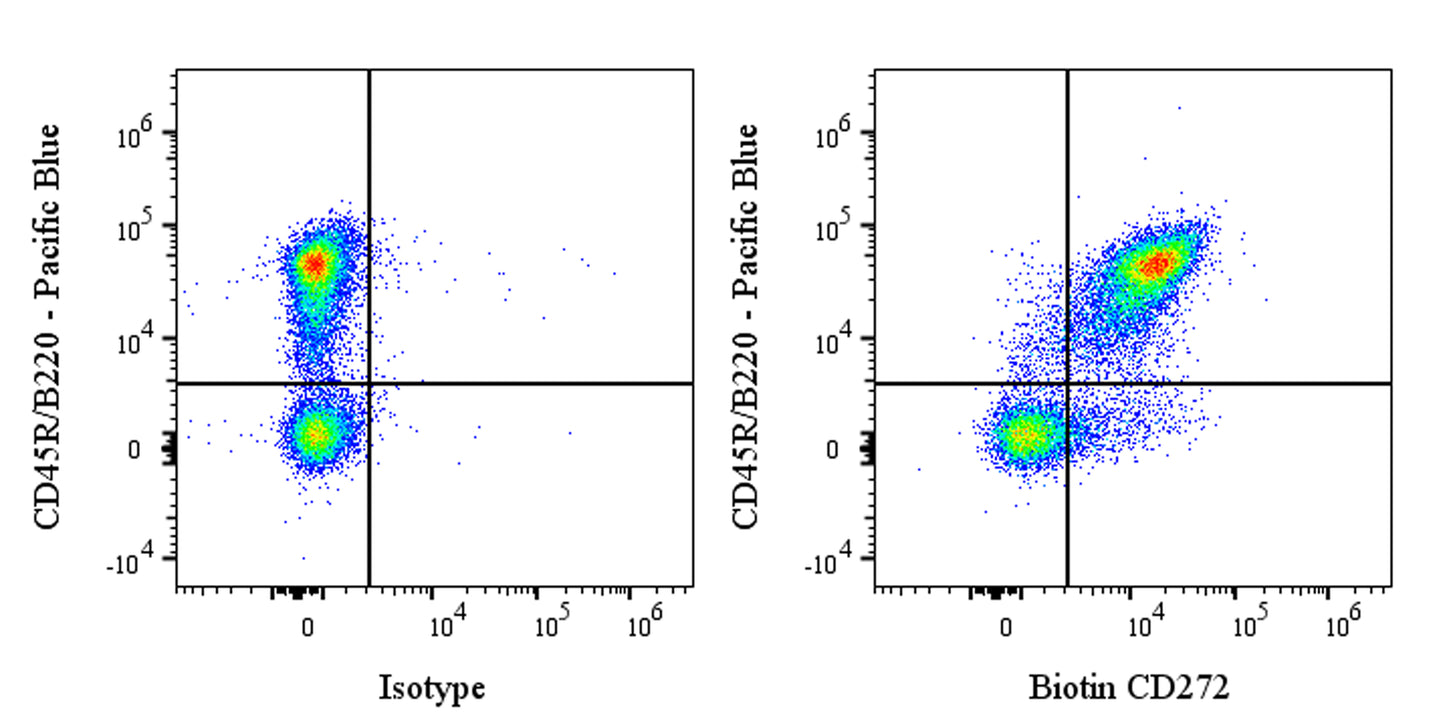
Flow cytometric analysis of CD272 expression on C57BL/6 mouse splenocytes. C57BL/6 mouse splenocytes were stained with Pacific Blue™ Rat Anti-Mouse CD45R/B220 Antibody and either Biotin Armenian hamster IgG Isotype Control (left panel) or SDT Biotin Armenian Hamster Anti-Mouse CD272 Antibody (right panel) at 0.5μl/test followed by Sav-iFluor 488. Flow cytometry and data analysis were performed using Agilent NovoCyte Quanteon and FlowJo™ software.
Biotin Armenian Hamster Anti-Mouse CD272 Antibody (6A6)
Biotin Armenian Hamster Anti-Mouse CD272 Antibody (6A6)
Price:
Regular price
$85 USD
Regular price
Sale price
$85 USD
Unit price
per
For shipping services or bulk orders, you may request a quotation.
Secure checkout with

View full details
Product Details
Product Details
Product Specification
| Host | Armenian hamster |
| Antigen | CD272 |
| Synonyms | B- and T-lymphocyte attenuator; B- and T-lymphocyte-associated protein; Btla |
| Location | Cell membrane |
| Accession | Q7TSA3 |
| Clone Number | 6A6 |
| Antibody Type | Recombinant mAb |
| Isotype | IgG |
| Isotype Control | S0B80066 |
| Application | FCM |
| Reactivity | Ms |
| Positive Sample | C57BL/6 mouse splenocytes |
| Purification | Protein G |
| Concentration | 0.5 mg/ml |
| Conjugation | Biotin |
| Physical Appearance | Liquid |
| Storage Buffer | PBS pH7.4, 0.09% sodium azide |
| Stability & Storage | 12 months from date of receipt / reconstitution, 2 to 8 °C as supplied |
Dilution
| application | dilution | species |
| FCM | 0.25μg per million cells in 100μl volume | Ms |
Background
CD272, also known as B- and T-lymphocyte attenuator (BTLA), is an inhibitory receptor belonging to the CD28 immunoglobulin superfamily. It is encoded by the BTLA gene and primarily expressed on B cells, T cells, macrophages, and dendritic cells. BTLA plays a crucial role in regulating immune responses by acting as a negative regulator of antigen receptor signaling. Its ligand is HVEM (herpesvirus entry mediator, also known as CD270), and their interaction inhibits T cell and B cell activation, proliferation, and cytokine production. Structurally, BTLA is similar to other immune checkpoint proteins like PD-1 and CTLA-4, containing an extracellular IgV-like domain and intracellular immunoreceptor tyrosine-based inhibitory motifs (ITIMs) that mediate its inhibitory functions. BTLA's signaling involves the recruitment of tyrosine phosphatases SHP-1 and SHP-2, which dampen immune activation. Due to its role in immune regulation, the BTLA-HVEM axis is considered a promising target for cancer immunotherapy.
Picture
Picture
FC