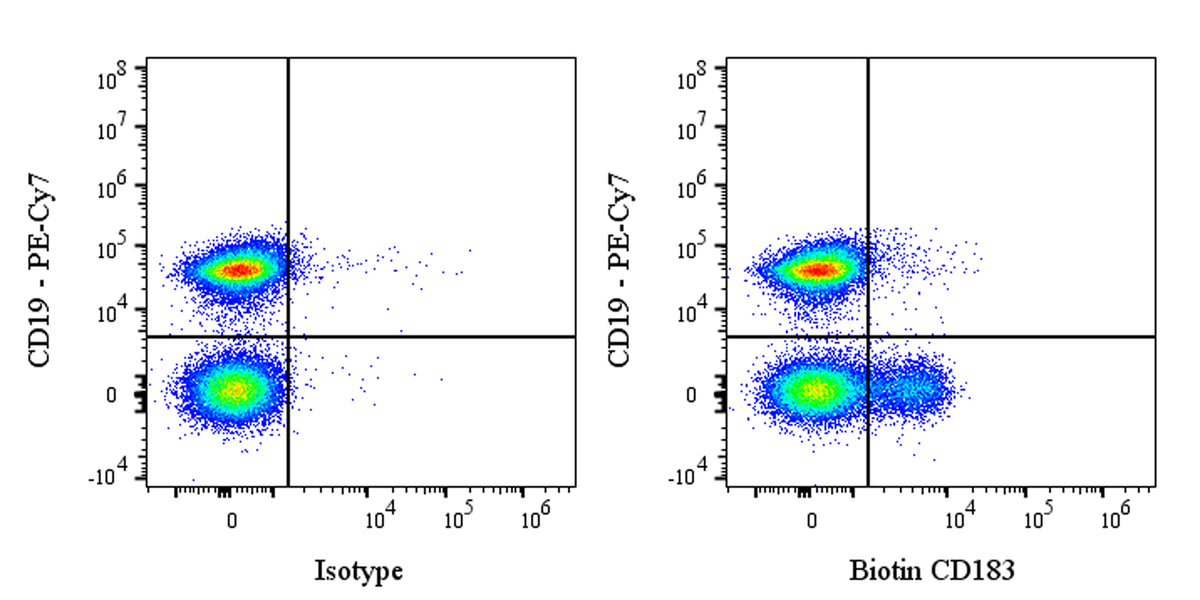
Flow cytometric analysis of Mouse CD183 expression on C57BL/6 mouse splenocytes. C57BL/6 mouse splenocytes were stained with PE-Cy7 Rat Anti-Mouse CD19 Antibody and either Biotin Armenian hamster IgG Isotype Control (left panel) or SDT Biotin Armenian hamster Anti-Mouse CD183 Antibody (right panel) at 2 μl/test followed by Sav-iFluor 488. Flow cytometry and data analysis were performed using Agilent NovoCyte Quanteon and FlowJo™ software.
Biotin Armenian hamster Anti-Mouse CD183 Antibody (CXCR3-173)
Biotin Armenian hamster Anti-Mouse CD183 Antibody (CXCR3-173)
Price:
Regular price
$70 USD
Regular price
Sale price
$70 USD
Unit price
per
For shipping services or bulk orders, you may request a quotation.
Secure checkout with

View full details
Product Details
Product Details
Product Specification
| Host | Armenian hamster |
| Antigen | CD183 |
| Synonyms | C-X-C chemokine receptor type 3; CXC-R3; CXCR-3; Interferon-inducible protein 10 receptor (IP-10 receptor); Cmkar3; Cxcr3 |
| Location | Cell membrane |
| Accession | O88410 |
| Clone Number | CXCR3-173 |
| Antibody Type | Recombinant mAb |
| Isotype | IgG |
| Isotype Control | S0B80066 |
| Application | FCM |
| Reactivity | Ms |
| Positive Sample | C57BL/6 mouse splenocytes |
| Purification | Protein G |
| Concentration | 0.5 mg/ml |
| Conjugation | Biotin |
| Physical Appearance | Liquid |
| Storage Buffer | PBS pH7.4, 0.09% sodium azide |
| Stability & Storage | 12 months from date of receipt / reconstitution, 2 to 8 °C as supplied |
Dilution
| application | dilution | species |
| FCM | 1μg per million cells in 100μl volume | Ms |
Background
CD183, also known as CXCR3, is a 40-kDa, seven-transmembrane G-protein-coupled receptor encoded on chromosome Xq13 that selectively binds the IFN-γ-inducible chemokines CXCL9, CXCL10 and CXCL11; upon ligation it triggers Gi-mediated signaling cascades (MAPK, PI3K/AKT, PLCβ3/μ-calpain, cAMP/PKA and p38MAPK) that induce rapid integrin activation, cytoskeletal rearrangement and chemotactic migration of activated/memory CD4⁺ and CD8⁺ T cells, NK cells and endothelial cells, thereby orchestrating Th1-oriented inflammatory responses, anti-viral immunity and angiostasis; the receptor exists in three alternatively spliced isoforms (CXCR3-A, -B and -alt) that differ in their C-termini and third intracellular loop, enabling ligand-specific functional bias—CXCR3-A promotes proliferation, survival and invasion, whereas CXCR3-B mediates growth inhibition, apoptosis and vascular suppression—and is prominently expressed in inflamed tissues and various cancers, making it a key therapeutic target for autoimmune, neoplastic and infectious diseases.
Picture
Picture
FC