WB result of Bcl10 Rabbit pAb
Primary antibody: Bcl10 Rabbit pAb at 1/1000 dilution
Lane 1: Ramos whole cell lysate 20 µg
Lane 2: HeLa whole cell lysate 20 µg
Lane 3: HuT-78 whole cell lysate 20 µg
Lane 4: Raji whole cell lysate 20 µg
Secondary antibody: Goat Anti- rabbit IgG, (H+L), HRP conjugated at 1/10000 dilution
Predicted MW: 26 kDa
Observed MW: 28 kDa
Bcl-10 Rabbit Polyclonal Antibody
Bcl-10 Rabbit Polyclonal Antibody
Price:
Regular price
$100 USD
Regular price
Sale price
$100 USD
Unit price
per
For shipping services or bulk orders, you may request a quotation.
Secure checkout with

View full details
Product Details
Product Details
Product Specification
| Host | Rabbit |
| Antigen | Bcl-10 |
| Synonyms | B-cell lymphoma/leukemia 10; B-cell CLL/lymphoma 10 (Bcl-10); CARD-containing molecule enhancing NF-kappa-B; CARD-like apoptotic protein (hCLAP); CED-3/ICH-1 prodomain homologous E10-like regulator (CIPER); Cellular homolog of vCARMEN (cCARMEN); CIPER; CLAP; BCL10 |
| Immunogen | Synthetic Peptide |
| Location | Cytoplasm, Nucleus |
| Accession | O95999 |
| Antibody Type | Polyclonal antibody |
| Isotype | IgG |
| Application | WB |
| Reactivity | Hu, Ms, Rt |
| Positive Sample | Ramos, HeLa, HuT-78, Raji, A20, mouse spleen, rat spleen |
| Purification | Immunogen Affinity |
| Concentration | 0.5 mg/ml |
| Conjugation | Unconjugated |
| Physical Appearance | Liquid |
| Storage Buffer | PBS, 40% Glycerol, 0.05% BSA, 0.03% Proclin 300 |
| Stability & Storage | 12 months from date of receipt / reconstitution, -20 °C as supplied |
Dilution
| application | dilution | species |
| WB | 1:1000 | Hu, Ms, Rt |
Background
Bcl-10 (B-cell lymphoma/leukemia 10) is a critical adaptor protein and key signaling molecule within the immune system, primarily known for its central role in activating the nuclear factor-kappa B (NF-κB) pathway, which regulates inflammation, cell survival, and proliferation. Structurally, Bcl10 contains an N-terminal caspase recruitment domain (CARD) that facilitates homotypic interactions with other CARD-containing proteins, such as MALT1 and CARD11, forming the essential CBM (CARD11-Bcl10-MALT1) signalosome complex upon antigen receptor stimulation in lymphocytes. This complex assembly triggers downstream kinase cascades, ultimately leading to the phosphorylation and degradation of IκB inhibitors, thereby allowing NF-κB transcription factors to translocate into the nucleus and induce the expression of pro-inflammatory cytokines and anti-apoptotic genes. Dysregulation or chromosomal translocations involving the BCL10 gene are frequently associated with various B-cell malignancies, particularly mucosa-associated lymphoid tissue (MALT) lymphomas, highlighting its dual significance as both a vital component of innate and adaptive immunity and a potential oncogenic driver when aberrantly expressed or mutated.
Picture
Picture
Western Blot
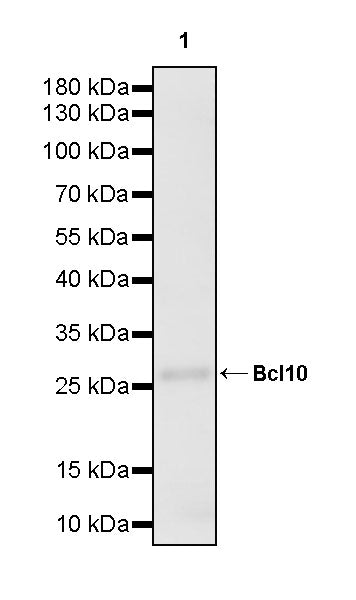
WB result of Bcl10 Rabbit pAb
Primary antibody: Bcl10 Rabbit pAb at 1/1000 dilution
Lane 1: A20 whole cell lysate 20 µg
Lane 2: mouse spleen lysate 20 µg
Secondary antibody: Goat Anti- rabbit IgG, (H+L), HRP conjugated at 1/10000 dilution
Predicted MW: 26 kDa
Observed MW: 28 kDa
WB result of Bcl10 Rabbit pAb
Primary antibody: Bcl10 Rabbit pAb at 1/1000 dilution
Lane 1: rat spleen lysate 20 µg
Secondary antibody: Goat Anti- rabbit IgG, (H+L), HRP conjugated at 1/10000 dilution
Predicted MW: 26 kDa
Observed MW: 28 kDa