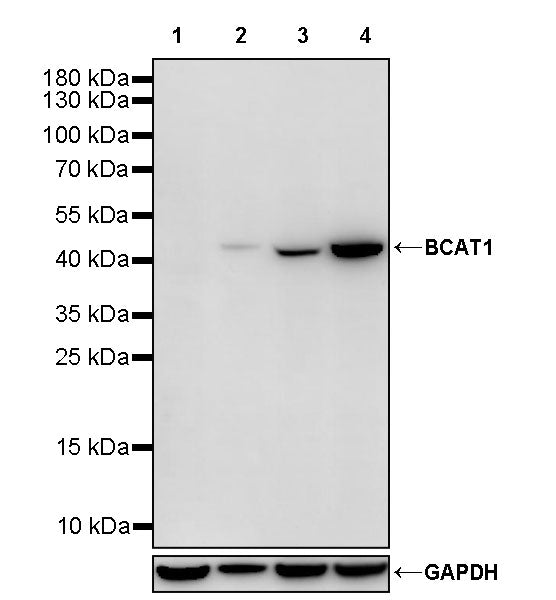
WB result of BCAT1 Recombinant Rabbit mAb
Primary antibody: BCAT1 Recombinant Rabbit mAb at 1/1000 dilution
Lane 1: SK-BR-3 whole cell lysate 20 µg
Lane 2: 293T whole cell lysate 20 µg
Lane 3: Jurkat whole cell lysate 20 µg
Lane 4: Molt-4 whole cell lysate 20 µg
Negative control: SK-BR-3 whole cell lysate
Secondary antibody: Goat Anti- rabbit IgG, (H+L), HRP conjugated at 1/10000 dilution
Predicted MW: 43 kDa
Observed MW: 45 kDa
BCAT1 Recombinant Rabbit mAb (S-4159-9)
BCAT1 Recombinant Rabbit mAb (S-4159-9)
Price:
Regular price
$100 USD
Regular price
Sale price
$100 USD
Unit price
per
For shipping services or bulk orders, you may request a quotation.
Secure checkout with

View full details
Product Details
Product Details
Product Specification
| Host | Rabbit |
| Antigen | BCAT1 |
| Synonyms | Branched-chain-amino-acid aminotransferase, cytosolic; BCT1; ECA39 |
| Immunogen | Synthetic Peptide |
| Location | Cytoplasm |
| Accession | P54687 |
| Clone Number | S-4159-9 |
| Antibody Type | Recombinant mAb |
| Isotype | IgG |
| Application | WB |
| Reactivity | Hu |
| Positive Sample | 293T, Jurkat, Molt-4 |
| Purification | Protein A |
| Concentration | 0.5 mg/ml |
| Conjugation | Unconjugated |
| Physical Appearance | Liquid |
| Storage Buffer | PBS, 40% Glycerol, 0.05% BSA, 0.02% sodium azide |
| Stability & Storage | 12 months from date of receipt / reconstitution, -20 °C as supplied |
Dilution
| application | dilution | species |
| WB | 1:1000 | Hu |
Background
BCAT1 (cytosolic branched-chain aminotransferase 1) is a pyridoxal phosphate-dependent enzyme primarily localized in the cytoplasm, encoded by the BCAT1 gene on human chromosome 20. As a key enzyme in the catabolism of branched-chain amino acids (BCAAs), BCAT1 reversibly transfers the amino groups of leucine, isoleucine, and valine to α-ketoglutarate, generating the corresponding branched-chain α-keto acids and glutamate, thereby playing an important role in nitrogen metabolism and energy production. Under physiological conditions, BCAT1 exhibits low-level expression in various tissues outside the liver, but it is significantly upregulated in multiple malignancies, including glioblastoma, making it a key metabolic regulator promoting tumor progression. Mechanistically, BCAT1 overexpression not only provides nitrogen sources and carbon skeletons for tumor cells by enhancing BCAA catabolism, but also directly binds to and inhibits CBX4, a core component of the polycomb repressive complex 1 (PRC1), thereby epigenetically maintaining chromatin accessibility of glutaminase (GLS) and promoting glutamine-dependent pyrimidine synthesis. Furthermore, BCAT1 modulates the α-ketoglutarate/glutamate ratio, affecting global DNA methylation levels and reshaping gene expression profiles to enhance chemotherapy resistance. Notably, the catalytic activity of BCAT1 is finely regulated by phosphorylation of its key residues; for example, phosphorylation of Ser5 and Ser327 activates its function by promoting enzyme-substrate binding or enhancing catalytic efficiency, respectively. These findings reposition BCAT1 from a conventional metabolic enzyme to a central hub linking BCAA catabolism, epigenetic regulation, and tumor malignant phenotypes, making it a highly promising antitumor therapeutic target.
Picture
Picture
Western Blot