BAFF/TNFSF13B/CD257 Trimer His Tag Protein, Human
BAFF/TNFSF13B/CD257 Trimer His Tag Protein, Human
Price:
Regular price
$215 USD
Regular price
Sale price
$215 USD
Unit price
per
For shipping services or bulk orders, you may request a quotation.
Secure checkout with

View full details
Product Details
Product Details
Product Specification
| Species | Human |
| Synonyms | B-cell-activating factor, B lymphocyte stimulator (BLyS), TNFSF13B, BLYS, TALL1, TNFSF20, ZTNF4 |
| Accession | Q9Y275 |
| Amino Acid Sequence | Ala134-Leu285 with His Tag at the N-Terminus |
| Expression System | HEK293 |
| Molecular Weight | 15-25kDa (Reducing) |
| Purity | >90% by SDS-PAGE,> 95% by HPLC |
| Conjugation | Unconjugated |
| Tag | His Tag |
| Physical Appearance | Lyophilized Powder |
| Storage Buffer | PBS, pH7.4, 5% trehalose |
| Reconstitution | Reconstitute at 0.1-1 mg/ml according to the size in ultrapure water after rapid centrifugation. |
| Stability & Storage | · 12 months from date of receipt, lyophilized powder stored at -20 to -80℃. |
| Reference | 1.Vincent FB, Morand EF, Mackay F. BAFF and innate immunity: new therapeutic targets for systemic lupus erythematosus. Immunol Cell Biol. 2012 Mar;90(3):293-303. |
Background
BAFF (B cell activating factor), also known as BLyS/TALL-1/TNFSF13B, is a member of the TNF superfamily that exists as a homotrimer and regulates B cell survival through specific binding to three receptors: BAFF-R, TACI, and BCMA. BAFF is a type II transmembrane protein with an extracellular domain forming a β-sheet-rich "sandwich" structure; the receptor-binding interface comprises the DE loop and N-terminal loop, whose surface charge distribution determines high-affinity binding to BAFF-R and cross-recognition with TACI/BCMA. BAFF serves as a central regulator of B cell development, homeostasis maintenance, and humoral immunity, promoting transitional B cell survival, germinal center reactions, and antibody class switching. BAFF overexpression is closely associated with autoimmune diseases including systemic lupus erythematosus, rheumatoid arthritis, and Sjögren's syndrome, with serum levels serving as disease activity biomarkers; the BAFF-targeting monoclonal antibody Belimumab represents the first new drug approved for SLE in 50 years, significantly improving patient outcomes by blocking BAFF-receptor interactions and reducing autoreactive B cells, marking a landmark milestone in B cell-targeted therapy.
Picture
Picture
Bioactivity
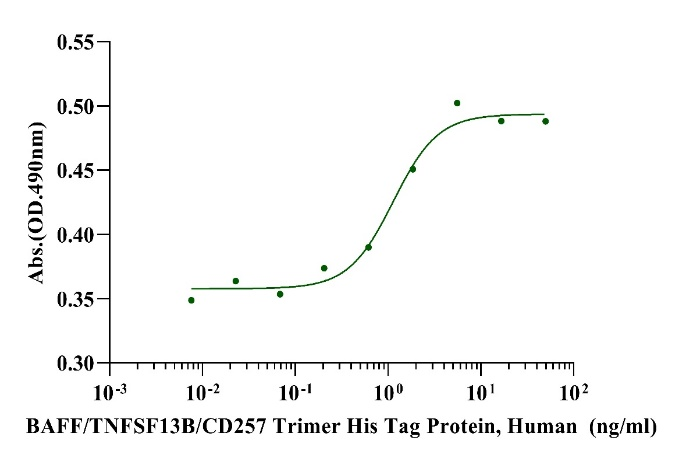
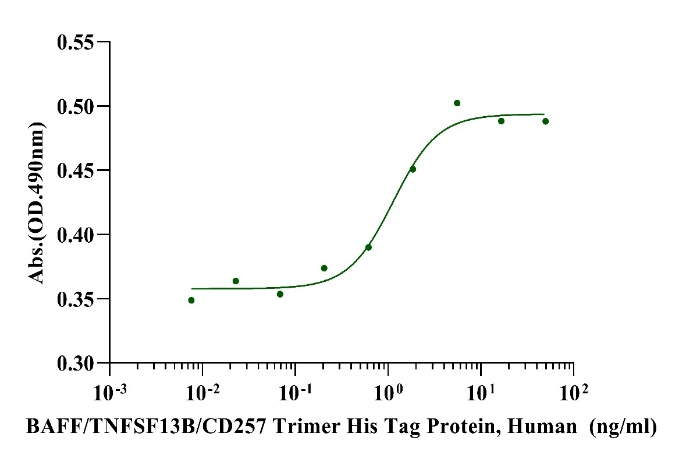
BAFF/TNFSF13B/CD257 Trimer His Tag Protein, Human (Cat. No. UA016073) stimulates proliferation of mouse spleen cells. The EC50 for this effect is 0.74-1.70 ng/mL.
SDS-PAGE
2μg (R: reducing condition, N:non-reducing condition).
SEC-HPLC
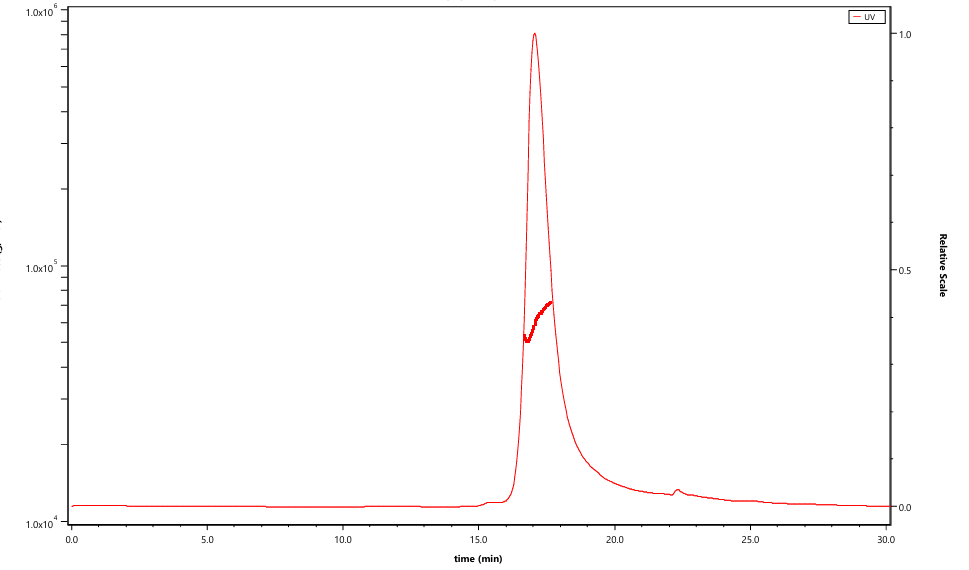
The purity of BAFF/TNFSF13B/CD257 Trimer His Tag Protein, Human (Cat. No. UA016073) is more than 95% and the molecular weight of this protein is around 61.1 kDa verified by SEC-MALS.
ELISA
Immobilized BCMA/TNFRSF17 Fc Chimera Protein, Human (Cat. No. UA010043) at 2.0μg/mL (100μL/well) can bind BAFF His Tag Protein, Human (Cat. No. UA016073) with EC50 of 2.0-3.1 ng/mL.
Immobilized TACI/CD267/TNFRSF13B Fc Chimera Protein, Human (Cat. No.UA011118) at 2.0μg/mL (100μL/well) can bind BAFF His Tag Protein, Human (Cat. No. UA016073) with EC50 of 1.18-2.42 ng/mL.
Immobilized Biotinylated BAFFR/TNFRSF13C Fc&Avi Tag Protein, Human (Cat. No.UA011346) at 2.0μg/mL (100μL/well) on Streptavidin precoated (0.5μg/well) plate, can bind BAFF His Tag Protein, Human (Cat. No. UA016073) with EC50 of 0.71-1.99 ng/mL.
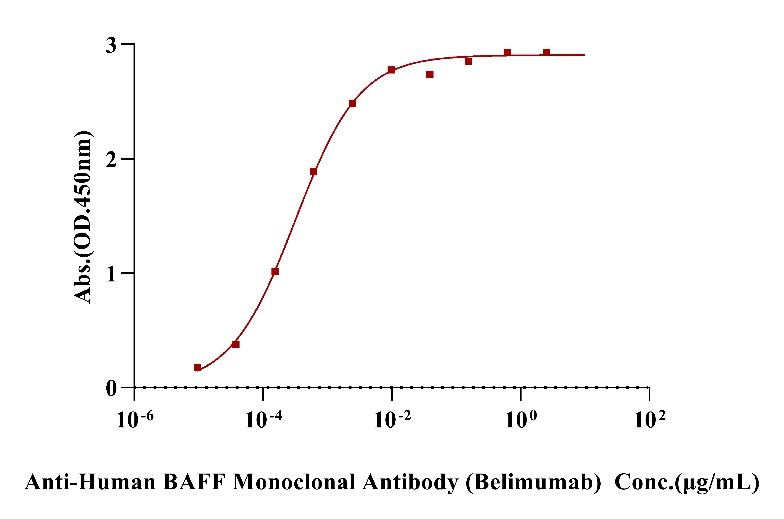
Immobilized BAFF/TNFSF13B/CD257 Trimer His Tag Protein, Human (Cat. No. UA016073) at 1.0μg/mL(100μL/well) can bind Anti-Human BAFF Monoclonal Antibody (Belimumab) (Cat. No. UA016211) with EC50 of 0.22-0.42 ng/mL.
SPR
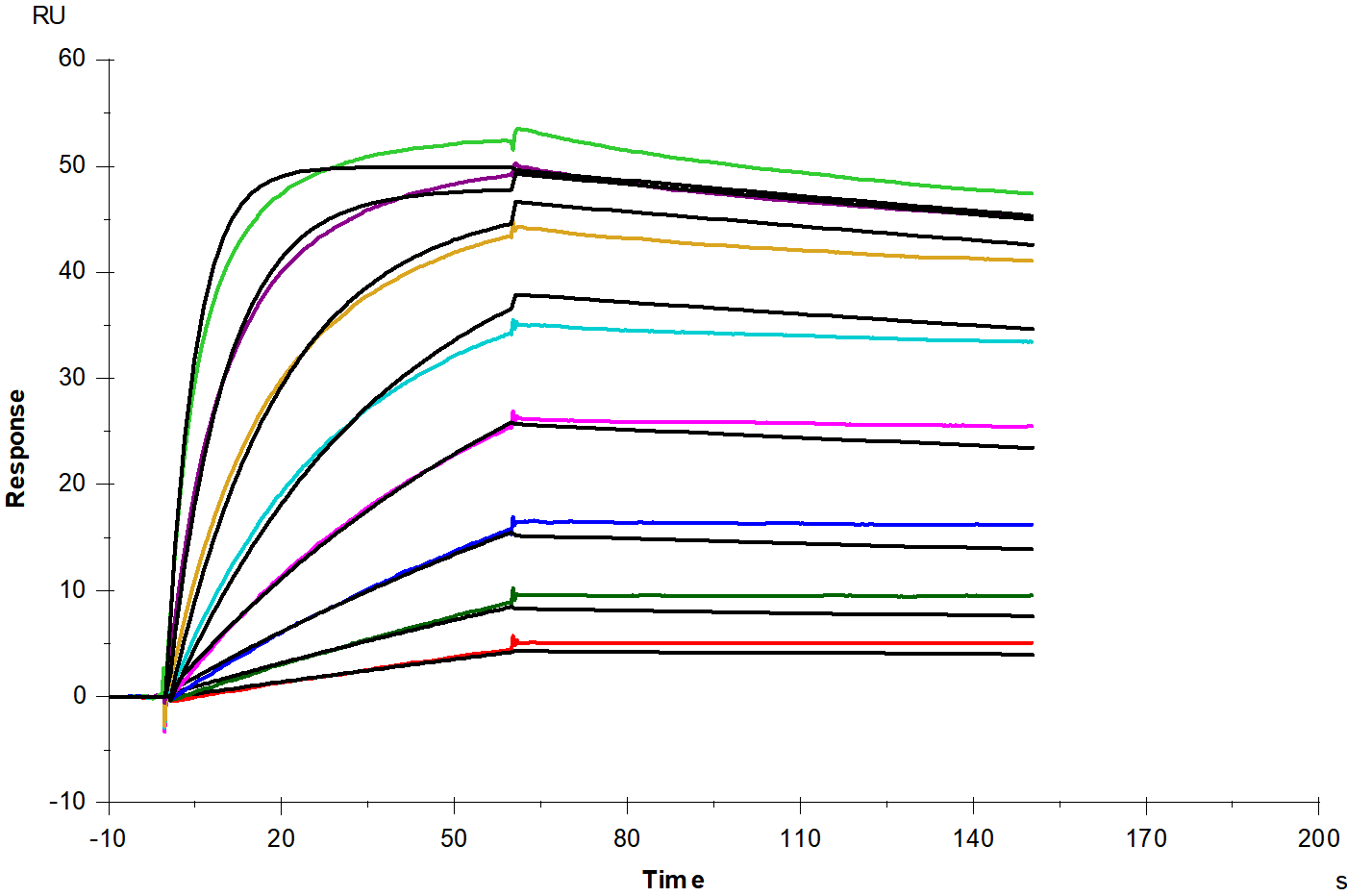
Protein A Chip captured BAFFR Fc Chimera Protein, Human (Cat. No. UA011010), can bind BAFF His Tag Protein, Human (Cat. No. UA016073) with an affinity constant of 0.25nM as determined in SPR assay.