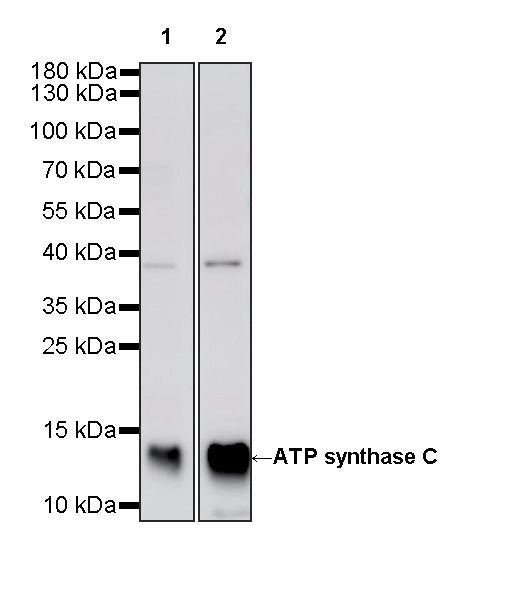
WB result of ATP synthase C Recombinant Rabbit mAb
Primary antibody: ATP synthase C Recombinant Rabbit mAb at 1/1000 dilution
Lane 1: 293T whole cell lysate 20 µg
Lane 2: K-562 whole cell lysate 20 µg
Secondary antibody: Goat Anti-Rabbit IgG (H+L), HRP conjugated at 1/10000 dilution
Predicted MW: 14 kDa
Observed MW: 14 kDa
ATP synthase C Recombinant Rabbit mAb (S-6124)
ATP synthase C Recombinant Rabbit mAb (S-6124)
Price:
Regular price
$100 USD
Regular price
Sale price
$100 USD
Unit price
per
For shipping services or bulk orders, you may request a quotation.
Secure checkout with

View full details
Product Details
Product Details
Product Specification
| Host | Rabbit |
| Antigen | ATP synthase C |
| Synonyms | ATP synthase F(0) complex subunit C1, mitochondrial; ATP synthase lipid-binding protein; ATP synthase membrane subunit c locus 1Imported; ATP synthase proteolipid P1; ATP synthase proton-transporting mitochondrial F(0) complex subunit C1; ATPase protein 9; ATP5G1; ATP5MC1 |
| Location | Mitochondrion |
| Accession | P05496 |
| Clone Number | S-6124 |
| Antibody Type | Recombinant mAb |
| Isotype | IgG |
| Application | WB |
| Reactivity | Hu |
| Predicted Reactivity | / |
| Purification | Protein A |
| Concentration | 0.5 mg/ml |
| Conjugation | Unconjugated |
| Physical Appearance | Liquid |
| Storage Buffer | PBS, 40% Glycerol, 0.05% BSA, 0.02% sodium azide |
| Stability & Storage | 12 months from date of receipt / reconstitution, -20 °C as supplied |
Dilution
| application | dilution | species |
| WB | 1:1000 | Hu |
Background
The C subunit of ATP synthase is the core component of the proton channel within the F₀ portion and serves as the rotor element of the rotary motor. Within the membrane, each C subunit folds into a hairpin structure composed of two hydrophobic α-helices connected by a polar loop, and multiple C subunits (typically 10 to 14) assemble into an oligomeric ring. Driven by the proton motive force, protons enter through the inlet half-channel on the a subunit and reach a conserved acidic residue (such as Asp61 in Escherichia coli) located at the interface between C subunits; upon protonation, this carboxyl group becomes occluded between the subunits. As the C ring rotates, the protonated residue moves to the outlet half-channel of the a subunit, where it is deprotonated and the proton is released to the other side of the membrane. This cycle proceeds sequentially around the ring, driving continuous rotation of the C ring. The rotation of the C ring is coupled, through the polar loop in close contact with it, to the γ and ε subunits of F₁, causing the central stalk to rotate together and thereby inducing conformational changes at the catalytic sites of the β subunits, ultimately accomplishing ATP synthesis.
Picture
Picture
Western Blot