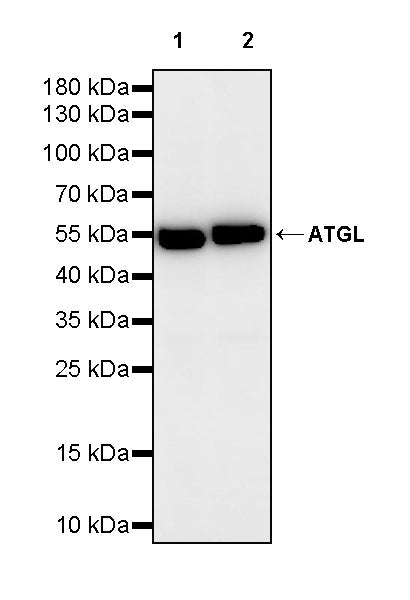
WB result of ATGL Recombinant Rabbit mAb
Primary antibody: ATGL Recombinant Rabbit mAb at 1/5000 dilution
Lane 1: A431 whole cell lysate 20 µg
Lane 2: HeLa whole cell lysate 20 µg
Secondary antibody: Goat Anti- rabbit IgG, (H+L), HRP conjugated at 1/10000 dilution
Predicted MW: 55 kDa
Observed MW: 55 kDa
ATGL Recombinant Rabbit mAb
ATGL Recombinant Rabbit mAb
Price:
Regular price
$100 USD
Regular price
Sale price
$100 USD
Unit price
per
For shipping services or bulk orders, you may request a quotation.
Secure checkout with

View full details
Product Details
Product Details
Product Specification
| Host | Rabbit |
| Antigen | ATGL |
| Synonyms | Patatin-like phospholipase domain-containing protein 2; Adipose triglyceride lipase; Calcium-independent phospholipase A2-zeta (iPLA2-zeta); Desnutrin; Pigment epithelium-derived factor receptor (PEDF-R); TTS2.2; Transport-secretion protein 2 (TTS2); PNPLA2 |
| Location | Cytoplasm, Cell membrane |
| Accession | Q96AD5 |
| Antibody Type | Recombinant mAb |
| Isotype | IgG |
| Application | WB |
| Reactivity | Hu, Ms, Rt |
| Positive Sample | A431, HeLa, 3T3-L1, NIH/3T3 |
| Purification | Protein A |
| Concentration | 1 mg/ml |
| Conjugation | Unconjugated |
| Physical Appearance | Liquid |
| Storage Buffer | PBS, 40% Glycerol, 0.05% BSA, 0.02% sodium azide |
| Stability & Storage | 12 months from date of receipt / reconstitution, -20 °C as supplied |
Dilution
| application | dilution | species |
| WB | 1:2000-1:20000 | Hu, Ms, Rt |
Background
ATGL is the rate-limiting enzyme that initiates the hydrolysis of triglycerides in living organisms. This protein consists of 504 amino acids and contains a conserved patatin domain as its core functional region, which harbors the Ser-Asp catalytic dyad (Ser47 and Asp166) responsible for catalyzing the first step of triglyceride hydrolysis. ATGL is expressed in various tissues including white adipose tissue, brown adipose tissue, heart, liver, and small intestine, where it plays a central role in maintaining whole-body energy homeostasis by hydrolyzing triglycerides into diglycerides and free fatty acids. The function of ATGL is tightly regulated: its catalytic activity requires binding to the cofactor CGI-58 for full activation, while inhibitors such as G0S2, CIDEC, and members of the PLIN family can suppress its activity through direct interaction. Dysfunction of ATGL leads to severe metabolic disorders; mutations in its gene can cause neutral lipid storage disease (NLSD) characterized by triglyceride accumulation in multiple tissues, while systemic ATGL-deficient mice exhibit severe phenotypes including cardiomyopathy and premature death. In recent years, research has also revealed novel functions of ATGL, such as its ability to hydrolyze bacterial endotoxin lipopolysaccharide (LPS), thereby negatively regulating non-canonical inflammasome activation, offering potential new therapeutic targets for inflammatory diseases like sepsis.
Picture
Picture
Western Blot
WB result of ATGL Recombinant Rabbit mAb
Primary antibody: ATGL Recombinant Rabbit mAb at 1/5000 dilution
Lane 1: 3T3-L1 whole cell lysate 20 µg
Lane 2: NIH/3T3 whole cell lysate 20 µg
Secondary antibody: Goat Anti- rabbit IgG, (H+L), HRP conjugated at 1/10000 dilution
Predicted MW: 55 kDa
Observed MW: 55 kDa