WB result of ATF7IP Recombinant Rabbit mAb
Primary antibody: ATF7IP Recombinant Rabbit mAb at 1/1000 dilution
Lane 1: HeLa whole cell lysate 20 µg
Lane 2: Raji whole cell lysate 20 µg
Lane 3: A549 whole cell lysate 20 µg
Lane 4: Molt-4 whole cell lysate 20 µg
Lane 5: Daudi whole cell lysate 20 µg
Lane 6: K562 whole cell lysate 20 µg
Lane 7: HCT 116 whole cell lysate 20 µg
Secondary antibody: Goat Anti- rabbit IgG, (H+L), HRP conjugated at 1/10000 dilution
Predicted MW: 136 kDa
Observed MW: 220 kDa
ATF7IP Recombinant Rabbit mAb (S-4081-25)
ATF7IP Recombinant Rabbit mAb (S-4081-25)
Price:
Regular price
$100 USD
Regular price
Sale price
$100 USD
Unit price
per
For shipping services or bulk orders, you may request a quotation.
Secure checkout with

View full details
Product Details
Product Details
Product Specification
| Host | Rabbit |
| Antigen | ATF7IP |
| Synonyms | Activating transcription factor 7-interacting protein 1; ATF-interacting protein (ATF-IP); ATF7-interacting protein; ATFa-associated modulator (hAM); MBD1-containing chromatin-associated factor 1; P621; MCAF; MCAF1 |
| Immunogen | Synthetic Peptide |
| Location | Nucleus |
| Accession | Q6VMQ6 |
| Clone Number | S-4081-25 |
| Antibody Type | Recombinant mAb |
| Isotype | IgG |
| Application | WB |
| Reactivity | Hu |
| Positive Sample | HeLa, Raji, A549, Molt-4, Daudi, K562, HCT116, NIH/3T3, Neuro-2a, rat testis, COS-7 |
| Purification | Protein A |
| Concentration | 0.5 mg/ml |
| Conjugation | Unconjugated |
| Physical Appearance | Liquid |
| Storage Buffer | PBS, 40% Glycerol, 0.05% BSA, 0.03% Proclin 300 |
| Stability & Storage | 12 months from date of receipt / reconstitution, -20 °C as supplied |
Dilution
| application | dilution | species |
| WB | 1:1000-1:2000 | Hu |
Background
ATF7IP (Activating Transcription Factor 7 Interacting Protein), also known as MCAF1 or AM, is a crucial nuclear cofactor that primarily functions as a stabilizer and facilitator for the histone methyltransferase SUV39H1, thereby playing a pivotal role in the establishment and maintenance of heterochromatin through the promotion of H3K9 trimethylation. By interacting with SUV39H1, ATF7IP enhances the enzyme's stability and catalytic activity, which is essential for silencing repetitive DNA sequences, maintaining genomic integrity, and regulating gene expression programs involved in cell proliferation and differentiation. Beyond its canonical role in epigenetic silencing, ATF7IP has been implicated in various physiological and pathological processes, including embryonic development, spermatogenesis, and cancer progression, where its dysregulation can lead to chromosomal instability and aberrant transcriptional profiles, highlighting its significance as a key modulator of chromatin architecture and cellular identity.
Picture
Picture
Western Blot
WB result of ATF7IP Recombinant Rabbit mAb
Primary antibody: ATF7IP Recombinant Rabbit mAb at 1/1000 dilution
Lane 1: NIH/3T3 whole cell lysate 20 µg
Lane 2: Neuro-2a whole cell lysate 20 µg
Lane 3: mouse testis lysate 20 µg
Secondary antibody: Goat Anti- rabbit IgG, (H+L), HRP conjugated at 1/10000 dilution
Predicted MW: 136 kDa
Observed MW: 220 kDa
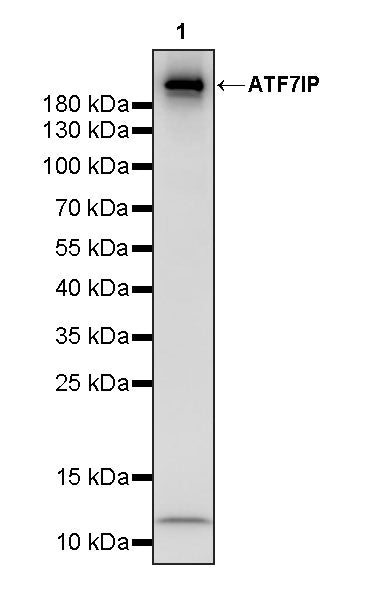
WB result of ATF7IP Recombinant Rabbit mAb
Primary antibody: ATF7IP Recombinant Rabbit mAb at 1/1000 dilution
Lane 1: rat testis lysate 20 µg
Secondary antibody: Goat Anti- rabbit IgG, (H+L), HRP conjugated at 1/10000 dilution
Predicted MW: 136 kDa
Observed MW: 220 kDa
WB result of ATF7IP Recombinant Rabbit mAb
Primary antibody: ATF7IP Recombinant Rabbit mAb at 1/1000 dilution
Lane 1: COS-7 whole cell lysate 20 µg
Secondary antibody: Goat Anti- rabbit IgG, (H+L), HRP conjugated at 1/10000 dilution
Predicted MW: 136 kDa
Observed MW: 220 kDa