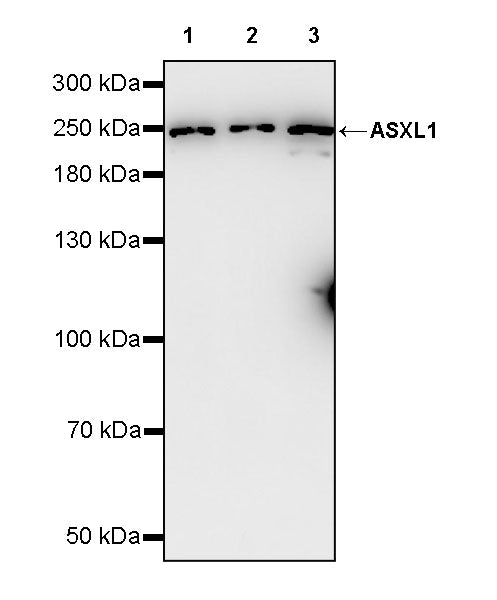
WB result of ASXL1 Recombinant Rabbit mAb
Primary antibody: ASXL1 Recombinant Rabbit mAb at 1/1000 dilution
Lane 1: MCF7 whole cell lysate 20 µg
Lane 2: K562 whole cell lysate 20 µg
Lane 3: HL-60 whole cell lysate 20 µg
Secondary antibody: Goat Anti- rabbit IgG, (H+L), HRP conjugated at 1/10000 dilution
Predicted MW: 165 kDa
Observed MW: 250 kDa
This blot was developed with high sensitivity substrate
ASXL1 Recombinant Rabbit mAb (S-4409-30)
ASXL1 Recombinant Rabbit mAb (S-4409-30)
Price:
Regular price
$100 USD
Regular price
Sale price
$100 USD
Unit price
per
For shipping services or bulk orders, you may request a quotation.
Secure checkout with

View full details
Product Details
Product Details
Product Specification
| Host | Rabbit |
| Antigen | ASXL1 |
| Synonyms | Polycomb group protein ASXL1; KIAA0978 |
| Immunogen | Synthetic Peptide |
| Location | Nucleus |
| Accession | Q8IXJ9 |
| Clone Number | S-4409-30 |
| Antibody Type | Recombinant mAb |
| Isotype | IgG |
| Application | WB |
| Reactivity | Hu |
| Positive Sample | MCF7, K562, HL-60 |
| Purification | Protein A |
| Concentration | 2 mg/ml |
| Conjugation | Unconjugated |
| Physical Appearance | Liquid |
| Storage Buffer | PBS, 40% Glycerol, 0.05% BSA, 0.02% sodium azide |
| Stability & Storage | 12 months from date of receipt / reconstitution, -20 °C as supplied |
Dilution
| application | dilution | species |
| WB | 1:1000 | Hu |
Background
ASXL1 (Additional Sex Combs Like 1) is the mammalian homolog of the Drosophila Asx (Additional sex combs) protein and is an important member of the Polycomb family, playing a critical role in epigenetic regulation. Structurally, this protein contains a highly conserved N-terminal HARE (ASXL homology domain), a C-terminal PHD (Plant Homeodomain) zinc finger domain, and multiple nuclear localization signals. The PHD domain can recognize and bind to methylated histone H3 at lysine 4 (H3K4me3) and lysine 27 (H3K27me3), thereby functioning as a "reader" of chromatin modifications to participate in the fine-tuned regulation of gene expression. Functionally, ASXL1 can both bind to the BAP1 deubiquitinase complex to form the PR-DUB complex, which specifically removes ubiquitination from H2AK119ub1 to silence gene expression, and cooperate with the PRC2 methyltransferase complex to promote the deposition of H3K27me3, thus playing a dual and dynamic regulatory role in embryonic development, hematopoietic stem cell self-renewal, and differentiation. However, loss-of-function mutations in the ASXL1 gene, particularly truncating mutations near its C-terminal PHD domain, are frequently observed in various myeloid malignancies such as myelodysplastic syndrome, chronic myelomonocytic leukemia, and acute myeloid leukemia. These mutations typically shift the function of ASXL1 from a tumor suppressor to an oncogenic factor, promoting tumor initiation and progression through aberrant activation of downstream targets such as HOX genes. Therefore, ASXL1 is not only an important prognostic biomarker in myeloid malignancies but is also emerging as a highly promising therapeutic target for epigenetic-based interventions.
Picture
Picture
Western Blot