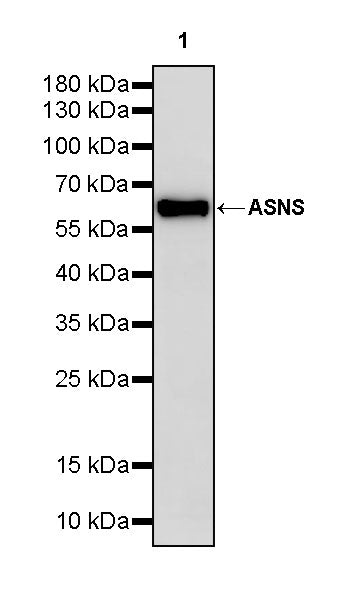
WB result of ASNS Recombinant Rabbit mAb
Primary antibody: ASNS Recombinant Rabbit mAb at 1/1000 dilution
Lane 1: Ramos whole cell lysate 20 µg
Lane 2: K562 whole cell lysate 20 µg
Lane 3: HCT 116 whole cell lysate 20 µg
Secondary antibody: Goat Anti- rabbit IgG, (H+L), HRP conjugated at 1/10000 dilution
Predicted MW: 64 kDa
Observed MW: 64 kDa
ASNS Recombinant Rabbit mAb (S-4216-14)
ASNS Recombinant Rabbit mAb (S-4216-14)
Price:
Regular price
$100 USD
Regular price
Sale price
$100 USD
Unit price
per
For shipping services or bulk orders, you may request a quotation.
Secure checkout with

View full details
Product Details
Product Details
Product Specification
| Host | Rabbit |
| Antigen | ASNS |
| Synonyms | Asparagine synthetase [glutamine-hydrolyzing]; Cell cycle control protein TS11; Glutamine-dependent asparagine synthetase; TS11 |
| Immunogen | Synthetic Peptide |
| Location | Cytoplasm |
| Accession | P08243 |
| Clone Number | S-4216-14 |
| Antibody Type | Recombinant mAb |
| Isotype | IgG |
| Application | WB |
| Reactivity | Hu, Ms, Rt |
| Positive Sample | Ramos, K562, HCT116, RAW264.7, rat pancreas |
| Purification | Protein A |
| Concentration | 0.5 mg/ml |
| Conjugation | Unconjugated |
| Physical Appearance | Liquid |
| Storage Buffer | PBS, 40% Glycerol, 0.05% BSA, 0.02% sodium azide |
| Stability & Storage | 12 months from date of receipt / reconstitution, -20 °C as supplied |
Dilution
| application | dilution | species |
| WB | 1:1000 | Hu, Ms, Rt |
Background
Asparagine synthetase (ASNS) is a crucial glutamine-dependent ligase enzyme that catalyzes the ATP-dependent conversion of aspartate and glutamine into asparagine and glutamate, playing a pivotal role in cellular amino acid homeostasis and protein synthesis. Beyond its fundamental metabolic function, ASNS serves as a key stress-response protein regulated by the integrated stress response (ISR) pathway, particularly under conditions of amino acid deprivation or endoplasmic reticulum stress, where its expression is upregulated via the GCN2-ATF4 signaling axis to ensure cell survival. In the context of cancer biology, ASNS has emerged as a significant therapeutic target because certain malignancies, such as specific subtypes of acute lymphoblastic leukemia (ALL), lack sufficient endogenous ASNS activity, rendering them highly sensitive to L-asparaginase therapy which depletes circulating asparagine; conversely, tumors with high ASNS expression often exhibit resistance to this treatment and may leverage increased asparagine production to support mTORC1 signaling and proliferation under nutrient-scarce conditions, highlighting its dual nature as both a metabolic housekeeper and a determinant of chemotherapeutic efficacy.
Picture
Picture
Western Blot
WB result of ASNS Recombinant Rabbit mAb
Primary antibody: ASNS Recombinant Rabbit mAb at 1/1000 dilution
Lane 1: RAW264.7 whole cell lysate 20 µg
Secondary antibody: Goat Anti- rabbit IgG, (H+L), HRP conjugated at 1/10000 dilution
Predicted MW: 64 kDa
Observed MW: 64 kDa
WB result of ASNS Recombinant Rabbit mAb
Primary antibody: ASNS Recombinant Rabbit mAb at 1/1000 dilution
Lane 1: rat pancreas lysate 20 µg
Secondary antibody: Goat Anti- rabbit IgG, (H+L), HRP conjugated at 1/10000 dilution
Predicted MW: 64 kDa
Observed MW: 64 kDa