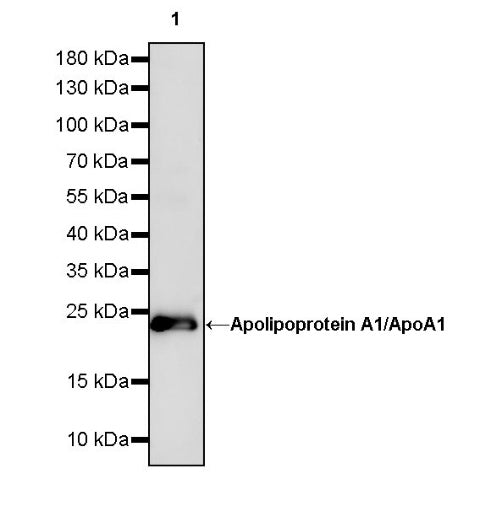
WB result of Apolipoprotein A1/ApoA1 Recombinant Rabbit mAb
Primary antibody: Apolipoprotein A1/ApoA1 Recombinant Rabbit mAb at 1/1000 dilution
Lane 1: human serum lysate 5 µg
Secondary antibody: Goat Anti-rabbit IgG, (H+L), HRP conjugated at 1/10000 dilution
Predicted MW: 30 kDa
Observed MW: 23 kDa
Apolipoprotein A1/ApoA1 Recombinant Rabbit mAb (S-979-25)
Apolipoprotein A1/ApoA1 Recombinant Rabbit mAb (S-979-25)
Price:
Regular price
$100 USD
Regular price
Sale price
$100 USD
Unit price
per
For shipping services or bulk orders, you may request a quotation.
Secure checkout with

View full details
Product Details
Product Details
Product Specification
| Host | Rabbit |
| Antigen | Apolipoprotein A1/ApoA1 |
| Synonyms | Apolipoprotein A-I, Apo-AI, ApoA-I |
| Immunogen | Synthetic Peptide |
| Location | Secreted |
| Accession | P02647 |
| Clone Number | S-979-25 |
| Antibody Type | Recombinant mAb |
| Isotype | IgG |
| Application | WB |
| Reactivity | Hu |
| Predicted Reactivity | Pr, Or, Gor |
| Purification | Protein A |
| Concentration | 0.5 mg/ml |
| Conjugation | Unconjugated |
| Physical Appearance | Liquid |
| Storage Buffer | PBS, 40% Glycerol, 0.05% BSA, 0.03% Proclin 300 |
| Stability & Storage | 12 months from date of receipt / reconstitution, -20 °C as supplied |
Dilution
| application | dilution | species |
| WB | 1:1000 |
Background
Apolipoprotein A1 (ApoA1) is a crucial protein component of plasma lipoproteins that plays diverse essential functions in the human body. ApoA1 is the major structural protein of high-density lipoproteins (HDL). It is primarily responsible for transporting cholesterol from body tissues to the liver for metabolism and excretion, a process known as reverse cholesterol transport. It possesses anti-atherogenic properties, helping to reduce the risk of cardiovascular diseases. Elevated ApoA1 levels may be observed in diseases such as atherosclerosis, diabetes, hyperlipoproteinemia, and liver dysfunction. Long-term alcohol consumption, the use of contraceptives, menopause, and long-term estrogen use among women may also lead to increased ApoA1 levels.
Picture
Picture
Western Blot