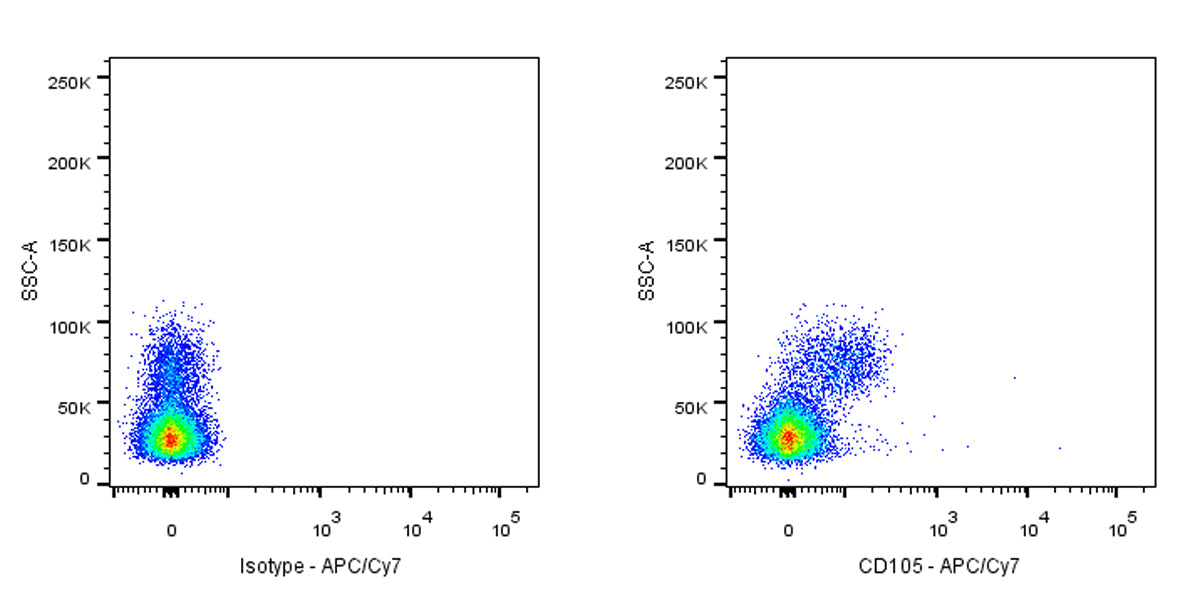
Flow cytometric analysis of Human CD105 expression on Human PBMC (human peripheral blood mononuclear cells). Human PBMC were stained with either APC-Cy7 Mouse IgG2b, κ Isotype Control (Left panel) or SDT APC-Cy7 Mouse Anti-Human CD105 antibody (Right panel) at 5μl/test treated with True-Stain Monocyte Blocker™. Flow cytometry and data analysis were performed using BD FACSymphony™ A1 and FlowJo™ software.
APC-Cy7 Mouse Anti-Human CD105 Antibody (S-837-10)
APC-Cy7 Mouse Anti-Human CD105 Antibody (S-837-10)
Price:
Regular price
$260 USD
Regular price
Sale price
$260 USD
Unit price
per
For shipping services or bulk orders, you may request a quotation.
Secure checkout with

View full details
Product Details
Product Details
Product Specification
| Synonyms | Endoglin; END; ENG |
| Immunogen | Recombinant Protein |
| Location | Cell membrane |
| Accession | P17813 |
| Clone Number | S-837-10 |
| Antibody Type | Mouse mAb |
| Isotype | IgG2b,k |
| Application | FCM |
| Reactivity | Hu |
| Purification | Protein A |
| Concentration | 0.2 mg/ml |
| Conjugation | APC-Cy7 |
| Physical Appearance | Liquid |
| Storage Buffer | PBS, 1% BSA, 0.3% Proclin 300 |
| Stability & Storage | 12 months from date of receipt / reconstitution, 2 to 8 °C as supplied |
Dilution
| application | dilution | species |
| FCM | 5μl per million cells in 100μl volume | Hu |
Background
CD105, also known as endoglin, is a type I transmembrane glycoprotein predominantly expressed on endothelial cells and serves as an accessory receptor for the transforming growth factor-beta (TGF-β) superfamily. It plays a crucial role in angiogenesis, making it a key factor in tumor growth, survival, and metastasis. Structurally, CD105 is a homodimeric protein with a large extracellular domain, a hydrophobic transmembrane region, and a short cytoplasmic tail. Its expression is upregulated in proliferating endothelial cells, especially in tumor vessels, inflamed tissues, and during embryogenesis. Mutations in the CD105 gene are associated with hereditary hemorrhagic telangiectasia (HHT), a disorder characterized by abnormal blood vessel formation. Due to its involvement in angiogenesis, CD105 has emerged as a potential therapeutic target for cancer treatment.
Picture
Picture
FC