WB result of AP1M1 Recombinant Rabbit mAb
Primary antibody: AP1M1 Recombinant Rabbit mAb at 1/1000 dilution
Lane 1: MDA-MB-231 whole cell lysate 20 µg
Lane 2: Jurkat whole cell lysate 20 µg
Lane 3: HepG2 whole cell lysate 20 µg
Lane 4: K-562 whole cell lysate 20 µg
Lane 5: PC-3 whole cell lysate 20 µg
Lane 6: HEK-293 whole cell lysate 20 µg
Lane 7: HeLa whole cell lysate 20 µg
Lane 8: SH-SY5Y whole cell lysate 20 µg
Secondary antibody: Goat Anti-Rabbit IgG (H+L), HRP conjugated at 1/10000 dilution
Predicted MW: 49 kDa
Observed MW: 49 kDa
AP1M1 Recombinant Rabbit mAb (S-4593-28)
AP1M1 Recombinant Rabbit mAb (S-4593-28)
Price:
Regular price
$100 USD
Regular price
Sale price
$100 USD
Unit price
per
For shipping services or bulk orders, you may request a quotation.
Secure checkout with

View full details
Product Details
Product Details
Product Specification
| Host | Rabbit |
| Antigen | AP1M1 |
| Synonyms | AP-1 complex subunit mu-1; AP-mu chain family member mu1A; Adaptor protein complex AP-1 subunit mu-1; Adaptor-related protein complex 1 subunit mu-1; Clathrin assembly protein complex 1 mu-1 medium chain 1; Clathrin coat assembly protein AP47; CLTNM |
| Immunogen | Synthetic Peptide |
| Location | Cytoplasm |
| Accession | Q9BXS5 |
| Clone Number | S-4593-28 |
| Antibody Type | Recombinant mAb |
| Isotype | IgG |
| Application | WB |
| Reactivity | Hu, Ms, Rt |
| Positive Sample | MDA-MB-231, Jurkat, HepG2, K-562, PC-3, HEK-293, HeLa, SH-SY5Y, NIH/3T3, mouse brain, mouse testis, rat brain, rat testis |
| Purification | Protein A |
| Concentration | 0.5 mg/ml |
| Conjugation | Unconjugated |
| Physical Appearance | Liquid |
| Storage Buffer | PBS, 40% Glycerol, 0.05% BSA, 0.02% sodium azide |
| Stability & Storage | 12 months from date of receipt / reconstitution, -20 °C as supplied |
Dilution
| application | dilution | species |
| WB | 1:1000-1:2000 | Hu, Ms, Rt |
Background
AP1M1, also known as the mu 1 subunit of adaptor related protein complex 1, is a core component of the clathrin adaptor AP-1 complex. As the medium chain subunit of the AP-1 complex, it assembles with γ-adaptin, β'-adaptin, and the small chain AP1S1 to form a heterotetramer. This complex is primarily localized on the trans-Golgi network (TGN) and endosomal membranes, where its core function is to mediate the recruitment of clathrin to membranes and to recognize sorting signals in the cytoplasmic tails of transmembrane cargo proteins, thereby playing a critical role in vesicular transport processes, particularly in protein trafficking from the Golgi apparatus to endosomes. Within this process, it is responsible for recognizing and binding specific sorting signals, participating in various physiological processes, with its encoding gene being especially abundantly expressed in human testis and brain tissues. Furthermore, AP1M1 protein serves as an important target exploited by certain viruses, such as HIV-1, to hijack the host cellular transport machinery and to affect the surface expression of immune molecules like MHC-I.
Picture
Picture
Western Blot
WB result of AP1M1 Recombinant Rabbit mAb
Primary antibody: AP1M1 Recombinant Rabbit mAb at 1/1000 dilution
Lane 1: NIH/3T3 whole cell lysate 20 µg
Lane 2: mouse brain lysate 20 µg
Lane 3: mouse testis lysate 20 µg
Secondary antibody: Goat Anti-Rabbit IgG (H+L), HRP conjugated at 1/10000 dilution
Predicted MW: 49 kDa
Observed MW: 49 kDa
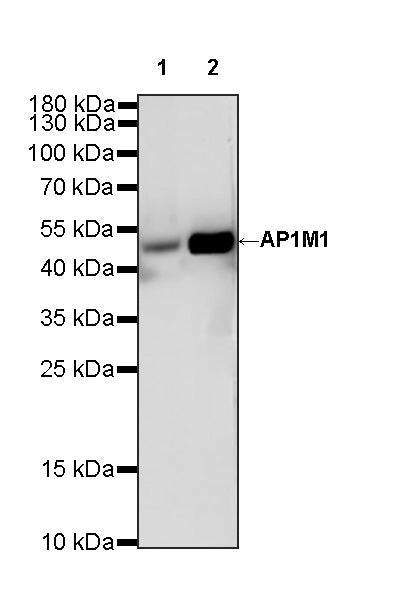
WB result of AP1M1 Recombinant Rabbit mAb
Primary antibody: AP1M1 Recombinant Rabbit mAb at 1/1000 dilution
Lane 1: rat brain lysate 20 µg
Lane 2: rat testis lysate 20 µg
Secondary antibody: Goat Anti-Rabbit IgG (H+L), HRP conjugated at 1/10000 dilution
Predicted MW: 49 kDa
Observed MW: 49 kDa