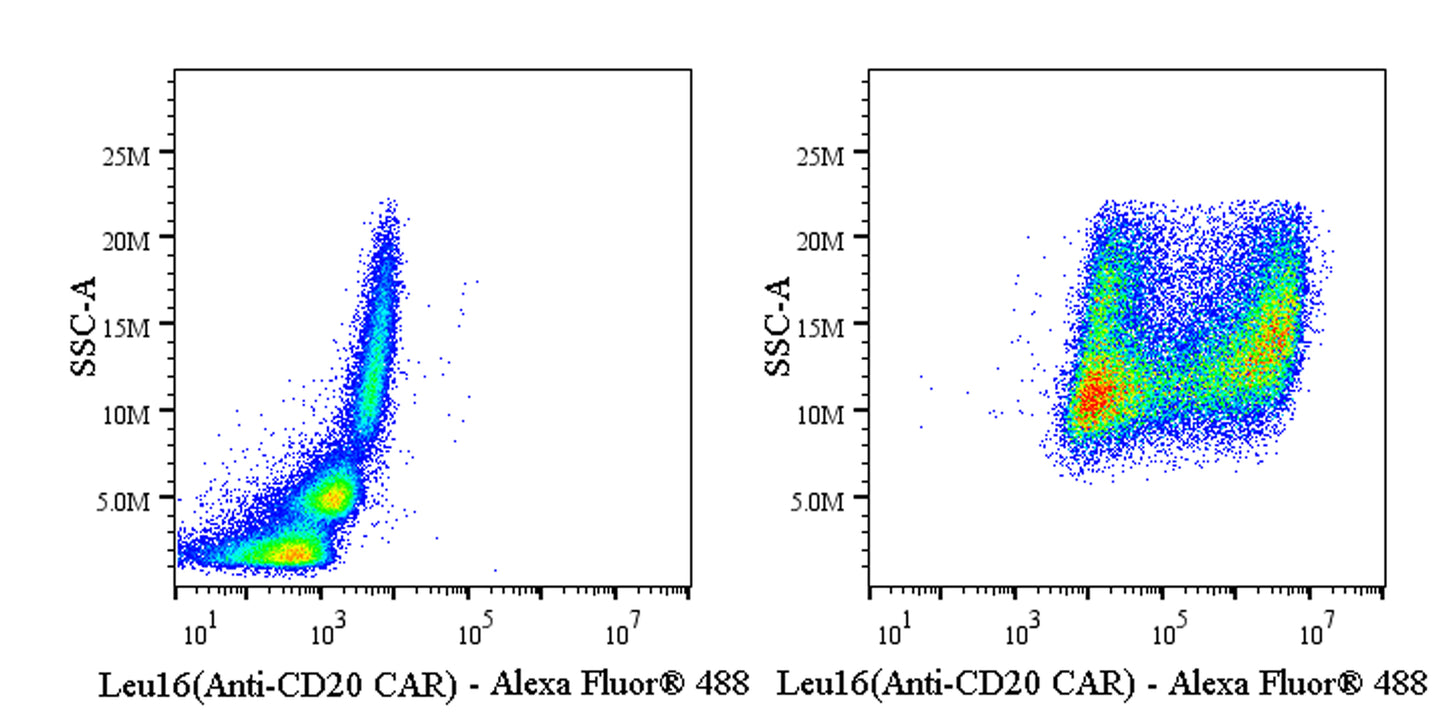
Flow cytometric analysis of Leu16 expression on CAR (Leu16 scFv) transfected 293F (human embryonic kidney epithelial cell) (right panel) or 293F spiked with PBMCs (human peripheral blood mononuclear cells) (left panel). The cells were stained with Anti-Mouse Leu16 scFv (Anti-CD20 CAR) Recombinant Rabbit mAb (Alexa Fluor® 488 Conjugate) at 2 μl/test. Flow cytometry and data analysis were performed using BD FACSymphony™ A1 and FlowJo™ software.
Anti-Mouse Leu16 scFv (Anti-CD20 CAR) Recombinant Rabbit mAb (Alexa Fluor® 488 Conjugate) (S-5469)
Anti-Mouse Leu16 scFv (Anti-CD20 CAR) Recombinant Rabbit mAb (Alexa Fluor® 488 Conjugate) (S-5469)
Price:
Regular price
$1,250 USD
Regular price
Sale price
$1,250 USD
Unit price
per
For shipping services or bulk orders, you may request a quotation.
Secure checkout with

View full details
Product Details
Product Details
Product Specification
| Host | Rabbit |
| Clone Number | S-5469 |
| Antibody Type | Recombinant mAb |
| Isotype | IgG |
| Isotype Control | S0B0161 |
| Application | FCM |
| Reactivity | Ms |
| Purification | Protein A |
| Concentration | 0.1 mg/ml |
| Conjugation | Alexa Fluor® 488 |
| Physical Appearance | Liquid |
| Storage Buffer | PBS, 1% BSA, 0.09% sodium azide |
| Stability & Storage | 12 months from date of receipt / reconstitution, 2 to 8 °C as supplied |
Dilution
| application | dilution | species |
| FCM | 2μl per million cells in 100μl volume | Ms |
Background
Anti-Leu16, commonly referred to as Leu16, is a monoclonal antibody targeting CD20—a surface antigen on B cells—and is frequently employed as a key antigen-recognition component in the design of anti-CD20 chimeric antigen receptors (CARs) due to its superior binding characteristics. The antibody sequences, particularly the single-chain variable fragment (scFv) responsible for antigen recognition, are widely utilized in CAR construct design to engineer CAR-T therapies capable of specifically attacking CD20-positive tumor cells. The Leu16-derived scFv is combined with other CAR elements—including a hinge region, a transmembrane domain, and intracellular co-stimulatory signaling domains (such as CD28 or 4-1BB)—to form the complete CAR molecule. However, since the original Leu16 is murine-derived, its clinical application faces potential immunogenicity challenges; consequently, related research has been devoted to modifying its sequences through humanization or deimmunization strategies to reduce the risk of immune rejection in humans and enhance therapeutic safety and persistence. As an important component of CD20-targeting strategies, Leu16-based CAR designs are advancing the development of novel immunotherapies against B-cell lymphomas, leukemias, and autoimmune diseases (such as lupus nephritis), and are often used in combination with CD19-targeting CARs or engineered as dual-targeting CARs to achieve more comprehensive B-cell depletion and reduce relapse caused by antigen escape.
Picture
Picture
FC