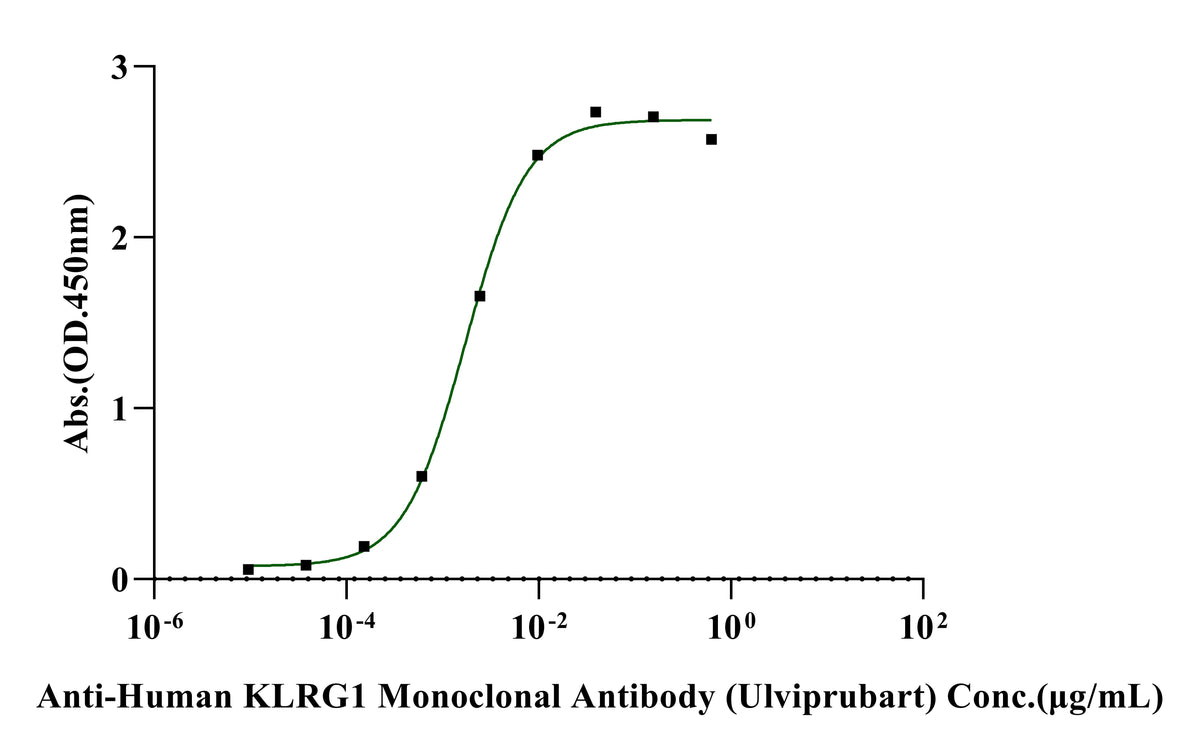
Immobilized KLRG1 Fc Chimera Protein, Human (Cat. No. UA016150) at 1 μg/mL (100 μL/well) can bind Anti-Human KLRG1 Monoclonal Antibody (Ulviprubart) (Cat. No. UA016212) with EC50 of 1.40-2.12 ng/mL.
Anti-Human KLRG1 Monoclonal Antibody (Ulviprubart)
Anti-Human KLRG1 Monoclonal Antibody (Ulviprubart)
Price:
Regular price
$615 USD
Regular price
Sale price
$615 USD
Unit price
per
For shipping services or bulk orders, you may request a quotation.
Secure checkout with

View full details
Product Details
Product Details
Product Specification
| Host | Human |
| Synonyms | Ulviprubart |
| Concentration | 2mg/mL |
| Expression System | HEK293 |
| Conjugation | Unconjugated |
| Physical Appearance | Liquid |
| Storage Buffer | PBS pH7.4, containing no preservative |
| Stability & Storage |
2 to 8 °C for 2 weeks under sterile conditions; -20 °C for 3 months under sterile conditions; -80 °C for 24 months under sterile conditions. Please avoid repeated freeze-thaw cycles. |
| Reference | 1.Konry T, Sulllivan M, Rozzo A, Ward A, Rao P, Soler-Ferran D, Greenberg S. Single Cell Droplet-Based Efficacy and Transcriptomic Analysis of a Novel Anti-KLRG1 Antibody for Elimination of Autoreactive T Cells. Res Sq [Preprint]. 2024 Sep 8:rs.3.rs-4745216. |
Background
Ulviprubart is a humanized, non-fucosylated monoclonal antibody that targets KLRG1 (killer cell lectin-like receptor G1). Its core mechanism involves specifically binding to and depleting terminally differentiated effector memory T cells (TEM/TEMRA) that highly express KLRG1, while preserving naïve T cells, regulatory T cells, and B cells, thereby precisely eliminating pathogenic autoreactive T cells. In clinical practice, Ulviprubart is primarily being developed for the treatment of inclusion body myositis (IBM) and T-cell large granular lymphocytic leukemia (T-LGLL). Although the Phase II/III MUSCLE trial in IBM did not meet its primary endpoint, a trend toward delayed disease progression was observed in the subgroup of patients with mild-to-moderate disease. In T-LGLL, a Phase I study demonstrated a response rate of 53% in those with neutropenia and 22% in those with anemia. The clinical significance of Ulviprubart lies in being the first agent to achieve selective targeting of highly differentiated cytotoxic T cells, offering a novel therapeutic strategy for T-cell-mediated diseases that are refractory to conventional immunosuppression, while further work is needed to identify the optimal patient population who would derive the greatest benefit.
Picture
Picture
ELISA