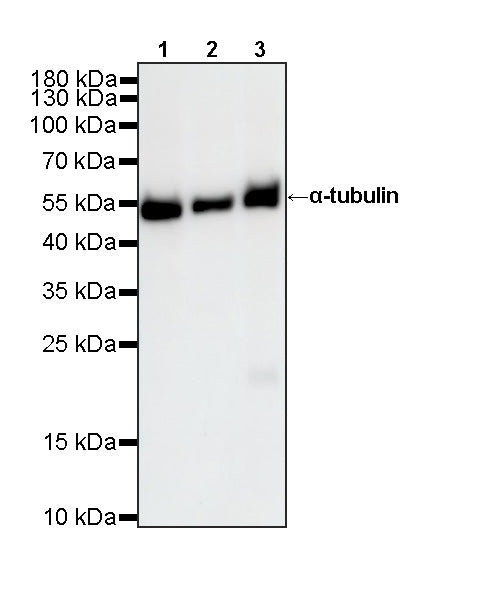
WB result of Anti-Biotin Recombinant Rabbit mAb (HRP Conjugate)
Primary antibody: α-tubulin Recombinant Mouse mAb (Biotin Conjugate) at 1/100 dilution
Lane 1: HeLa whole cell lysate 20 μg
Lane 2: NIH/3T3 whole cell lysate 20 μg
Lane 3: C6 whole cell lysate 20 μg
Secondary antibody: Biotin Recombinant Rabbit mAb (HRP Conjugate) at 1/2000 dilution
Predicted MW: 52 kDa
Observed MW: 52 kDa
Anti-Biotin Recombinant Rabbit mAb (HRP Conjugate) (S-3083)
Anti-Biotin Recombinant Rabbit mAb (HRP Conjugate) (S-3083)
Price:
Regular price
$120 USD
Regular price
Sale price
$120 USD
Unit price
per
For shipping services or bulk orders, you may request a quotation.
Secure checkout with

View full details
Product Details
Product Details
Product Specification
| Host | Rabbit |
| Antigen | Biotin |
| Clone Number | S-3083 |
| Antibody Type | Recombinant mAb |
| Isotype | IgG |
| Application | ELISA, WB |
| Purification | Protein A |
| Concentration | 1 mg/ml |
| Conjugation | HRP |
| Physical Appearance | Liquid |
| Storage Buffer | PBS, 40% Glycerol, 0.05%BSA, 0.03% Proclin 300 |
| Stability & Storage | 12 months from date of receipt / reconstitution, -20 °C as supplied |
Dilution
| application | dilution | species |
| ELISA | 1:2000-1:5000 | Species independent |
| WB | 1:2000-1:5000 | Species independent |
Background
Biotin, also known as vitamin B7 or vitamin H, is a water-soluble B-complex vitamin that serves as a crucial coenzyme for carboxylases, facilitating key biochemical processes such as gluconeogenesis, fatty acid synthesis, and amino acid metabolism. Since the human body cannot synthesize biotin on its own, it must be obtained through dietary sources (e.g., egg yolks, nuts, and animal liver) or in small amounts via gut microbiota. Its molecular structure consists of a ureido ring fused with a tetrahydrothiophene ring, and the valeric acid side chain enables binding to enzyme proteins for biological activity. Although widely believed to strengthen hair and nails due to its affinity for keratin, scientific evidence primarily supports biotin supplementation for addressing deficiencies or metabolic disorders, which may manifest as dermatitis, hair loss, or neurological abnormalities. The recommended daily intake for adults is approximately 30 μg, with higher doses needed for pregnant women or specific populations. While biotin toxicity is rare, excessive intake can interfere with laboratory tests (e.g., thyroid hormones, cardiac biomarkers).
Picture
Picture
Western Blot