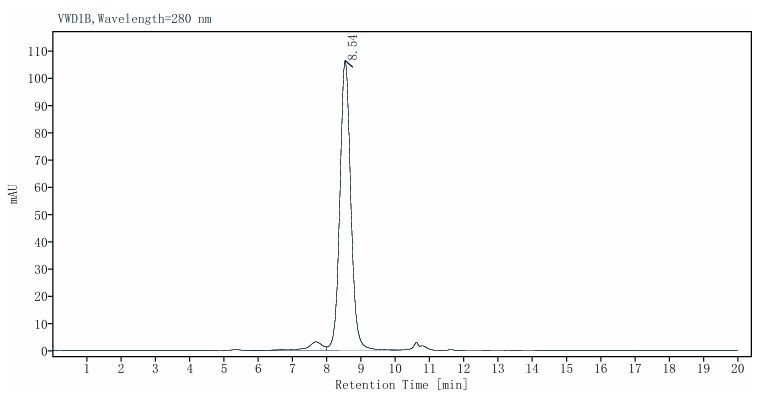
2μg (R: reducing condition, N: non-reducing condition).
Annexin A1 His Tag Protein, Cynomolgus
Annexin A1 His Tag Protein, Cynomolgus
Price:
Regular price
$195 USD
Regular price
Sale price
$195 USD
Unit price
per
For shipping services or bulk orders, you may request a quotation.
Secure checkout with

View full details
Product Details
Product Details
Product Specification
| Species | Cynomolgus |
| Accession | XP_005581995.1 |
| Amino Acid Sequence | Ala2-Asn346 with His Tag at the C-Terminus |
| Expression System | HEK293 |
| Molecular Weight | 35-40kDa(Reducing) |
| Endotoxin | <0.1EU/μg |
| Tag | His Tag |
| Physical Appearance | Lyophilized powder |
| Storage Buffer | PBS, 5% trehalose, pH7.4 |
| Reconstitution | Reconstitute at 0.1-1 mg/ml according to the size in ultrapure water after rapid centrifugation |
| Stability & Storage |
· 12 months from date of receipt, lyophilized powder stored at -20 to -80℃. · 3 months, -20 to -80℃ under sterile conditions after reconstitution. · 1 week, 2 to 8℃ under sterile conditions after reconstitution. · Please avoid repeated freeze-thaw cycles. |
Background
Annexin A1 (ANXA1) is a calcium-dependent phospholipid-binding protein whose central domain contains four repeat sequences; its N-terminal tail is embedded in the core region in the absence of calcium and is released upon calcium binding to expose the active site. Functionally, ANXA1 is a glucocorticoid-induced anti-inflammatory effector molecule that inhibits neutrophil migration and promotes the clearance of apoptotic cells by binding to formyl peptide receptors (FPR1/FPR2), while also participating in the regulation of cell proliferation, differentiation, and apoptosis. Clinically, ANXA1 is abnormally expressed in various tumors and is closely associated with chemoresistance and prognostic assessment, making it a potential diagnostic biomarker and therapeutic target; in addition, its autoantibodies correlate with disease activity in autoimmune diseases such as systemic lupus erythematosus.
Picture
Picture
SDS-PAGE
SEC-HPLC
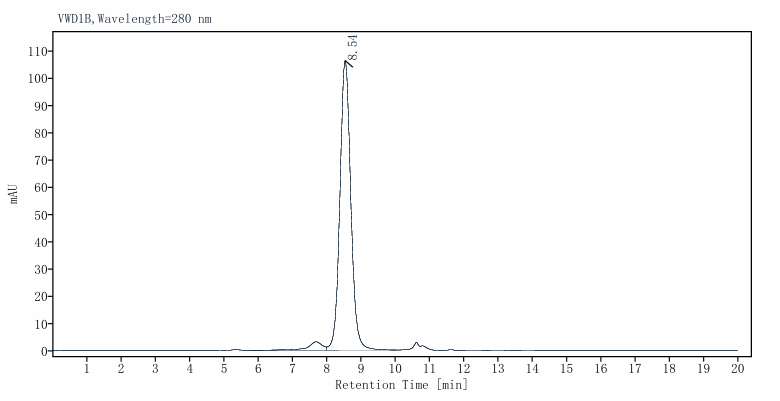
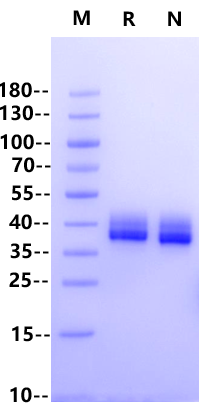
The purity of Annexin A1 His Tag Protein, Cynomolgus is more than 95% determined by SEC-HPLC.
ELISA
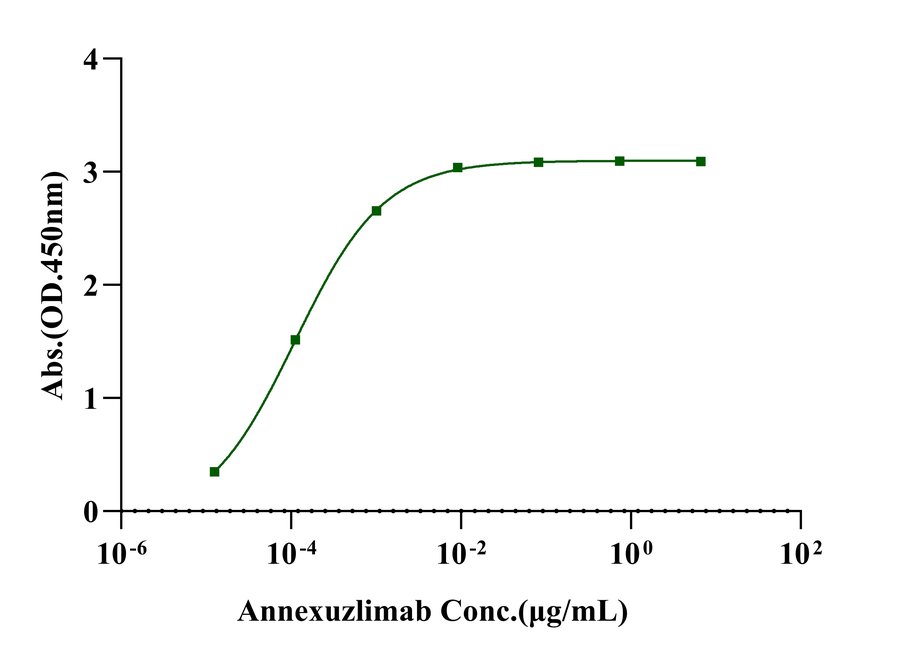
Immobilized Annexin A1 His Tag Protein, Cynomolgus (Cat. No. UA016128) at 2 μg/mL (100 μL/well) can bind Annexuzlimab with a linear range of 0.11-0.14 ng/mL.