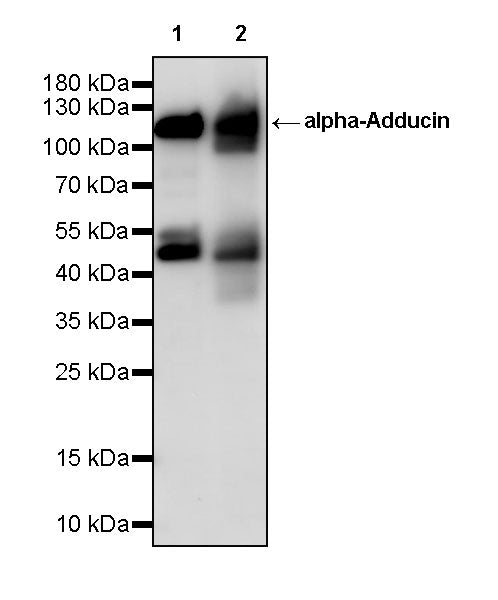
WB result of alpha-Adducin Recombinant Rabbit mAb
Primary antibody: alpha-Adducin Recombinant Rabbit mAb at 1/1000 dilution
Lane 1: HT-29 whole cell lysate 20 µg
Lane 2: U-2 OS whole cell lysate 20 µg
Secondary antibody: Goat Anti- rabbit IgG, (H+L), HRP conjugated at 1/10000 dilution
Predicted MW: 81 kDa
Observed MW: 120 kDa
alpha-Adducin Recombinant Rabbit mAb (S-5283)
alpha-Adducin Recombinant Rabbit mAb (S-5283)
Price:
Regular price
$100 USD
Regular price
Sale price
$100 USD
Unit price
per
For shipping services or bulk orders, you may request a quotation.
Secure checkout with

View full details
Product Details
Product Details
Product Specification
| Host | Rabbit |
| Antigen | alpha-Adducin |
| Synonyms | Alpha-adducin; ADDA; ADD1 |
| Location | Cytoplasm, Cytoskeleton, Cell membrane |
| Accession | P35611 |
| Clone Number | S-5283 |
| Antibody Type | Recombinant mAb |
| Isotype | IgG |
| Application | WB |
| Reactivity | Hu |
| Positive Sample | HT-29, U-2 OS |
| Predicted Reactivity | Mk |
| Purification | Protein A |
| Concentration | 0.5 mg/ml |
| Conjugation | Unconjugated |
| Physical Appearance | Liquid |
| Storage Buffer | PBS, 40% Glycerol, 0.05% BSA, 0.02% sodium azide |
| Stability & Storage | 12 months from date of receipt / reconstitution, -20 °C as supplied |
Dilution
| application | dilution | species |
| WB | 1:1000 | Hu |
Background
alpha-Adducin is a cytoskeleton-associated protein predominantly expressed in blood cells and brain tissue, belonging to the adducin family. Its core function is to serve as an important component of the membrane skeleton complex, regulating the assembly and dynamic reorganization of the membrane cytoskeleton through interactions with actin filaments and spectrin, thereby playing a critical role in maintaining cell morphology, cell polarity, and cell–cell adhesion. This protein is encoded by the ADD1 gene and its structure includes an N-terminal globular head domain (responsible for actin binding), a central highly conserved MARCKS-like domain (involved in protein kinase C-mediated phosphorylation regulation), and a C-terminal tail domain (mediating heterodimerization or heterotetramerization with spectrin and other adducin subunits, β and γ). The functional regulation of alpha-adducin primarily depends on phosphorylation modifications at multiple sites by protein kinase C and Rho-associated kinases; this dynamic phosphorylation modulates its binding affinity for actin and the stability of the membrane skeleton, thereby responding to intracellular and extracellular signals and participating in the regulation of synaptic plasticity, cell migration, and epithelial barrier function. In the field of hypertension research, polymorphisms of the alpha-adducin gene (especially the Gly460Trp variant) have become a focus of classical genetic studies—this mutation is believed to enhance the function of proteins involved in renal tubular sodium reabsorption, leading to a significantly increased risk of salt-sensitive hypertension, and thus is used as an important biomarker for genetic susceptibility to hypertension. In addition, alpha-adducin also plays a role in neurodevelopment and synaptic function, and its aberrant expression or dysfunction may be associated with the pathogenesis of neuropsychiatric disorders such as schizophrenia and bipolar disorder. Meanwhile, its abnormal expression in various tumors also suggests that it may participate in cancer cell migration and invasion, although its specific role remains to be further explored. Overall, as a multifunctional membrane skeleton regulatory protein, alpha-adducin not only holds an important position in basic cell biology but also provides a unique entry point for investigating the pathological mechanisms of diseases such as hypertension, neurological disorders, and cancer.
Picture
Picture
Western Blot