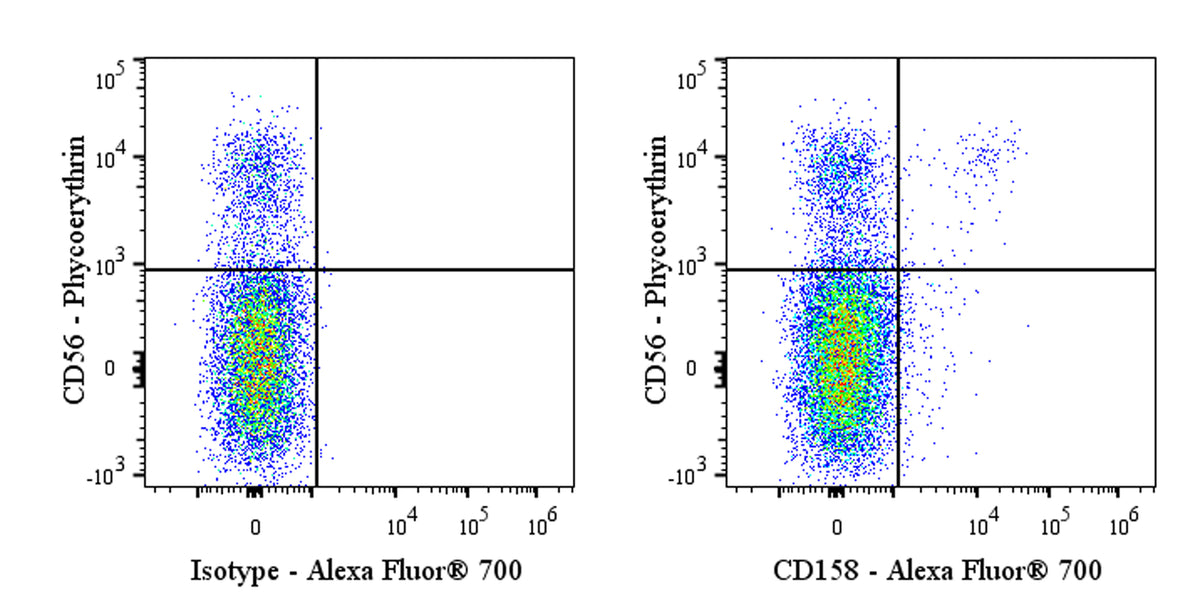
Flow cytometric analysis of human CD158 expression on human PBMC (human peripheral blood mononuclear cells). Human PBMC were stained with Phycoerythrin Mouse Anti-Human CD56 Antibody and either Alexa Fluor® 700 Mouse IgG2b, κ Isotype Control (left panel) or SDT Alexa Fluor® 700 Mouse Anti-Human CD158 antibody (right panel) at 1.25 μl/test. Flow cytometry and data analysis were performed using Agilent NovoCyte Quanteon and FlowJo™ software.
Alexa Fluor® 700 Mouse Anti-Human CD158 Antibody (S-2918)
Alexa Fluor® 700 Mouse Anti-Human CD158 Antibody (S-2918)
Price:
Regular price
$175 USD
Regular price
Sale price
$175 USD
Unit price
per
For shipping services or bulk orders, you may request a quotation.
Secure checkout with

View full details
Product Details
Product Details
Product Specification
| Host | Mouse |
| Antigen | CD158 |
| Synonyms | CD158a; CD158g; CD158h; KIR2DL1; KIR2DS1; KIR2DS3; KIR2DS5 |
| Location | Cell membrane |
| Accession | P43626、Q14953、Q14954 |
| Clone Number | S-2918 |
| Antibody Type | Mouse mAb |
| Isotype | IgG2b,k |
| Application | FCM |
| Reactivity | Hu |
| Positive Sample | Human PBMC |
| Purification | Protein A |
| Concentration | 0.2 mg/ml |
| Conjugation | Alexa Fluor® 700 |
| Physical Appearance | Liquid |
| Storage Buffer | PBS, 1% BSA, 0.3% Proclin 300 |
| Stability & Storage | 12 months from date of receipt / reconstitution, 2 to 8 °C as supplied |
Dilution
| application | dilution | species |
| FCM | 1.25μl per million cells in 100μl volume | Hu |
Background
CD158, also known as killer-cell immunoglobulin-like receptor (KIR), is a polymorphic type I transmembrane glycoprotein expressed chiefly on natural killer (NK) cells and subsets of T cells that recognizes specific HLA class I allotypes (HLA-A, -B or -C) and transmits either inhibitory or activating signals—depending on whether its cytoplasmic tail contains ITIMs or associates with the ITAM-bearing adaptor DAP12—to regulate cytotoxic activity, thereby serving as a critical immune checkpoint whose blockade is being explored clinically to unleash NK-cell mediated anti-tumor responses.
Picture
Picture
FC