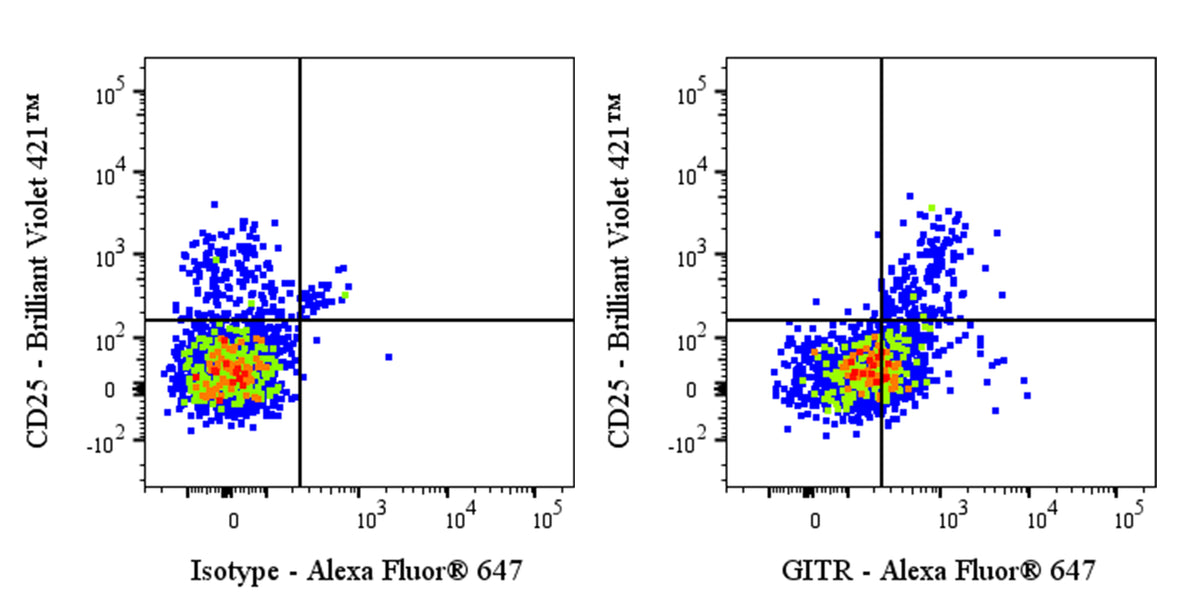
Flow cytometric analysis of GITR expression on C57BL/6 mouse splenocytes. C57BL/6 mouse splenocytes were stained with Brilliant Violet 421™ Rat Anti-Mouse CD25 Antibody and either Alexa Fluor® 647 Rat IgG2b, λ Isotype Control (left panel) or SDT Alexa Fluor® 647 Rat Anti-Mouse GITR Antibody (right panel) at 0.5 μl/test. Total viable cells, as determined by Fixable Viability Dye 777 (S0B88805), were used for analysis. Flow cytometry and data analysis were performed using BD FACSymphony™ A1 and FlowJo™ software.
Alexa Fluor® 647 Rat Anti-Mouse GITR Antibody (DTA-1)
Alexa Fluor® 647 Rat Anti-Mouse GITR Antibody (DTA-1)
Price:
Regular price
$100 USD
Regular price
Sale price
$100 USD
Unit price
per
For shipping services or bulk orders, you may request a quotation.
Secure checkout with

View full details
Product Details
Product Details
Product Specification
| Host | Rat |
| Antigen | GITR |
| Synonyms | Tumor necrosis factor receptor superfamily member 18; Glucocorticoid-induced TNFR-related protein; CD357; Gitr; Tnfrsf18 |
| Location | Secreted, Cell membrane |
| Accession | O35714 |
| Clone Number | DTA-1 |
| Antibody Type | Rat mAb |
| Isotype | Rat IgG2b, λ |
| Isotype Control | S0B8039 |
| Application | FCM |
| Reactivity | Ms |
| Positive Sample | C57BL/6 mouse splenocytes |
| Purification | Protein G |
| Concentration | 0.5 mg/ml |
| Conjugation | Alexa Fluor® 647 |
| Physical Appearance | Liquid |
| Storage Buffer | PBS, 1% BSA, 0.09% sodium azide |
| Stability & Storage | 12 months from date of receipt / reconstitution, 2 to 8 °C as supplied |
Dilution
| application | dilution | species |
| FCM | 0.25μg per million cells in 100μl volume | Ms |
Background
GITR (glucocorticoid-induced TNF receptor, TNFRSF18/CD357) is a cell-surface receptor of the TNF-receptor superfamily that is constitutively expressed at high levels on regulatory T cells (Tregs) and is rapidly up-regulated on activated CD4⁺/CD8⁺ T cells and NK cells; engagement of GITR by its ligand GITRL (TNFSF18) on antigen-presenting cells delivers a costimulatory signal that activates the NF-κB pathway, enhances IL-2 and IFN-γ production, up-regulates the anti-apoptotic protein Bcl-xL, and thereby amplifies effector T-cell proliferation, cytokine secretion and cytotoxicity while transiently destabilizing FoxP3 and the suppressive function of Tregs, making GITR an attractive target for cancer immunotherapy.
Picture
Picture
FC