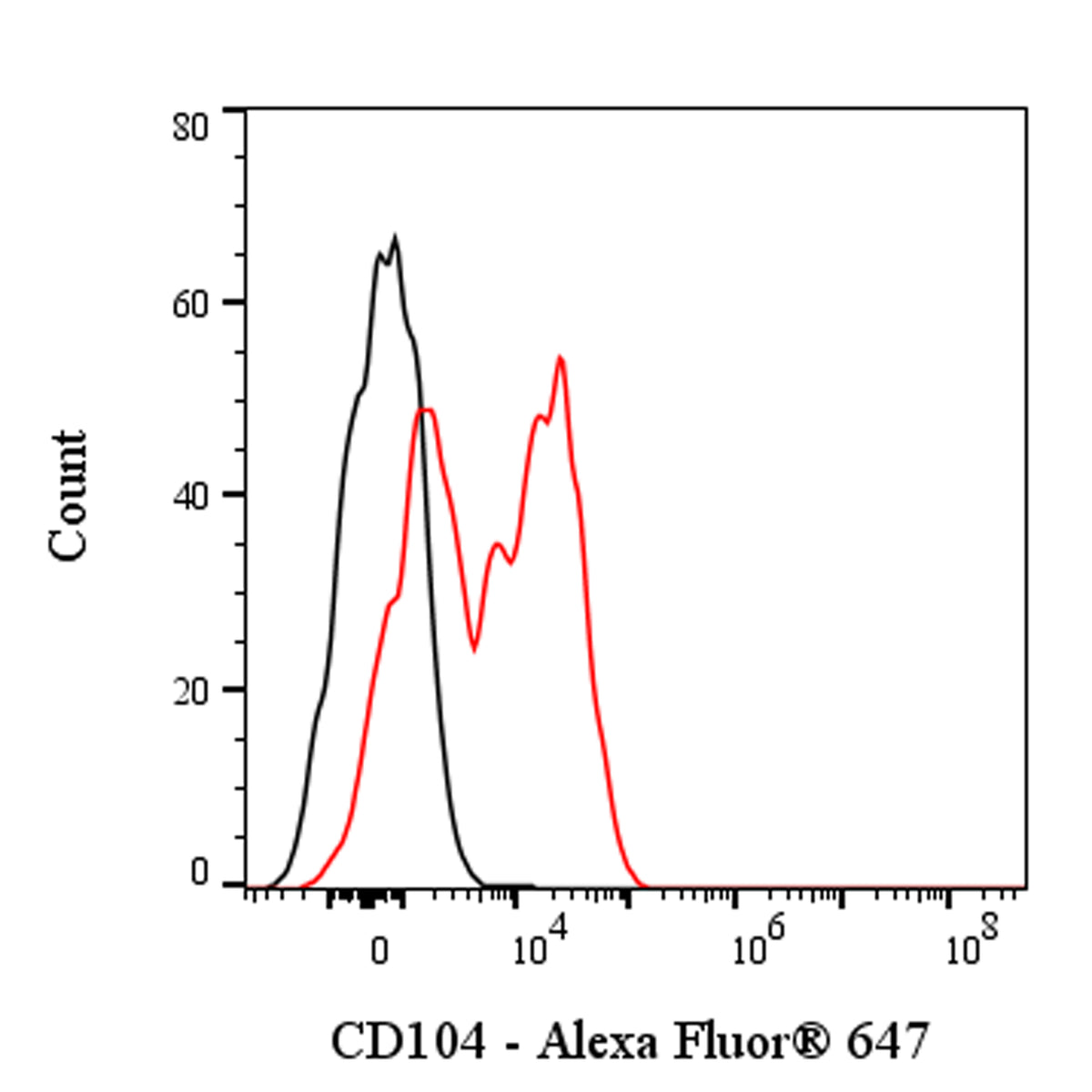
Flow cytometric analysis of mouse CD104 expression on BALB/c mouse thymocytes. BALB/c mouse thymocytes were stained with were stained with Brilliant Violet 421™ Rat Anti-Mouse CD4 Antibody and Phycoerythrin Rat Anti-Mouse CD8 Antibody (S0B5598) and either Alexa Fluor® 647 Rat IgG2a, κ Isotype Control (Black line histogram) or SDT Alexa Fluor® 647 Rat Anti-Mouse CD104 Antibody (Red line histogram) at 2 μl/test. The Histogram shows CD104 expression derived from CD4-CD8- gated events with the forward. Flow cytometry and data analysis were performed using Agilent NovoCyte Quanteon and FlowJo™ software.
Alexa Fluor® 647 Rat Anti-Mouse CD104 Antibody (S-R716)
Alexa Fluor® 647 Rat Anti-Mouse CD104 Antibody (S-R716)
Price:
Regular price
$210 USD
Regular price
Sale price
$210 USD
Unit price
per
For shipping services or bulk orders, you may request a quotation.
Secure checkout with

View full details
Product Details
Product Details
Product Specification
| Host | Rat |
| Antigen | Integrin beta 4 |
| Synonyms | Integrin beta-4; Itgb4 |
| Location | Cell membrane |
| Accession | A2A863 |
| Clone Number | S-R716 |
| Antibody Type | Rat mAb |
| Isotype | IgG2a,k |
| Application | FCM |
| Reactivity | Ms |
| Positive Sample | BALB/c mouse thymocytes |
| Purification | Protein G |
| Concentration | 0.5 mg/ml |
| Conjugation | Alexa Fluor® 647 |
| Physical Appearance | Liquid |
| Storage Buffer | PBS, 1% BSA, 0.3% Proclin 300 |
| Stability & Storage | 12 months from date of receipt / reconstitution, 2 to 8 °C as supplied |
Dilution
| application | dilution | species |
| FCM | 1μg per million cells in 100μl volume | Ms |
Background
Integrin beta 4 (CD104) is a key subunit of the integrin family, primarily functioning as a receptor for laminins and often associating with the alpha 6 subunit to form the α6β4 integrin complex. This transmembrane glycoprotein receptor plays a crucial role in mediating cell-matrix adhesion and signaling, which regulates gene expression, cell growth, and migration. ITGB4 is particularly important in maintaining the stability of hemidesmosomes, which anchor epithelial cells to the basement membrane. Additionally, its expression and activity are implicated in various biological processes, including wound healing, tissue integrity, and cancer progression. Abnormal mutations or dysregulation of ITGB4 have been associated with diseases such as epidermolysis bullosa with pyloric atresia.
Picture
Picture
FC