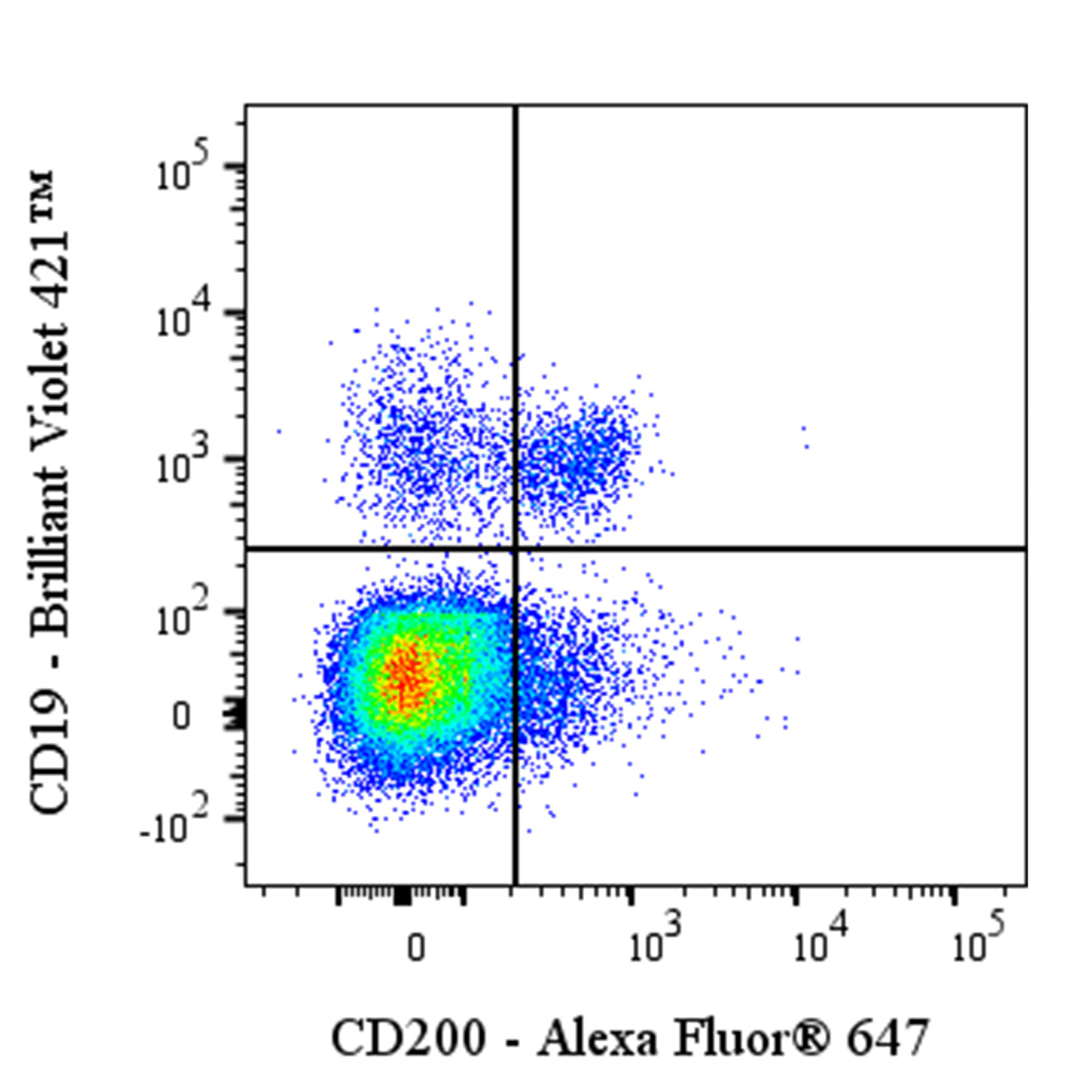
Flow cytometric analysis of CD200 expression on human PBMCs (human peripheral blood mononuclear cells). Human PBMCs were stained with Brilliant Violet 421™ Mouse Anti-Human CD19 Antibody and SDT Alexa Fluor® 647 Rabbit Anti-Human CD200 Antibody at 2 μl/test. Total viable cells, as determined by Fixable Viability Dye 515 (S0B88804), were used for analysis. Flow cytometry and data analysis were performed using BD FACSymphony™ A1 and FlowJo™ software.
Alexa Fluor® 647 Rabbit Anti-Human CD200 Antibody (S-1008-60)
Alexa Fluor® 647 Rabbit Anti-Human CD200 Antibody (S-1008-60)
Price:
Regular price
$120 USD
Regular price
Sale price
$120 USD
Unit price
per
For shipping services or bulk orders, you may request a quotation.
Secure checkout with

View full details
Product Details
Product Details
Product Specification
| Host | Rabbit |
| Antigen | CD200 |
| Synonyms | OX-2 membrane glycoprotein; MOX1; MOX2 |
| Immunogen | Recombinant Protein |
| Location | Cell membrane |
| Accession | P41217 |
| Clone Number | S-1008-60 |
| Antibody Type | Recombinant mAb |
| Isotype | IgG |
| Isotype Control | S0B8021 |
| Application | FCM |
| Reactivity | Hu |
| Positive Sample | Human PBMC |
| Purification | Protein A |
| Concentration | 0.1 mg/ml |
| Conjugation | Alexa Fluor® 647 |
| Physical Appearance | Liquid |
| Storage Buffer | PBS, 1% BSA, 0.09% sodium azide |
| Stability & Storage | 12 months from date of receipt / reconstitution, 2 to 8 °C as supplied |
Dilution
| application | dilution | species |
| FCM | 2μl per million cells in 100μl volume | Hu |
Background
CD200, also known as OX-2 membrane glycoprotein, is a type I transmembrane protein encoded by the CD200 gene and belongs to the immunoglobulin superfamily. It is primarily expressed on various cell types, including immune cells, neuronal cells, and some non-hematopoietic cells. CD200 plays a crucial role in immune regulation by interacting with its receptor, CD200R, which is mainly expressed on myeloid cells, microglia, and activated T cells. This interaction generates inhibitory signals that suppress immune responses, such as reducing the production of inflammatory cytokines like IL-2 and IFN-γ, and promoting the expansion of regulatory T cells. In addition, CD200 is involved in maintaining immune tolerance and preventing autoimmune diseases. However, its expression on tumor cells can lead to immune evasion by inhibiting antitumor T-cell responses. Therefore, CD200 is considered a potential target for cancer immunotherapy and the treatment of inflammatory and autoimmune diseases.
Picture
Picture
FC