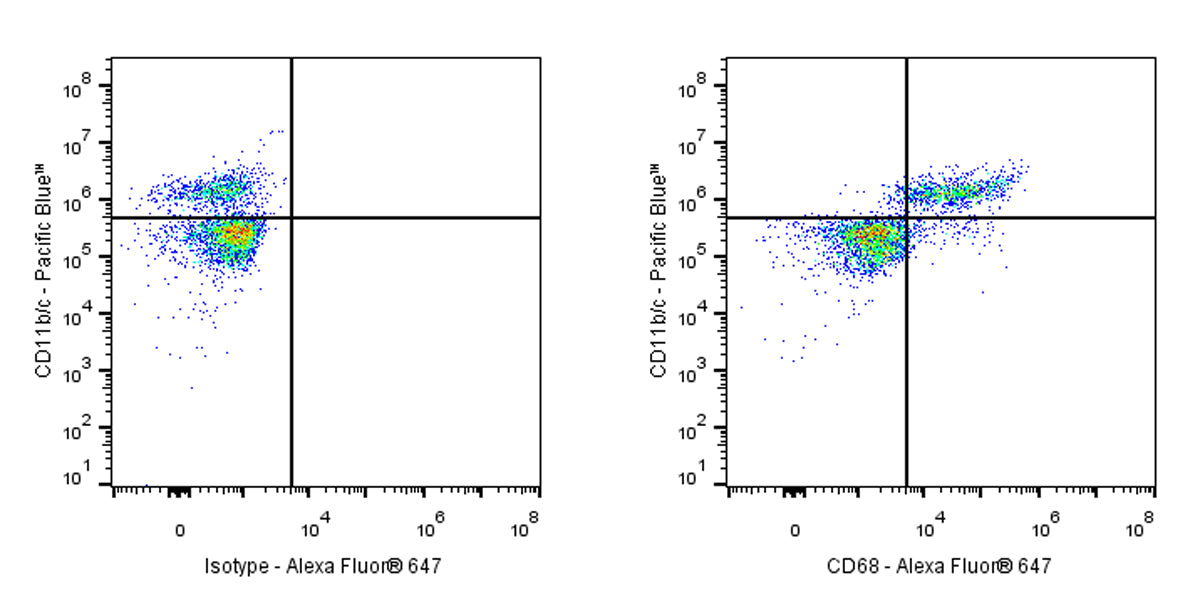
SD Rat peritoneal exudates cells were fixed with 4% PFA and permeabilization with the 0.1% Tween. Cells were then intracellularly stained with Pacific Blue Mouse Anti-Rat CD11b/c and either Alexa Fluor® 647 Mouse IgG1, κ Isotype Control (Left panel) or SDT Alexa Fluor® 647 Mouse Anti-Rat CD68 Antibody Antibody (Right panel) at 1.25 μl/test. Flow cytometry and data analysis were performed using BD FACSymphony™ A1 and FlowJo™ software.
Alexa Fluor® 647 Mouse Anti-Rat CD68 Antibody (S-R674)
Alexa Fluor® 647 Mouse Anti-Rat CD68 Antibody (S-R674)
Price:
Regular price
$200 USD
Regular price
Sale price
$200 USD
Unit price
per
For shipping services or bulk orders, you may request a quotation.
Secure checkout with

View full details
Product Details
Product Details
Product Specification
| Host | Mouse |
| Antigen | CD68 |
| Synonyms | Cd68 |
| Location | Lysosome, Endosome, Cell membrane |
| Accession | Q4FZY1 |
| Clone Number | S-R674 |
| Antibody Type | Mouse mAb |
| Isotype | IgG1,k |
| Application | ICFCM |
| Reactivity | Rt |
| Positive Sample | SD Rat peritoneal exudates cells |
| Purification | Protein G |
| Concentration | 0.2 mg/ml |
| Conjugation | Alexa Fluor® 647 |
| Physical Appearance | Liquid |
| Storage Buffer | PBS, 1% BSA, 0.3% Proclin 300 |
| Stability & Storage | 12 months from date of receipt / reconstitution, 2 to 8 °C as supplied |
Dilution
| application | dilution | species |
| ICFCM | 1.25μl per million cells in 100μl volume | Rt |
Background
CD68, also known as macrosialin in mice, is a heavily glycosylated type I transmembrane glycoprotein that belongs to the lysosome-associated membrane protein family. It is predominantly expressed in cells of the monocyte lineage, such as macrophages, microglia, and osteoclasts. CD68 serves as a reliable marker for these immune cells and plays a crucial role in various immunological processes. It is primarily located within lysosomes and endosomes but can also be found on the cell surface. CD68 is involved in phagocytosis, antigen presentation, and the clearance of cellular debris and pathogens. In addition, it has been implicated in the regulation of bone resorption and may serve as a receptor for malaria sporozoite in liver infection. In the context of cancer, CD68 expression is often used as a prognostic marker, with higher numbers of CD68-positive tumor-associated macrophages correlating with worse outcomes in some studies.
Picture
Picture
FC