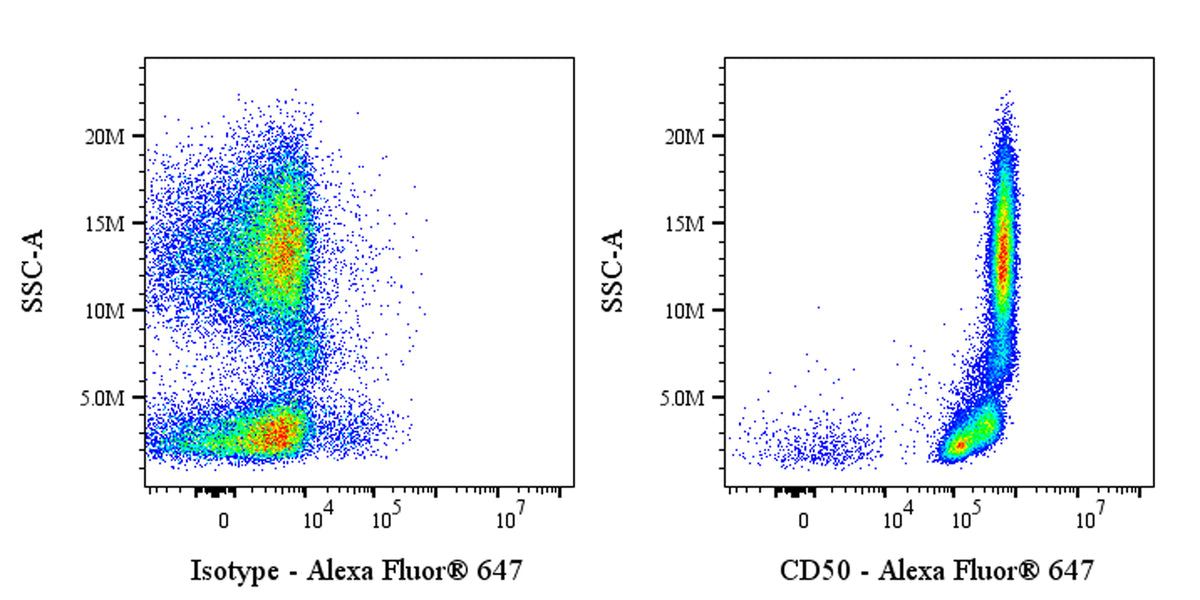
Flow cytometric analysis of CD50 expression on human peripheral blood leukocytes. Human peripheral blood leukocytes were stained with Alexa Fluor® 647 Mouse IgG2b, k Isotype Control (left panel) or SDT Alexa Fluor® 647 Mouse Anti-Human CD50 Antibody (right panel) at 5 μl/test. Flow cytometry and data analysis were performed using Agilent NovoCyte Quanteon and FlowJo™ software.
Alexa Fluor® 647 Mouse Anti-Human CD50 Antibody (S-4993)
Alexa Fluor® 647 Mouse Anti-Human CD50 Antibody (S-4993)
Price:
Regular price
$100 USD
Regular price
Sale price
$100 USD
Unit price
per
For shipping services or bulk orders, you may request a quotation.
Secure checkout with

View full details
Product Details
Product Details
Product Specification
| Host | Mouse |
| Antigen | CD50 |
| Synonyms | Intercellular adhesion molecule 3; CDw50; ICAM-R; ICAM3 |
| Location | Cell membrane |
| Accession | P32942 |
| Clone Number | S-4993 |
| Antibody Type | Mouse mAb |
| Isotype | IgG2b,k |
| Application | FCM |
| Reactivity | Hu |
| Positive Sample | Human peripheral blood leukocytes |
| Purification | Protein A |
| Concentration | 0.2 mg/ml |
| Conjugation | Alexa Fluor® 647 |
| Physical Appearance | Liquid |
| Storage Buffer | PBS, 1% BSA, 0.09% sodium azide |
| Stability & Storage | 12 months from date of receipt / reconstitution, 2 to 8 °C as supplied |
Dilution
| application | dilution | species |
| FCM | 5μl per million cells in 100μl volume | Hu |
Background
CD50, also known as Intercellular Adhesion Molecule 3 (ICAM-3), is a type I transmembrane glycoprotein belonging to the immunoglobulin superfamily that plays a pivotal role in the initiation and regulation of immune responses, particularly during the early stages of T-cell activation. Primarily expressed on the surface of leukocytes, including resting T cells, B cells, monocytes, and granulocytes, CD50 functions as a critical ligand for the leukocyte function-associated antigen-1 (LFA-1, or CD11a/CD18) integrin found on antigen-presenting cells and other immune effectors. This interaction facilitates stable adhesion between immune cells, thereby supporting essential processes such as immunological synapse formation, leukocyte migration, and costimulatory signaling that primes naive T cells for subsequent activation by ICAM-1 and other molecules. Beyond its adhesive properties, CD50 is involved in intracellular signal transduction pathways that influence cell morphology and cytoskeletal rearrangement, making it a key mediator in both innate and adaptive immunity, with its dysregulation implicated in various inflammatory disorders and hematological malignancies.
Picture
Picture
FC