Alexa Fluor 647-Labeled -Biotinylated CD20 Flag&Avi Tag Protein, Human (Detergent)
Alexa Fluor 647-Labeled -Biotinylated CD20 Flag&Avi Tag Protein, Human (Detergent)
Price:
Regular price
$1,145 USD
Regular price
Sale price
$1,145 USD
Unit price
per
For shipping services or bulk orders, you may request a quotation.
Secure checkout with

View full details
Product Details
Product Details
Product Specification
| Species | Human |
| Synonyms | MS4A1 |
| Amino Acid Sequence | Met‒Pro297 with a Flag&Avi Tag at the C-terminus. |
| Expression System | HEK293 |
| Molecular Weight | 40kDa (Reducing) |
| Conjugation | Alexa Fluor® 647 |
| Tag | Avi Tag, Flag Tag |
| Physical Appearance | Liquid |
| Storage Buffer | 25 mM Hepes, pH7.5,150 mM NaCI, 0.006%GDN |
| Stability & Storage | Stable for 3 months upon stored at -80℃ from the date of receipt. And avoid repeated freeze-thaws cycles. |
| Reference | 1. Rougé L, Chiang N, Steffek M, Kugel C, Croll TI, Tam C, Estevez A, Arthur CP, Koth CM, Ciferri C, Kraft E, Payandeh J, Nakamura G, Koerber JT, Rohou A. Structure of CD20 in complex with the therapeutic monoclonal antibody rituximab. Science. 2020 Mar 13;367(6483):1224-1230. |
Background
CD20 is a B-cell-specific membrane protein encoded by MS4A1 (chromosome 11q12), belonging to the MS4A family. It has four transmembrane helices and a key extracellular epitope (¹⁷⁰ANPSE¹⁷⁴), forming a tight homodimer that lacks a transmembrane pore, arguing against direct ionchannel function. CD20 is expressed from preB to mature B cells, lost on plasma cells, and highly overexpressed on malignant B cells in lymphomas, chronic lymphocytic leukaemia (CLL) and autoimmune diseases, establishing it as a validated therapeutic target.
AntiCD20 monoclonal antibodies fall into two types. Type I (rituximab, ofatumumab) bind two Fabs per dimer through homotypic Fab–Fab interactions, potently activating complement-dependent cytotoxicity (CDC). Type II (obinutuzumab) bind with 1:2 stoichiometry, showing reduced CDC but enhanced direct killing. These antibodies have transformed treatment, though resistance and relapse persist. Recent cryoEM structures (2.6–3.3 Å) have revealed the molecular basis of these differential binding modes, providing a framework for rationally designing nextgeneration CD20targeted immunotherapies.
Picture
Picture
FC
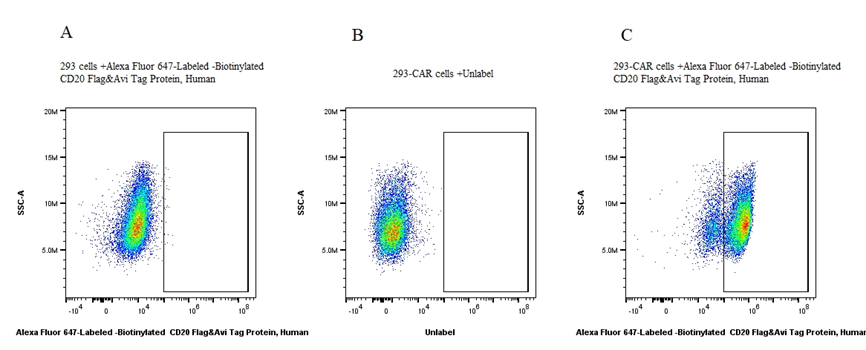
2e5 of transient transfected anti-CD20 ScFv CAR-293 cells were stained with 1 μg Alexa Fluor 647-Labeled -Biotinylated CD20 Flag&Avi Tag Protein, Human , (Cat. No. UA060048 ) and unlabel respectively (Fig. C and B), and non-transfected 293 cells were used as a control (Fig. A). Alexa Fluor 647 signal was used to evaluate the binding activity.
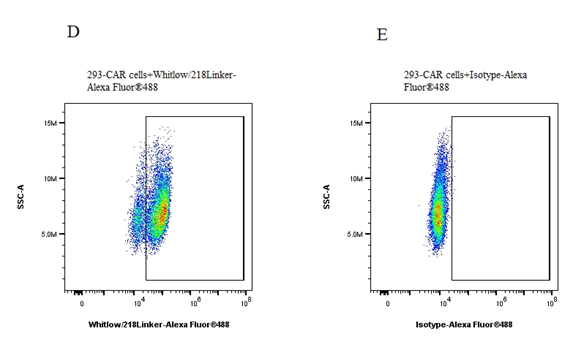
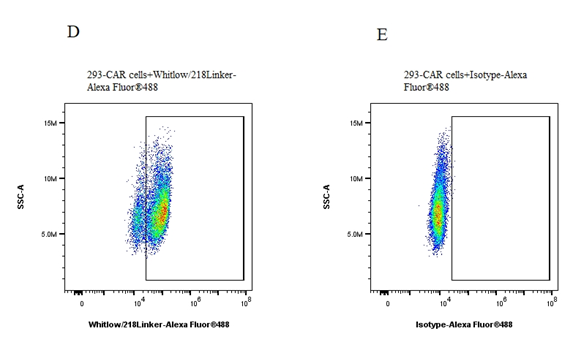
2e5 of transient transfected anti-CD20 ScFv CAR-cells were stained with isotype and
Whitlow/ 218 Linker-Alexa Fluor® 488(Fig. D and E). Alexa Fluor® 488 signal was used to evaluate the binding activity.
Whitlow/ 218 Linker-Alexa Fluor® 488(Fig. D and E). Alexa Fluor® 488 signal was used to evaluate the binding activity.