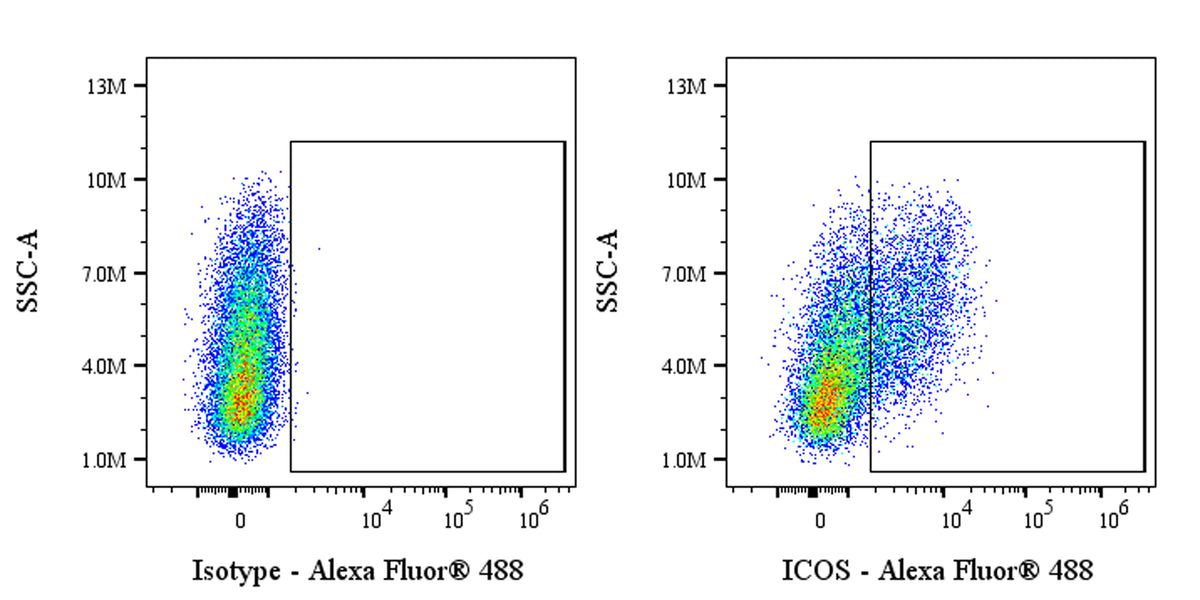
Flow cytometric analysis of ICOS expression on stimulated Mouse splenocytes. C57BL/6 Mouse splenocytes were stimulated 48 hours with 2.5 μg/ml Concanavalin A and then stained with Alexa Fluor® 488 Mouse IgG2b, κ Isotype Control (left panel) or SDT Alexa Fluor® 488 Rat Anti-Mouse ICOS Antibody at 2 μl/test. Flow cytometry and data analysis were performed using Agilent NovoCyte Quanteon and FlowJo™ software.
Alexa Fluor® 488 Rat Anti-Mouse ICOS Antibody (7E.17G9)
Alexa Fluor® 488 Rat Anti-Mouse ICOS Antibody (7E.17G9)
Price:
Regular price
$145 USD
Regular price
Sale price
$145 USD
Unit price
per
For shipping services or bulk orders, you may request a quotation.
Secure checkout with

View full details
Product Details
Product Details
Product Specification
| Host | Rat |
| Antigen | ICOS |
| Synonyms | Inducible T-cell costimulator; Activation-inducible lymphocyte immunomediatory molecule; CD28 and CTLA-4-like protein (CCLP); CD28-related protein 1 (CRP-1); CD278; Ailim; Icos |
| Location | Cell membrane |
| Accession | Q9WVS0 |
| Clone Number | 7E.17G9 |
| Antibody Type | Rat mAb |
| Isotype | IgG2b,k |
| Isotype Control | S0B5536 |
| Application | FCM |
| Reactivity | Ms |
| Positive Sample | ConA treated with C57BL/6 mouse splenocytes |
| Purification | Protein G |
| Concentration | 0.5 mg/ml |
| Conjugation | Alexa Fluor® 488 |
| Physical Appearance | Liquid |
| Storage Buffer | PBS, 1% BSA, 0.09% sodium azide |
| Stability & Storage | 12 months from date of receipt / reconstitution, 2 to 8 °C as supplied |
Dilution
| application | dilution | species |
| FCM | 1μg per million cells in 100μl volume | Ms |
Background
ICOS (inducible T-cell costimulator, CD278) is a 55–60 kDa disulfide-linked homodimeric CD28-superfamily receptor expressed mainly on activated CD4⁺ and CD8⁺ T cells, Th17, Tfh and some NK subsets; its surface engagement by the ligand ICOSL (B7-H2/CD275) on antigen-presenting cells delivers a critical secondary signal that amplifies PI3K–AKT–mTOR and MAPK cascades, enhances cytokine transcription (IL-4, IL-10, IL-17, IL-21, IFN-γ), stabilizes Tfh differentiation, germinal-center reactions and class-switch recombination, and promotes memory formation, whereas genetic loss or therapeutic blockade of ICOS attenuates autoimmune pathology in experimental allergic encephalomyelitis, lupus, colitis and graft-versus-host disease yet can dampen antitumor immunity, making the pathway a finely balanced target for both immunosuppressive and immunostimulatory clinical interventions.
Picture
Picture
FC