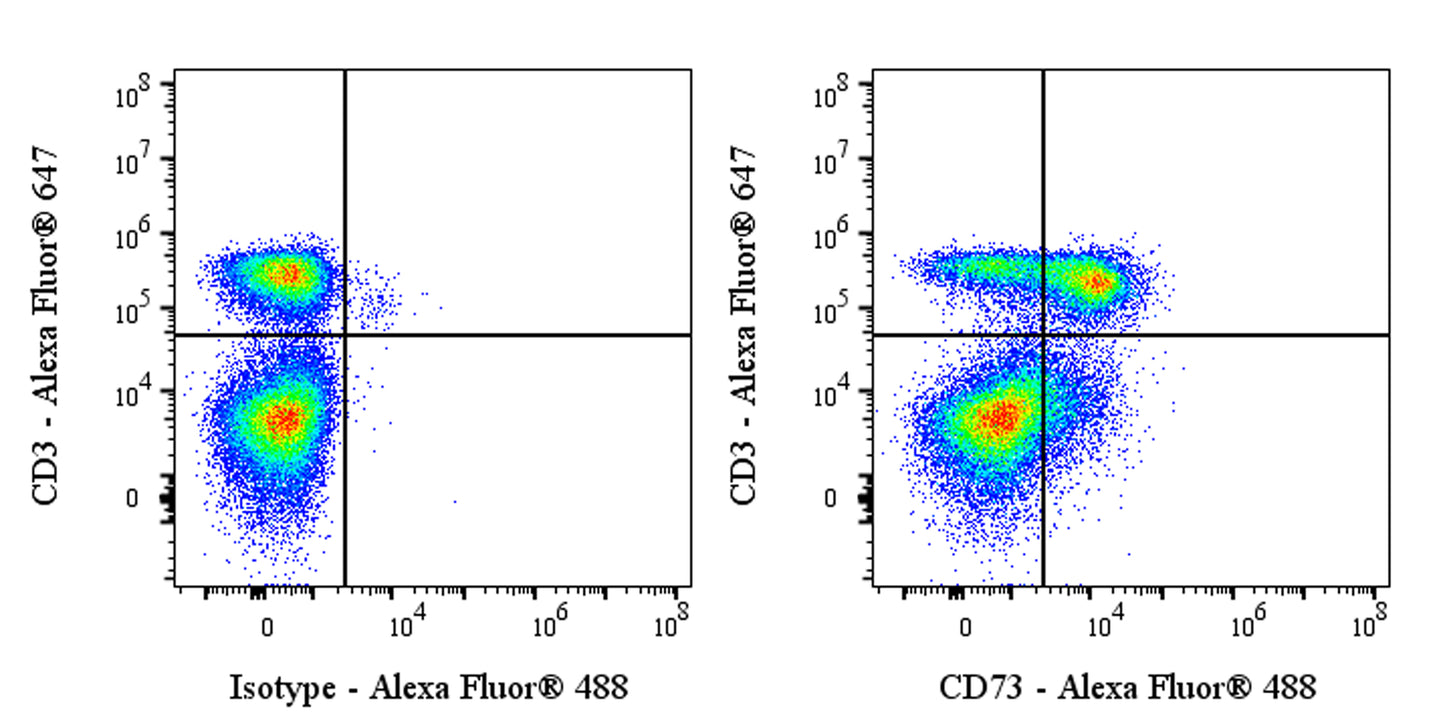
Flow cytometric analysis of Mouse CD73 expression on C57BL/6 mouse splenocytes. C57BL/6 mouse splenocytes were stained with Alexa Fluor® 647 Rat Anti-Mouse CD3 Antibody and either Alexa Fluor® 488 Rat IgG1, k Isotype Control (left panel) or SDT Alexa Fluor® 488 Rat Anti-Mouse CD73 Antibody (right panel) at 2 μl/test. Flow cytometry and data analysis were performed using Agilent NovoCyte Quanteon and FlowJo™ software.
Alexa Fluor® 488 Rat Anti-Mouse CD73 Antibody (S-R636)
Alexa Fluor® 488 Rat Anti-Mouse CD73 Antibody (S-R636)
Price:
Regular price
$70 USD
Regular price
Sale price
$70 USD
Unit price
per
For shipping services or bulk orders, you may request a quotation.
Secure checkout with

View full details
Product Details
Product Details
Product Specification
| Host | Rat |
| Antigen | CD73 |
| Synonyms | 5'-nucleotidase; 5'-deoxynucleotidase; Ecto-5'-nucleotidase; IMP-specific 5'-nucleotidase; Thymidylate 5'-phosphatase; Nt5; Nte; Nt5e |
| Location | Cell membrane |
| Accession | Q61503 |
| Clone Number | S-R636 |
| Antibody Type | Rat mAb |
| Isotype | IgG1,k |
| Positive Sample | C57BL/6 mouse splenocytes |
| Purification | Protein G |
| Concentration | 0.5 mg/ml |
| Conjugation | Alexa Fluor® 488 |
| Physical Appearance | Liquid |
| Storage Buffer | PBS, 1% BSA, 0.09% sodium azide |
| Stability & Storage | 12 months from date of receipt / reconstitution, 2 to 8 °C as supplied |
Dilution
| application | dilution | species |
| FCM | 1μg per million cells in 100μl volume | Ms |
Background
CD73 protein, also known as ecto-5′-nucleotidase, is a glycosylphosphatidylinositol (GPI)-anchored cell surface enzyme that catalyzes the hydrolysis of adenosine monophosphate (AMP) to adenosine (ADO). This enzyme plays a crucial role in the suppression of anti-tumor immune responses and promotes tumor progression by generating immunosuppressive adenosine. CD73 is widely expressed in various cell types, including lymphocytes, endothelial cells, epithelial cells, fibroblasts, and neural glial cells, and its expression is significantly influenced by hypoxia and inflammatory factors. During inflammation, CD73 protects endothelial barrier function and inhibits leukocyte trafficking, while also promoting the development of M2 macrophages, which have an anti-inflammatory phenotype. In cancer, CD73 is overexpressed in many tumors and is associated with tumor growth, metastasis, angiogenesis, poor prognosis, and resistance to chemotherapy, making it a promising prognostic indicator and therapeutic target. Additionally, CD73 can function as a cell adhesion molecule and a receptor for extracellular matrix molecules, playing roles in epithelial ion exchange, liquid transport, and tissue barrier maintenance.
Picture
Picture
FC