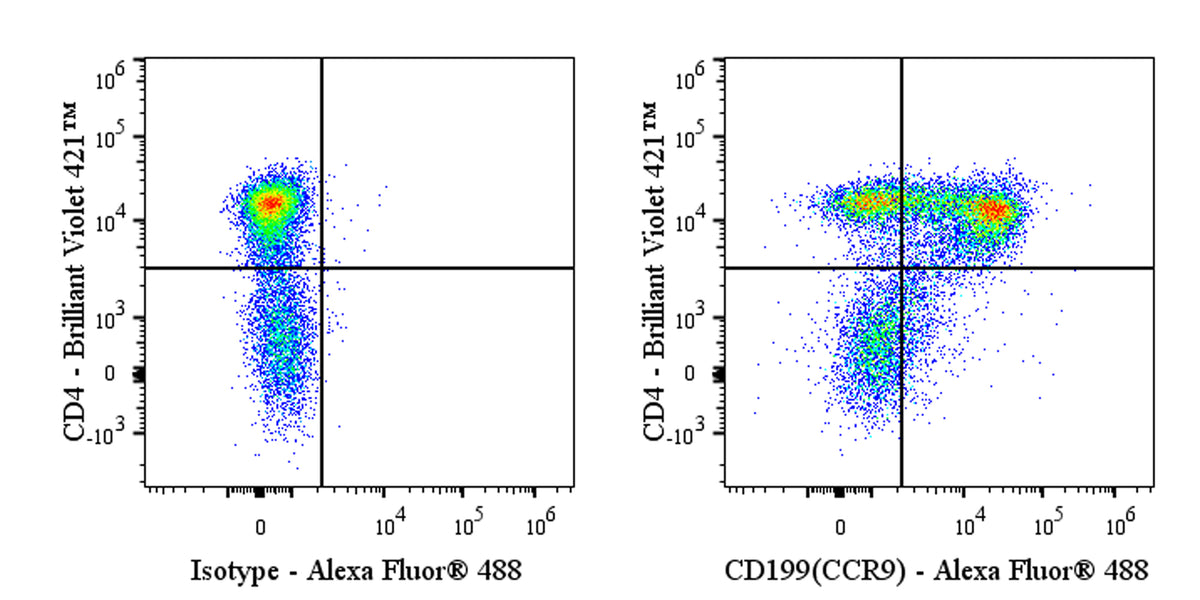
Flow cytometric analysis of mouse CD199 expression on BALB/c mouse thymocytes. BALB/c mouse thymocytes were stained with Brilliant Violet 421™ Rat Anti-Mouse CD4 and either Alexa Fluor® 488 Rat IgG2a, k Isotype Control (left panel) or SDT Alexa Fluor® 488 Rat Anti-Mouse CD199 Antibody (right panel) at 2 μl/test. Flow cytometry and data analysis were performed using BD FACSymphony™ A1 and FlowJo™ software.
Alexa Fluor® 488 Rat Anti-Mouse CD199 (CCR9) Antibody (9B1)
Alexa Fluor® 488 Rat Anti-Mouse CD199 (CCR9) Antibody (9B1)
Price:
Regular price
$120 USD
Regular price
Sale price
$120 USD
Unit price
per
For shipping services or bulk orders, you may request a quotation.
Secure checkout with

View full details
Product Details
Product Details
Product Specification
| Host | Rat |
| Antigen | CD199 |
| Synonyms | C-C chemokine receptor type 9; C-C CKR-9; CC-CKR-9; CCR-9; Chemokine C-C receptor 10; CDw199; Cmkbr10; Ccr9 |
| Location | Cell membrane |
| Accession | Q9WUT7 |
| Clone Number | 9B1 |
| Antibody Type | Rat mAb |
| Isotype | IgG2a,k |
| Application | FCM |
| Reactivity | Ms |
| Positive Sample | BALB/c mouse thymocytes |
| Purification | Protein G |
| Concentration | 0.5 mg/ml |
| Conjugation | Alexa Fluor® 488 |
| Physical Appearance | Liquid |
| Storage Buffer | PBS, 1% BSA, 0.09% sodium azide |
| Stability & Storage | 12 months from date of receipt / reconstitution, 2 to 8 °C as supplied |
Dilution
| application | dilution | species |
| FCM | 1μg per million cells in 100μl volume | Ms |
Background
CD199, also known as CCR9, is a member of the G protein-coupled receptor (GPCR) family and functions as a chemokine receptor. It is a ~42 kDa seven-transmembrane protein primarily involved in T cell development in the thymus and gut-associated immune responses. CCR9 is expressed on T lymphocytes and is upregulated in response to retinoic acid, which is produced by dendritic cells, facilitating the migration of T cells to gut-associated tissues. Its specific ligand is CCL25 (TECK), and the interaction between CCR9 and CCL25 plays a crucial role in the recruitment and maturation of thymocytes. Additionally, CCR9 is differentially expressed in T lymphocytes of the small intestine and colon, suggesting its involvement in specialized immune responses within the gastrointestinal tract.
Picture
Picture
FC