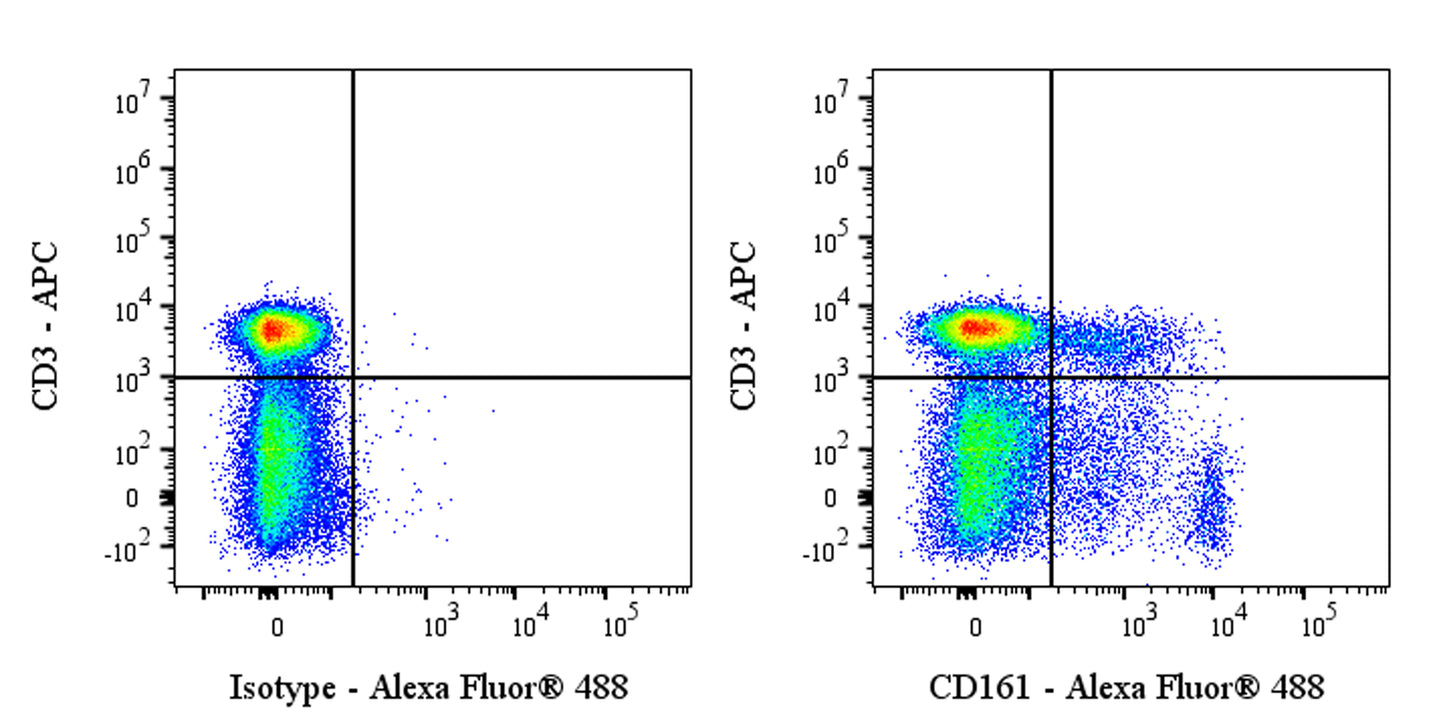
Flow cytometric analysis of rat CD161 expression on SD rat splenocytes. SD rat splenocytes were stained with APC Mouse Anti-Rat CD3 Antibody and either Alexa Fluor® 488 Mouse IgG1, κ Isotype Control (left panel) or SDT Alexa Fluor® 488 Mouse Anti-Rat CD161 Antibody (right panel) at 2 μl/test. Flow cytometry and data analysis were performed using BD FACSymphony™ A1 and FlowJo™ software.
Alexa Fluor® 488 Mouse Anti-Rat CD161 Antibody (S-R628)
Alexa Fluor® 488 Mouse Anti-Rat CD161 Antibody (S-R628)
Price:
Regular price
$100 USD
Regular price
Sale price
$100 USD
Unit price
per
For shipping services or bulk orders, you may request a quotation.
Secure checkout with

View full details
Product Details
Product Details
Product Specification
| Host | Mouse |
| Antigen | CD161 |
| Synonyms | Killer cell lectin-like receptor subfamily B member 1A; Antigen 3.2.3; CD161 antigen-like family member A; Natural killer cell surface protein P1-3.2.3 (NKR-P1 3.2.3); CD161a; Nkrp1a; Klrb1a |
| Location | Membrane |
| Accession | P27471 |
| Clone Number | S-R628 |
| Antibody Type | Mouse mAb |
| Isotype | IgG1,k |
| Application | FCM |
| Reactivity | Rt |
| Positive Sample | SD rat splenocytes |
| Purification | Protein G |
| Concentration | 0.5 mg/ml |
| Conjugation | Alexa Fluor® 488 |
| Physical Appearance | Liquid |
| Storage Buffer | PBS, 1% BSA, 0.3% Proclin 300 |
| Stability & Storage | 12 months from date of receipt / reconstitution, 2 to 8 °C as supplied |
Dilution
| application | dilution | species |
| FCM | 1μg per million cells in 100μl volume | Rt |
Background
CD161, also known as KLRB1 or NKRP1A, is a C-type lectin-like receptor primarily expressed on the surface of natural killer (NK) cells and a subset of T cells, including mucosal-associated invariant T (MAIT) cells and some CD8+ T cells. It is particularly enriched in immune cells located in mucosal sites such as the gut and liver. CD161 binds to its ligand, lectin-like transcript 1 (LLT1, also known as CLEC2D), and this interaction can have both inhibitory and costimulatory effects on immune cells. In the context of cancer immunotherapy, CD161 has been identified as a potential inhibitory receptor in glioma-infiltrating T cells. Its activation by CLEC2D on tumor or immunosuppressive cells can dampen T cell responses against cancer cells. Recent studies suggest that blocking the CD161-CLEC2D interaction may enhance T cell-mediated antitumor activity, making CD161 a promising target for cancer immunotherapy.
Picture
Picture
FC