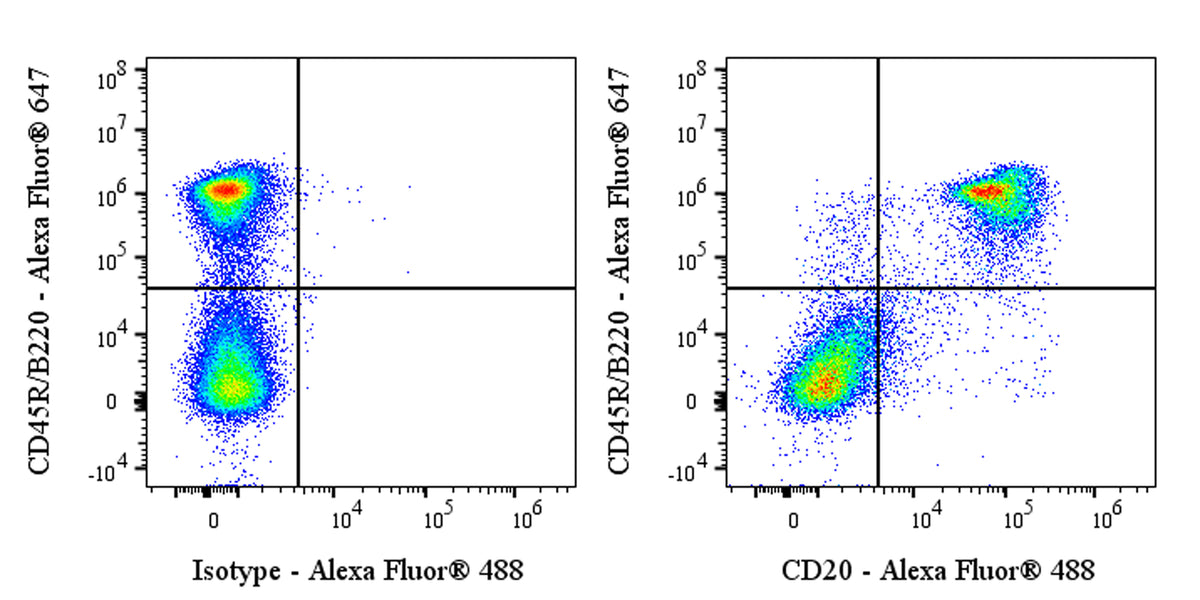
Flow cytometric analysis of mouse CD20 expression on C57BL/6 mouse splenocytes. C57BL/6 mouse splenocytes were stained with Alexa Fluor® 647 Rat Anti-Human/Mouse CD45R/B220 Antibody and either Alexa Fluor® 488 Mouse IgG2c, κ Isotype Control (left panel) or SDT Alexa Fluor® 488 Mouse Anti-Mouse CD20 Antibody (right panel) at 0.5μl/test. Total viable cells, as determined by Fixable Viability Dye 452 (S0D0021), were used for analysis. Flow cytometry and data analysis were performed using BD FACSymphony™ A1 and FlowJo™ software.
Alexa Fluor® 488 Mouse Anti-Mouse CD20 Antibody (S-3682)
Alexa Fluor® 488 Mouse Anti-Mouse CD20 Antibody (S-3682)
Price:
Regular price
$85 USD
Regular price
Sale price
$85 USD
Unit price
per
For shipping services or bulk orders, you may request a quotation.
Secure checkout with

View full details
Product Details
Product Details
Product Specification
| Host | Mouse |
| Antigen | CD20 |
| Synonyms | B-lymphocyte antigen CD20; B-cell differentiation antigen Ly-44; Lymphocyte antigen 44; Membrane-spanning 4-domains subfamily A member 1; Ly-44; Ms4a2; Ms4a1 |
| Location | Cell membrane |
| Accession | P19437 |
| Clone Number | S-3682 |
| Antibody Type | Mouse mAb |
| Isotype | IgG2c,k |
| Application | FCM |
| Reactivity | Ms |
| Positive Sample | C57BL/6 mouse splenocytes |
| Purification | Protein A |
| Concentration | 0.5 mg/ml |
| Conjugation | Alexa Fluor® 488 |
| Physical Appearance | Liquid |
| Storage Buffer | PBS, 1% BSA, 0.3% Proclin 300 |
| Stability & Storage | 12 months from date of receipt / reconstitution, 2 to 8 °C as supplied |
Dilution
| application | dilution | species |
| FCM | 0.25μg per million cells in 100μl volume | Ms |
Background
CD20 is a 33-37 kDa non-glycosylated phosphoprotein expressed on the surface of B cells from the pre-B cell stage through maturity, but absent on plasma cells. It belongs to the MS4A protein family and has four transmembrane domains, one intracellular domain, and two extracellular loops. CD20 is believed to facilitate calcium influx, which is essential for B cell activation and proliferation. Although its exact biological function is not fully elucidated, studies suggest it plays a role in B cell receptor signaling and may act as a calcium channel. CD20 is a key therapeutic target for B cell malignancies and autoimmune diseases, as it is expressed on various B cell cancers and its targeting can induce cell death through mechanisms like complement-dependent cytotoxicity and antibody-dependent cellular cytotoxicity.
Picture
Picture
FC