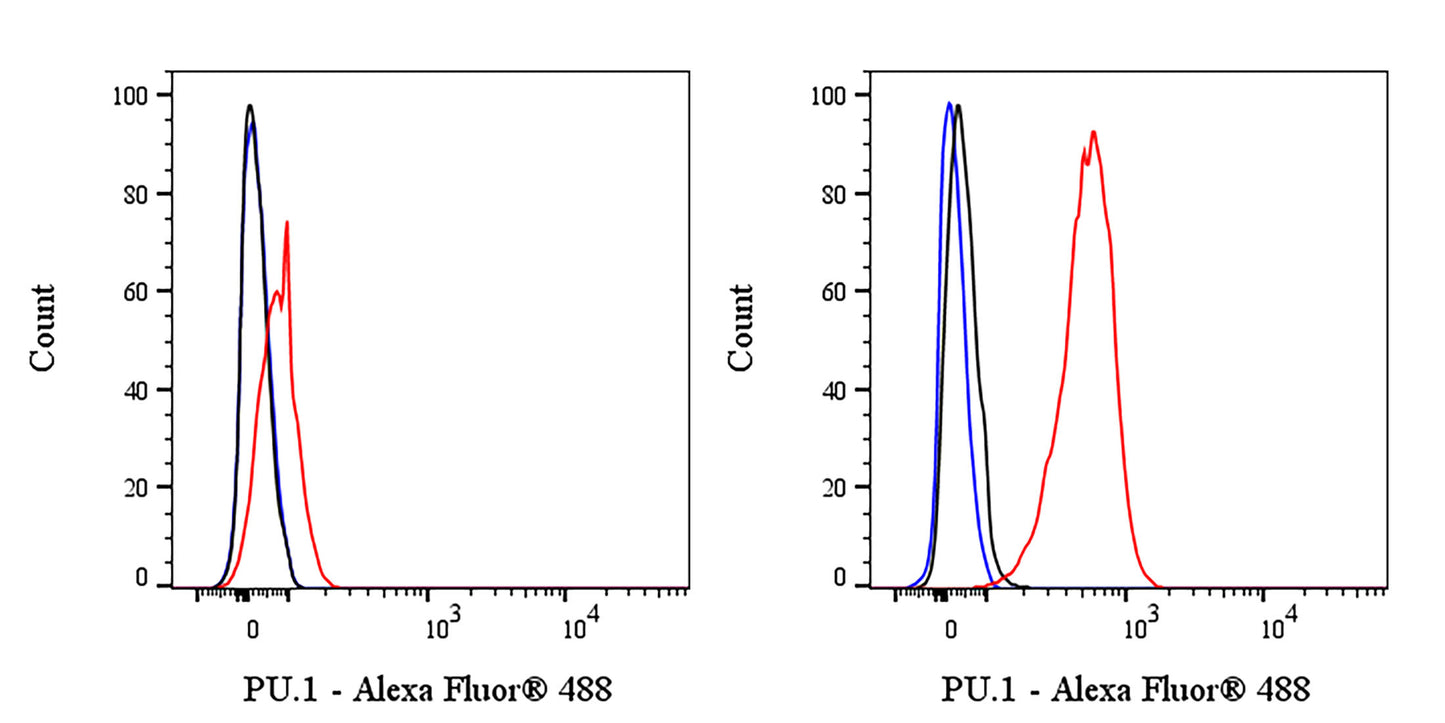
Flow cytometric analysis of 4% PFA fixed 90% methanol permeabilized THP-1(human monocytic leukemia monocyte, right) or HeLa (Human cervix adenocarcinoma epithelial cell, left) labelling SDT Alexa Fluor® 488 Mouse Anti-Human PU.1 Antibody (red line histogram) at 5 μl/test compared with Alexa Fluor® 488 Mouse IgG2a Isotype Control (black line histogram), cells without incubation with primary antibody and secondary antibody (blue line histogram) was used as unlabeled control. Flow cytometry and data analysis were performed using BD FACSymphony™ A1 and FlowJo™ software.
Alexa Fluor® 488 Mouse Anti-Human PU.1 Antibody (S-4307)
Alexa Fluor® 488 Mouse Anti-Human PU.1 Antibody (S-4307)
Price:
Regular price
$100 USD
Regular price
Sale price
$100 USD
Unit price
per
For shipping services or bulk orders, you may request a quotation.
Secure checkout with

View full details
Product Details
Product Details
Product Specification
| Host | Mouse |
| Antigen | PU.1 |
| Synonyms | Transcription factor PU.1; SPI1 |
| Location | Nucleus |
| Accession | P17947 |
| Clone Number | S-4307 |
| Antibody Type | Mouse mAb |
| Isotype | IgG2a |
| Isotype Control | S0B8029 |
| Application | ICFCM |
| Reactivity | Hu |
| Purification | Protein A |
| Concentration | 0.2 mg/ml |
| Conjugation | Alexa Fluor® 488 |
| Physical Appearance | Liquid |
| Storage Buffer | PBS, 1% BSA, 0.3% Proclin 300 |
| Stability & Storage | 12 months from date of receipt / reconstitution, 2 to 8 °C as supplied |
Dilution
| application | dilution | species |
| ICFCM | 5μl per million cells in 100μl volume | Hu |
Background
PU.1, also known as SPI1 (Spleen Focus Forming Virus Proviral Integration Oncogene), is a critical ETS-family transcription factor that serves as a master regulator of hematopoiesis, specifically governing the development, differentiation, and functional maturation of myeloid lineages (including monocytes, macrophages, and granulocytes) and B lymphocytes. Functioning by binding to specific purine-rich DNA sequences via its highly conserved ETS domain, PU.1 orchestrates complex gene regulatory networks by recruiting co-activators or co-repressors to control the expression of hundreds of target genes essential for immune cell identity, such as those encoding cytokine receptors, signaling molecules, and lineage-specific enzymes; its activity is tightly dosage-dependent, where precise expression levels determine cell fate decisions, with high levels promoting macrophage differentiation and lower levels favoring B-cell development, while its dysregulation, mutation, or aberrant overexpression is strongly implicated in various hematological malignancies, particularly acute myeloid leukemia (AML) and certain types of lymphoma, making it a pivotal molecule for understanding both normal immune system architecture and leukemogenesis.
Picture
Picture
FC