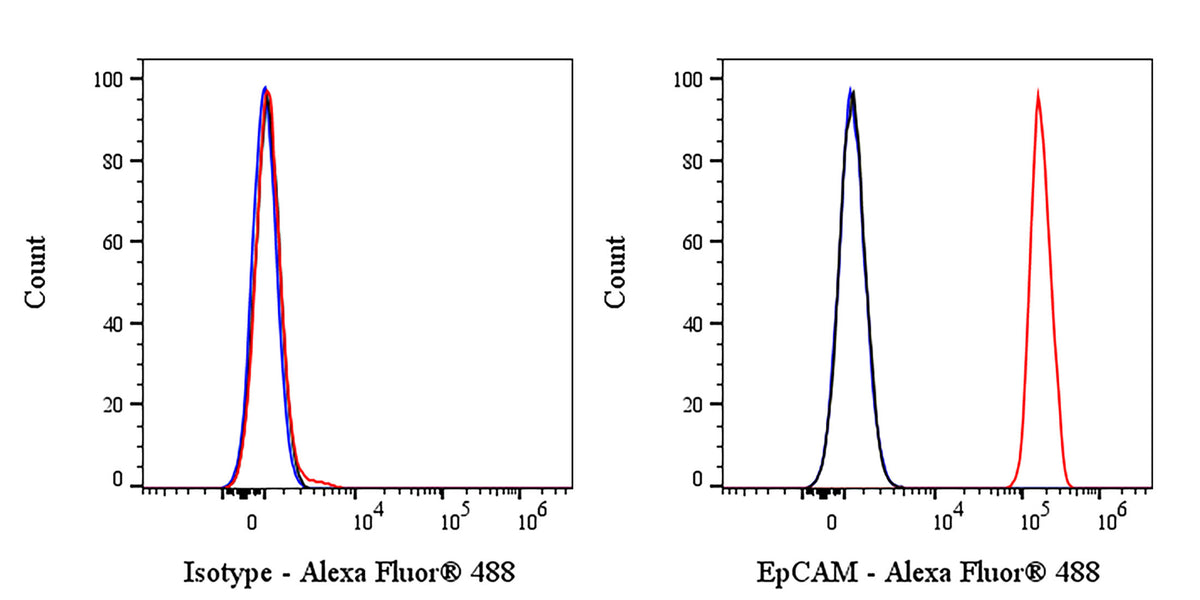
Flow cytometric analysis of Human EpCAM expression on HT-29 cells. Cells from the HT-29 (Human colorectal adenocarcinoma epithelial cell, right) or Sp2/0-Ag14 (Mouse hybridoma, left) were stained with Alexa Fluor® 488 Mouse IgG2b Isotype Control (black line histogram) or SDT Alexa Fluor® 488 Mouse Anti-Human EpCAM Antibody (red line histogram) at 2 μl/test followed by Sav-iFluor 488, cells without incubation with primary antibody and secondary antibody (blue line histogram) were used as unlabeled control. Flow cytometry and data analysis were performed using Agilent NovoCyte Quanteon and FlowJo™ software.
Alexa Fluor® 488 Mouse Anti-Human EpCAM Antibody (S-R464)
Alexa Fluor® 488 Mouse Anti-Human EpCAM Antibody (S-R464)
Price:
Regular price
$185 USD
Regular price
Sale price
$185 USD
Unit price
per
For shipping services or bulk orders, you may request a quotation.
Secure checkout with

View full details
Product Details
Product Details
Product Specification
| Host | Mouse |
| Antigen | EpCAM |
| Synonyms | Epithelial cell adhesion molecule; Ep-CAM; Adenocarcinoma-associated antigen; Cell surface glycoprotein Trop-1; Epithelial cell surface antigen; Epithelial glycoprotein (EGP); Epithelial glycoprotein 314 (EGP314; hEGP314); CD326; GA733-2; M1S2; M4S1; MIC18; TACSTD1; TROP1; EPCAM |
| Location | Cell membrane |
| Accession | P16422 |
| Clone Number | S-R464 |
| Antibody Type | Mouse mAb |
| Isotype | IgG2b |
| Isotype Control | S0B1580 |
| Application | FCM |
| Reactivity | Hu |
| Positive Sample | HT-29 |
| Purification | Protein A |
| Concentration | 0.1 mg/ml |
| Conjugation | Alexa Fluor® 488 |
| Physical Appearance | Liquid |
| Storage Buffer | PBS, 1% BSA, 0.09% sodium azide |
| Stability & Storage | 12 months from date of receipt / reconstitution, 2 to 8 °C as supplied |
Dilution
| application | dilution | species |
| FCM | 2μl per million cells in 100μl volume | Hu |
Background
EpCAM (epithelial cell adhesion molecule, CD326) is a 35–40 kDa type-I transmembrane glycoprotein expressed on most epithelia, where it first assembles into cis-dimers that further cluster into tetramers to support homotypic cell–cell contacts, and then—through sequential proteolytic cleavage—releases its intracellular domain (EpICD) that partners with β-catenin, FHL2 and LEF1 to enter the nucleus and drive Wnt-dependent transcription of genes controlling proliferation, stemness and epithelial-to-mesenchymal transition, thereby functioning not merely as an adhesion molecule but as a dynamic signaling hub that is highly up-regulated in most carcinomas, marks circulating tumor and cancer stem cells, and serves as both a prognostic biomarker and a therapeutic target while mutations that truncate or mis-localize the protein underlie the severe congenital diarrhea disorder tufting enteropathy.
Picture
Picture
FC