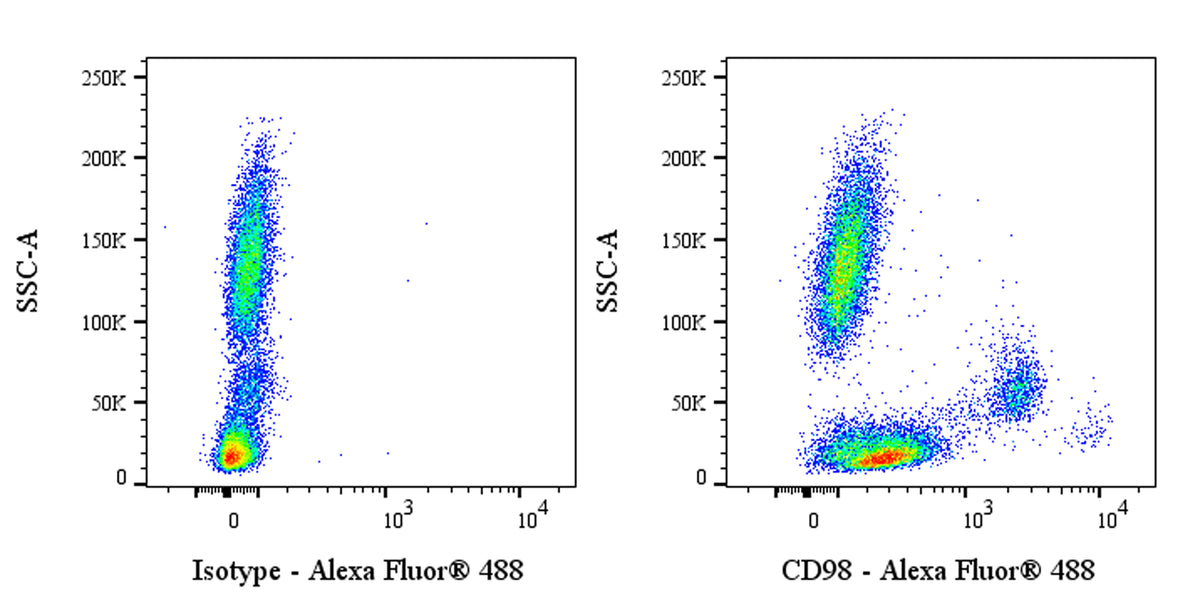
Flow cytometric analysis of Human CD81 expression on human peripheral blood cells. Human peripheral blood cells were stained with either Alexa Fluor® 488 Mouse IgG1, κ Isotype Control (left panel) or SDT Alexa Fluor® 488 Mouse Anti-Human CD98 Antibody (right panel) at 5 μl/test. Flow cytometry and data analysis were performed using BD FACSymphony™ A1 and FlowJo™ software.
Alexa Fluor® 488 Mouse Anti-Human CD98 Antibody (S-5622)
Alexa Fluor® 488 Mouse Anti-Human CD98 Antibody (S-5622)
Price:
Regular price
$130 USD
Regular price
Sale price
$130 USD
Unit price
per
For shipping services or bulk orders, you may request a quotation.
Secure checkout with

View full details
Product Details
Product Details
Product Specification
| Host | Mouse |
| Antigen | CD98 |
| Synonyms | Amino acid transporter heavy chain SLC3A2; 4F2 cell-surface antigen heavy chain (4F2hc); 4F2 heavy chain antigen; Lymphocyte activation antigen 4F2 large subunit; Solute carrier family 3 member 2; MDU1; SLC3A2 |
| Location | Cell membrane |
| Accession | P08195 |
| Clone Number | S-5622 |
| Antibody Type | Mouse mAb |
| Isotype Control | S0B1519 |
| Application | FCM |
| Reactivity | Hu |
| Positive Sample | Human peripheral blood cells |
| Purification | Protein A |
| Concentration | 0.2 mg/ml |
| Conjugation | Alexa Fluor® 488 |
| Physical Appearance | Liquid |
| Storage Buffer | PBS, 1% BSA, 0.09% sodium azide |
| Stability & Storage | 12 months from date of receipt / reconstitution, 2 to 8 °C as supplied |
Dilution
| application | dilution | species |
| FCM | 5μl per million cells in 100μl volume | Hu |
Background
CD98 (also known as 4F2 heavy chain or SLC3A2) is a widely expressed type II transmembrane glycoprotein that forms a heterodimeric complex through a disulfide bond between a heavy chain (approximately 80–85 kDa) and various light chains (approximately 40 kDa). The heavy chain itself lacks transport activity; instead, it acts as a chaperone that guides amino acid transporter light chains such as LAT1, LAT2, and xCT from the endoplasmic reticulum to the cell membrane, thereby conferring amino acid transport functions such as System L. Beyond amino acid transport, the CD98 heavy chain also directly binds to the cytoplasmic domain of β1 integrin through its intracellular region, amplifying integrin signaling and thereby regulating cell proliferation, survival, and adhesion. In the immune system, CD98 is essential for lymphocyte clonal expansion, and its deficiency significantly impairs adaptive immune responses. CD98 is highly expressed in a variety of tumors, where it promotes tumor progression by sustaining tumor metabolic demands and integrin-dependent anchorage-independent growth, making it a potential target for cancer immunotherapy; antibody drugs and CAR-T cell therapies targeting it are currently under development.
Picture
Picture
FC