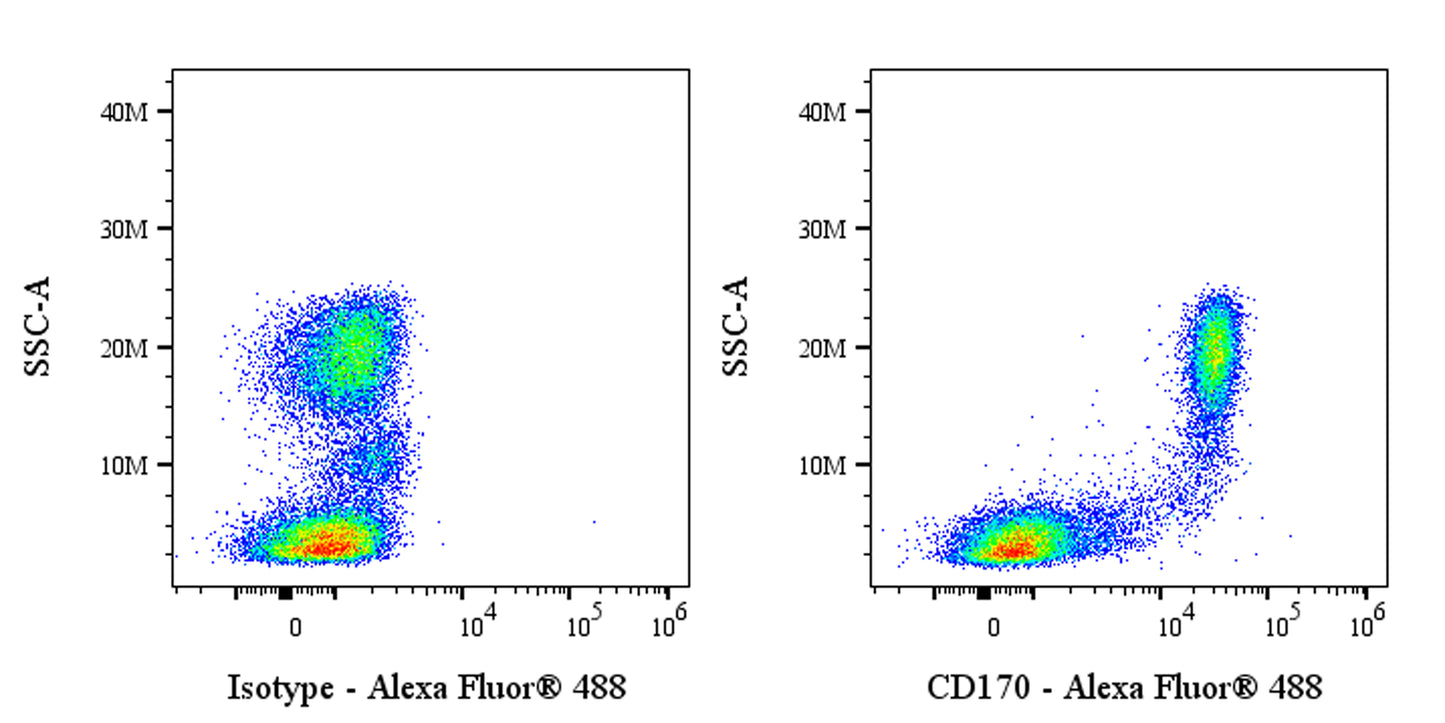
Flow cytometric analysis of CD170 expression on human peripheral blood cells. Human peripheral blood cells were stained with either Alexa Fluor® 488 IgG1, k Isotype Control (left panel) or SDT Alexa Fluor® 488 Mouse Anti-Human CD170 Antibody (right panel) at 5 μl/test. Flow cytometry and data analysis were performed using Agilent NovoCyte Quanteon and FlowJo™ software.
Alexa Fluor® 488 Mouse Anti-Human CD170 (Siglec-5) Antibody (S-4097)
Alexa Fluor® 488 Mouse Anti-Human CD170 (Siglec-5) Antibody (S-4097)
Price:
Regular price
$85 USD
Regular price
Sale price
$85 USD
Unit price
per
For shipping services or bulk orders, you may request a quotation.
Secure checkout with

View full details
Product Details
Product Details
Product Specification
| Host | Mouse |
| Antigen | CD170 (Siglec-5) |
| Synonyms | Sialic acid-binding Ig-like lectin 5; CD33 antigen-like 2; Obesity-binding protein 2 (OB-BP2; OB-binding protein 2); CD33L2; OBBP2; SIGLEC5 |
| Location | Membrane |
| Accession | O15389 |
| Clone Number | S-4097 |
| Isotype | IgG1,k |
| Application | FCM |
| Reactivity | Hu |
| Positive Sample | Human Peripheral Blood cells |
| Purification | Protein G |
| Concentration | 0.2 mg/ml |
| Conjugation | Alexa Fluor® 488 |
| Physical Appearance | Liquid |
| Storage Buffer | PBS, 1% BSA, 0.09% sodium azide |
| Stability & Storage | 12 months from date of receipt / reconstitution, 2 to 8 °C as supplied |
Dilution
| application | dilution | species |
| FCM | 5μl per million cells in 100μl volume | Hu |
Background
CD170 protein, also known as sialic acid-binding immunoglobulin-like lectin-5 (Siglec-5), is a type I transmembrane inhibitory receptor primarily expressed on myeloid cells (such as monocytes, macrophages, and neutrophils) and some B cells. It belongs to the immunoglobulin superfamily and the Siglec family. Its extracellular region contains an immunoglobulin-like domain that specifically recognizes and binds to sialylated glycans (commonly found on host cell surfaces), while its intracellular region contains an immunoreceptor tyrosine-based inhibitory motif (ITIM). Upon binding to sialylated self-ligands, the ITIM domain of CD170 becomes phosphorylated, recruiting and activating SH2 domain-containing protein tyrosine phosphatases (e.g., SHP-1/SHP-2), thereby transmitting potent inhibitory signals that negatively regulate the activation of myeloid cells, the production of inflammatory cytokines, and phagocytic functions. This mechanism plays a critical role in maintaining immune homeostasis and preventing excessive inflammatory responses against self-tissues. In pathological conditions, certain pathogens or tumor cells can evade immune surveillance by engaging CD170 through "molecular mimicry" or "decoy" mechanisms using surface sialylated glycans, thereby promoting persistent infection or tumor progression. Thus, CD170 is not only a key regulator of immune self-tolerance but also a potential target for infection immunotherapy and cancer immunotherapy. Modulating its function—for example, using monoclonal antibodies for blockade or agonism—may offer novel therapeutic strategies for autoimmune diseases, chronic inflammation, and cancer.
Picture
Picture
FC