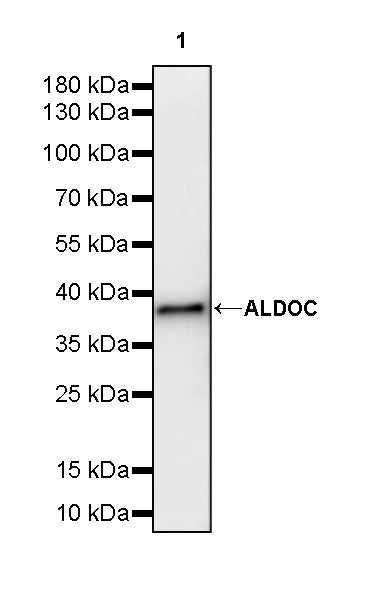
WB result of ALDOC Rabbit pAb
Primary antibody: ALDOC Rabbit pAb at 1/1000 dilution
Lane 1: A549 whole cell lysate 20 µg
Lane 2: PANC-1 whole cell lysate 20 µg
Lane 3: Raji whole cell lysate 20 µg
Lane 4: RPMI-8226 whole cell lysate 20 µg
Lane 5: U-87 MG whole cell lysate 20 µg
Low expression control: A549 whole cell lysate; PANC-1 whole cell lysate
Secondary antibody: Goat Anti- rabbit IgG, (H+L), HRP conjugated at 1/10000 dilution
Predicted MW: 39 kDa
Observed MW: 39 kDa
ALDOC Rabbit Polyclonal Antibody
ALDOC Rabbit Polyclonal Antibody
Price:
Regular price
$100 USD
Regular price
Sale price
$100 USD
Unit price
per
For shipping services or bulk orders, you may request a quotation.
Secure checkout with

View full details
Product Details
Product Details
Product Specification
| Host | Rabbit |
| Antigen | ALDOC |
| Synonyms | Fructose-bisphosphate aldolase C; ALDC |
| Immunogen | Synthetic Peptide |
| Location | Cytoskeleton |
| Accession | P09972 |
| Antibody Type | Polyclonal antibody |
| Isotype | IgG |
| Application | WB |
| Reactivity | Hu, Ms, Rt |
| Positive Sample | PANC-1, Raji, RPMI-8226, U-87 MG, COS-7 |
| Purification | Immunogen Affinity |
| Concentration | 0.5 mg/ml |
| Conjugation | Unconjugated |
| Physical Appearance | Liquid |
| Storage Buffer | PBS, 40% Glycerol, 0.05% BSA, 0.02% sodium azide |
| Stability & Storage | 12 months from date of receipt / reconstitution, -20 °C as supplied |
Dilution
| application | dilution | species |
| WB | 1:1000-1:5000 | Hu, Ms, Rt |
Background
ALDOC (Aldolase C, also known as fructose-bisphosphate aldolase C) is a key isozyme in the glycolytic metabolic pathway, specifically and highly expressed in neurons of the central nervous system. As an important member of the class I aldolase family, this protein reversibly catalyzes the cleavage of fructose-1,6-bisphosphate into dihydroxyacetone phosphate and glyceraldehyde-3-phosphate—a reaction that plays a central role not only in glucose breakdown for energy production but also in gluconeogenesis. Distinguished from ALDOA, which is highly expressed in muscle, and ALDOB, which is highly expressed in the liver, ALDOC is predominantly enriched in brain tissue. Its functions extend beyond classical metabolic pathways, with growing evidence indicating that it also possesses non-glycolytic functions related to cytoskeletal dynamics regulation, synaptic vesicle trafficking, and neuronal differentiation. Clinical studies have shown that abnormal expression or dysfunction of ALDOC is closely associated with various neurological disorders, including malignant progression of glioma, metabolic dysregulation in Alzheimer's disease, and neuronal damage following cerebral ischemia, highlighting its value as a key regulator of metabolic balance and cellular homeostasis in the central nervous system, as well as a potential disease biomarker.
Picture
Picture
Western Blot
WB result of ALDOC Rabbit pAb
Primary antibody: ALDOC Rabbit pAb at 1/1000 dilution
Lane 1: mouse cerebellum lysate 20 µg
Lane 2: mouse brain lysate 20 µg
Secondary antibody: Goat Anti- rabbit IgG, (H+L), HRP conjugated at 1/10000 dilution
Predicted MW: 39 kDa
Observed MW: 39 kDa
WB result of ALDOC Rabbit pAb
Primary antibody: ALDOC Rabbit pAb at 1/1000 dilution
Lane 1: rat cerebellum lysate 20 µg
Lane 2: rat brain lysate 20 µg
Secondary antibody: Goat Anti- rabbit IgG, (H+L), HRP conjugated at 1/10000 dilution
Predicted MW: 39 kDa
Observed MW: 39 kDa
WB result of ALDOC Rabbit pAb
Primary antibody: ALDOC Rabbit pAb at 1/1000 dilution
Lane 1: COS-7 whole cell lysate 20 µg
Secondary antibody: Goat Anti- rabbit IgG, (H+L), HRP conjugated at 1/10000 dilution
Predicted MW: 39 kDa
Observed MW: 39 kDa