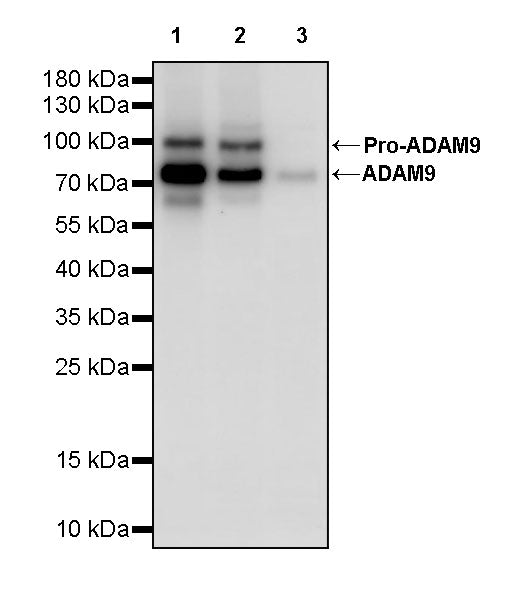
WB result of ADAM9 Recombinant Rabbit mAb
Primary antibody: ADAM9 Recombinant Rabbit mAb at 1/1000 dilution
Lane 1: C2C12 whole cell lysate 20 µg
Lane 2: NIH/3T3 whole cell lysate 20 µg
Lane 3: mouse brain lysate 20 µg
Secondary antibody: Goat Anti- rabbit IgG, (H+L), HRP conjugated at 1/10000 dilution
Predicted MW: 92 kDa
Observed MW: 75, 100 kDa
ADAM9 Recombinant Rabbit mAb (S-3270-251)
ADAM9 Recombinant Rabbit mAb (S-3270-251)
Price:
Regular price
$100 USD
Regular price
Sale price
$100 USD
Unit price
per
For shipping services or bulk orders, you may request a quotation.
Secure checkout with

View full details
Product Details
Product Details
Product Specification
| Host | Rabbit |
| Antigen | ADAM9 |
| Synonyms | Disintegrin and metalloproteinase domain-containing protein 9; Meltrin-gamma; Metalloprotease/disintegrin/cysteine-rich protein 9; Myeloma cell metalloproteinase; Kiaa0021; Mdc9; Mltng; Adam9 |
| Immunogen | Recombinant Protein |
| Location | Cell membrane |
| Accession | Q61072 |
| Clone Number | S-3270-251 |
| Antibody Type | Recombinant mAb |
| Isotype | IgG |
| Application | WB |
| Reactivity | Ms |
| Positive Sample | C2C12, NIH/3T3, mouse brain |
| Purification | Protein A |
| Concentration | 0.5 mg/ml |
| Conjugation | Unconjugated |
| Physical Appearance | Liquid |
| Storage Buffer | PBS, 40% Glycerol, 0.05% BSA, 0.02% sodium azide |
| Stability & Storage | 12 months from date of receipt / reconstitution, -20 °C as supplied |
Dilution
| application | dilution | species |
| WB | 1:1000 | Ms |
Background
ADAM9 (A Disintegrin and Metalloproteinase 9) is a type I transmembrane glycoprotein anchored to the cell membrane, belonging to the zinc-dependent metalloproteinase superfamily. Its structure consists of a signal peptide, a prodomain, a metalloproteinase catalytic domain, a disintegrin domain, a cysteine-rich domain, an epidermal growth factor-like domain, a transmembrane region, and a cytoplasmic tail. As a dual-function molecule possessing both proteolytic and adhesive activities, ADAM9 can, through its metalloproteinase domain, cleave and release a variety of substrates (such as TEK, KDR, EphB4, VCAM1, and CDH5), participating in angiogenesis, inflammation, and extracellular matrix remodeling; simultaneously, through its disintegrin domain, it binds to integrins (such as α6β1 and αvβ5), mediating cell–cell and cell–matrix adhesion and signal transduction, thereby regulating cell migration and motility. In tumor biology, ADAM9 is significantly upregulated in multiple cancer types (including lung cancer, liver cancer, and colorectal cancer), and its high expression is generally associated with poor patient prognosis, enhanced tumor invasion, and therapeutic resistance. Its pro-tumorigenic mechanisms are complex and diverse, including helping tumors evade immune surveillance by cleaving MICA molecules, shaping an immunosuppressive microenvironment by activating the IL6-STAT3 signaling pathway and regulating cholesterol metabolism, as well as driving malignant progression by promoting epithelial–mesenchymal transition (EMT) and cell cycle progression. Although under physiological conditions, ADAM9 knockout mice do not exhibit significant developmental abnormalities, suggesting functional compensation by other ADAM family members, its aberrant activation in tumors has been established as a key driver of tumor invasion and metastasis. Therefore, ADAM9 not only serves as a promising biomarker for malignancies but also represents a highly potential therapeutic target in anticancer drug development, with related targeting strategies being actively explored.
Picture
Picture
Western Blot