WB result of ADA Recombinant Rabbit mAb
Primary antibody: ADA Recombinant Rabbit mAb at 1/2000 dilution
Lane 1: Jurkat whole cell lysate 20 µg
Lane 2: MOLT-4 whole cell lysate 20 µg
Secondary antibody: Goat Anti-rabbit IgG, (H+L), HRP conjugated at 1/10000 dilution
Predicted MW: 41 kDa
Observed MW: 40 kDa
ADA Recombinant Rabbit mAb (S-5470)
ADA Recombinant Rabbit mAb (S-5470)
Price:
Regular price
$100 USD
Regular price
Sale price
$100 USD
Unit price
per
For shipping services or bulk orders, you may request a quotation.
Secure checkout with

View full details
Product Details
Product Details
Product Specification
| Host | Rabbit |
| Antigen | ADA |
| Synonyms | Adenosine deaminase; ADA1 |
| Location | Cytoplasm, Lysosome, Cell membrane |
| Accession | P00813 |
| Clone Number | S-5470 |
| Antibody Type | Recombinant mAb |
| Isotype | IgG |
| Application | WB, IHC-P |
| Reactivity | Hu |
| Positive Sample | Jurkat, MOLT-4 |
| Purification | Protein A |
| Concentration | 0.5 mg/ml |
| Conjugation | Unconjugated |
| Physical Appearance | Liquid |
| Storage Buffer | PBS, 40% Glycerol, 0.05% BSA, 0.02% sodium azide |
| Stability & Storage | 12 months from date of receipt / reconstitution, -20 °C as supplied |
Dilution
| application | dilution | species |
| WB | 1:1000-1:5000 | Hu |
| IHC-P | 1:500 | Hu |
Background
ADA, full name Adenosine Deaminase, is a widely distributed enzyme in the human body that plays a critical role in maintaining immune system function. Its core function is to catalyze the irreversible hydrolytic deamination of adenosine and 2'-deoxyadenosine, producing inosine and ammonia, thereby playing a key role in purine metabolism and the maintenance of adenosine homeostasis. Structurally, human ADA protein consists of 363 amino acids, with its activity dependent on a zinc ion coordinated with a histidine residue in the active site, adopting a classic α/β barrel fold to ensure its stability and catalytic function. The biological significance of ADA protein becomes particularly evident when it is deficient: mutations in its encoding gene can lead to loss of ADA activity, causing deoxyadenosine and its derivative dATP to accumulate in large amounts in lymphocytes (especially T cells), which are toxic to cells and impair DNA synthesis, ultimately resulting in a severe combined immunodeficiency disease known as ADA-SCID. Without treatment, affected infants are typically at risk of life-threatening severe infections during infancy. Because of its central role in the immune system, ADA has become an important drug target—for example, the inhibitor pentostatin has been approved by the FDA for clinical use, and both enzyme replacement therapy and gene therapy for ADA deficiency represent important practices in modern medicine
Picture
Picture
Western Blot
Immunohistochemistry
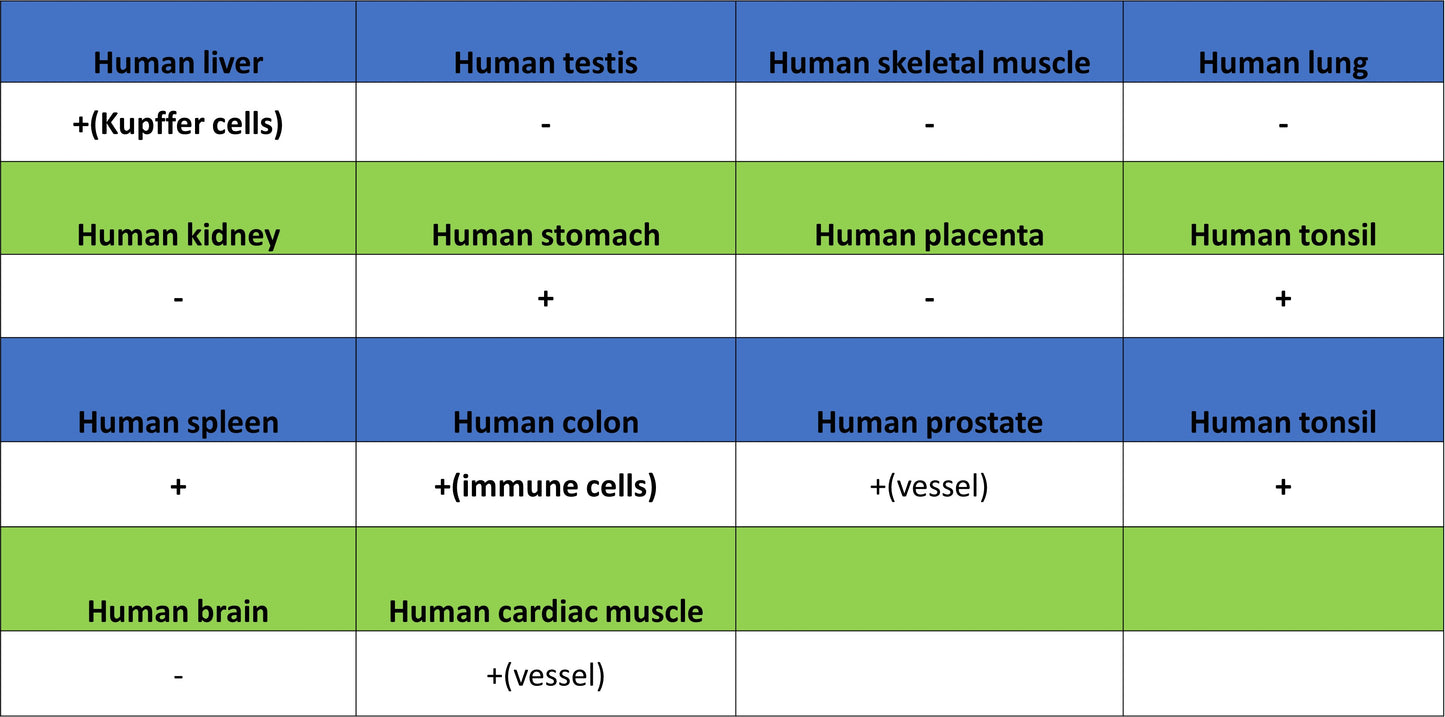
IHC shows positive staining in paraffin-embedded human spleen. Anti-ADA antibody was used at 1/500 dilution, followed by a HRP Polymer for Rabbit IgG (ready to use). Counterstained with hematoxylin. Heat mediated antigen retrieval with Tris/EDTA buffer pH9.0 was performed before commencing with IHC staining protocol.
IHC shows positive staining in paraffin-embedded human stomach. Anti-ADA antibody was used at 1/500 dilution, followed by a HRP Polymer for Rabbit IgG (ready to use). Counterstained with hematoxylin. Heat mediated antigen retrieval with Tris/EDTA buffer pH9.0 was performed before commencing with IHC staining protocol.
IHC shows positive staining in paraffin-embedded human hepatocellular carcinoma. Anti-ADA antibody was used at 1/500 dilution, followed by a HRP Polymer for Rabbit IgG (ready to use). Counterstained with hematoxylin. Heat mediated antigen retrieval with Tris/EDTA buffer pH9.0 was performed before commencing with IHC staining protocol.