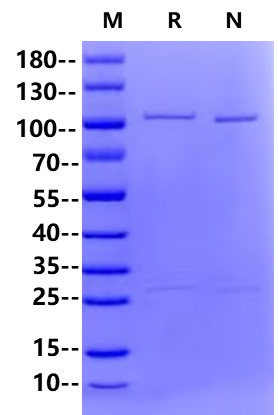
2μg (R: reducing condition, N: non-reducing condition).
ACSL6(46-697) GST Tag Protein, Human
ACSL6(46-697) GST Tag Protein, Human
Price:
Regular price
$480 USD
Regular price
Sale price
$480 USD
Unit price
per
For shipping services or bulk orders, you may request a quotation.
Secure checkout with

View full details
Product Details
Product Details
Product Specification
| Species | Human |
| Synonyms | Long-chain acyl-CoA synthetase 6, LACS 6, ACS2, FACL6 |
| Accession | Q9UKU0 |
| Amino Acid Sequence | His46-Met697 with GST Tag at the N-Terminus |
| Expression System | E.coli |
| Molecular Weight | 100-130kDa (Reducing) |
| Purity | >90% by SDS-PAGE |
| Conjugation | Unconjugated |
| Tag | GST Tag |
| Physical Appearance | Liquid |
| Storage Buffer | 50mM Tris, 150mM NaCl, pH7.5, 1mM DTT, 10%Glycerol |
| Stability & Storage | Stable for 12 months upon stored at -80℃ from the date of receipt. And avoid repeated freeze-thaws cycles. |
| Reference | 1. Kurotaki, A., et al. (2021). Substrate Specificity of Human Long-Chain Acyl-CoA Synthetase ACSL6 Variants. Biological & Pharmaceutical Bulletin, 44(10), 1571-1575. |
Background
ACSL6 is encoded by the ACSL6 gene located on human chromosome 5q31. The full-length protein comprises approximately 697 amino acids with a molecular weight of about 77.8 kDa. The gene produces multiple splice variants, with two major variants, ACSL6V1 and ACSL6V2, sharing a conserved fatty acid Gate domain but encoding slightly different short motifs that differ in aromatic amino acid residues. ACSL6 is highly and specifically expressed in the brain, erythrocytes, and testis, with a critical role in neurons, particularly in maintaining DHA levels.
Core Functions: The core function of ACSL6 is to activate long-chain polyunsaturated fatty acids, particularly DHA, and traffic them into membrane phospholipids, which is crucial for maintaining neuronal membrane lipid composition and synaptic plasticity. Experimental validation has shown that the ACSL6V2 variant possesses extremely high affinity for DHA and is the primary enzyme responsible for maintaining DHA homeostasis in the brain.
Picture
Picture
SDS-PAGE