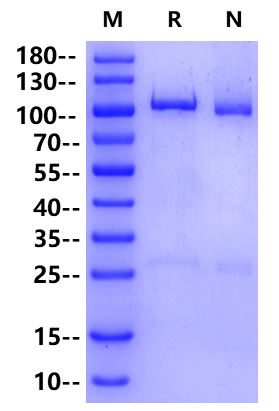
2μg (R: reducing condition, N: non-reducing condition).
ACSL1 GST Tag Protein, Human
ACSL1 GST Tag Protein, Human
Price:
Regular price
$480 USD
Regular price
Sale price
$480 USD
Unit price
per
For shipping services or bulk orders, you may request a quotation.
Secure checkout with

View full details
Product Details
Product Details
Product Specification
| Species | Human |
| Synonyms | ACSL1, FACL1 |
| Accession | P33121 |
| Amino Acid Sequence | Pro48-Val698 with GST Tag at the N-Terminus |
| Expression System | E.coli |
| Molecular Weight | 100-130kDa (Reducing) |
| Purity | >90% by SDS-PAGE |
| Conjugation | Unconjugated |
| Tag | GST Tag |
| Physical Appearance | Liquid |
| Storage Buffer | 50mM Tris, 150mM NaCl, pH7.5, 1mM DTT, 10%Glycerol |
| Stability & Storage | Stable for 12 months upon stored at -80℃ from the date of receipt. And avoid repeated freeze-thaws cycles. |
| Reference | 1. Zheng, Z.-G., et al. (2025). Ergosterol alleviates hepatic steatosis and insulin resistance via promoting fatty acid β-oxidation by activating mitochondrial ACSL1. Cell Reports, 44(1), 115203. |
Background
ACSL1 is a crucial member of the long-chain acyl-CoA synthetase family, encoded by the ACSL1 gene located on human chromosome 4q35.1. The protein comprises 698 amino acids with a molecular weight of approximately 78 kDa, and is highly expressed in metabolically active tissues including the heart, skeletal muscle, liver, and adipose tissue, with lower expression levels in the brain, kidney, and erythrocytes.
Structural Characteristics and Activity Regulation: ACSL1 contains two AMP-binding enzyme domains spanning residues 96–563 and 572–643, and its expression is regulated by transcription factors such as PPARs and SREBP. As a membrane-bound enzyme primarily localized to the outer mitochondrial membrane and endoplasmic reticulum, ACSL1 captures fatty acids through an "induced fit" mechanism and catalyzes their activation.
Core Functions: The primary function of ACSL1 is to catalyze the conversion of long-chain fatty acids (C16–C20) into acyl-CoAs. The resulting products can be directed towards β-oxidation for energy production or utilized for triglyceride synthesis for energy storage.
Research Progress: Currently, small molecule inhibitors targeting ACSL1 remain at the preclinical research stage, with no clinical candidate compounds or approved drugs.
Picture
Picture
SDS-PAGE