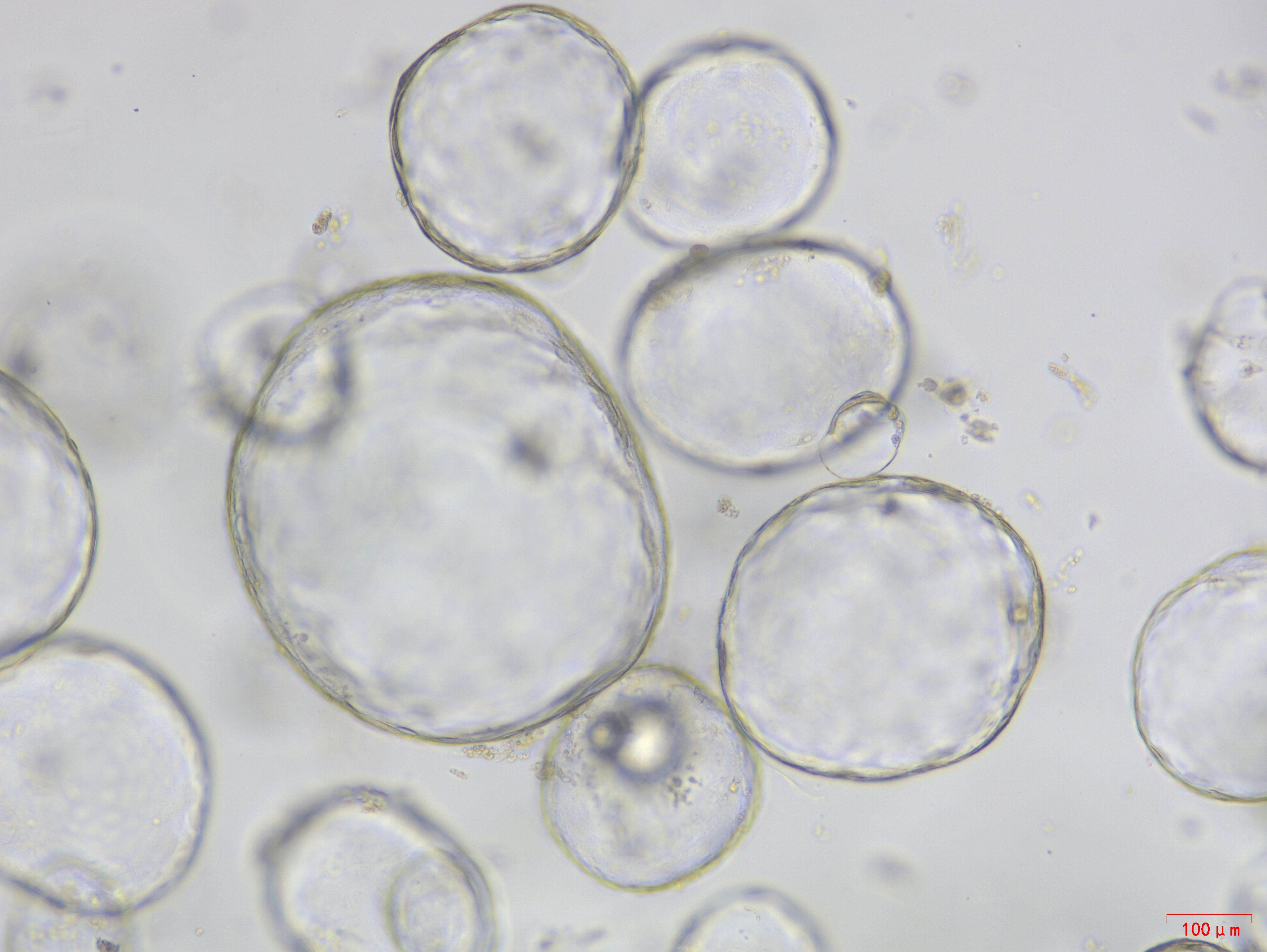
P4 D3
Cholangiocyte Organoid Expansion Culture Medium, Mouse
Cholangiocyte Organoid Expansion Culture Medium, Mouse
Price:
Regular price
$500 USD
Regular price
Sale price
$500 USD
Unit price
per
For shipping services or bulk orders, you may request a quotation.
Secure checkout with

View full details
Product Details
Product Details
Product Specification
| Species | Mouse |
| Endotoxin | <0.1EU/μg |
| Reconstitution | Reconstitute at 0.1-1 mg/ml according to the size in ultrapure water after rapid centrifugation. |
| Stability & Storage | -20℃ |
Components
Protein |
Reference dosage |
100ml system |
1000m system |
Cytokines 1 |
50ng/ml |
5μg |
50μg |
Cytokines 2 |
250ng/ml |
25μg |
250μg |
Cytokines 3 |
50ng/ml |
5μg |
50μg |
Cytokines 4 |
100ng/ml |
10μg |
100μg |
Cytokines 5 |
25ng/ml |
5μg |
25μg |
Protocol
1. Primary Culture
(1) Quickly dissect the mouse abdominal cavity in a biosafety cabinet, remove the liver tissue, and rinse it in pre-cooled PBS (supplemented with penicillin, streptomycin, and primary antibiotics). (2) Collect the rinsed tissue fragments into a 1.5 ml EP tube and mince them as finely as possible (to a homogenate-like consistency) using sterile pointed ophthalmic scissors. The degree of mincing correlates with digestion time—the finer the mincing, the shorter the digestion time. Transfer the minced tissue to a 15 ml sterile centrifuge tube. (3) Add 10 times the volume of tissue digestion solution and digest at 37°C with shaking for 10–30 min. Monitor the process closely. Terminate digestion when a large number of cells are observed leaking out under the microscope, and most cells appear as cell clusters (Note: Avoid digesting to a single-cell state). (4) After confirming digestion, add fetal bovine serum (FBS) to a final concentration of 2–5% or bovine serum albumin (BSA) to a final concentration of 0.1%, then mix by pipetting. (5) Filter the tissue and cell suspension through a 70 µm cell strainer. Centrifuge the filtered cell suspension at 1000 rpm for 5 min and discard the supernatant. (6) If obvious red precipitate (red blood cells) is observed in the pellet after centrifugation, add 2 ml of red blood cell lysis buffer, mix by pipetting, and incubate for 3 min. Add 10 ml of PBS to resuspend and terminate lysis, then centrifuge at 1000 rpm for 5 min and discard the supernatant. (7) Resuspend the pellet in an appropriate amount of basal medium or PBS. (8) Mix the extracellular matrix (ECM) gel with cells at a suitable ratio. For a 24-well cell culture plate, plate 25–30 µl of the ECM gel-cell mixture per well (perform at 4°C). (9) Place the plated culture plate in a 37°C incubator for 20–30 min to allow gelation, then add an appropriate amount of complete medium for mouse bile duct organoids (expansion) for culture.
2. Organoid Passaging
(1) Aspirate the medium and add 1–2 ml of 4°C PBS to each well, incubate for 2 min. (2) Gently pipette the ECM gel to detach it and collect it in a 15 ml centrifuge tube. Adjust the volume to 10–14 ml with PBS, incubate at 4°C for 20–30 min (group 3–5 wells together). Centrifuge at 1000 rpm for 5 min, discard the supernatant, and retain the pellet. (3) Resuspend the organoids in an appropriate amount of ECM gel, plate 25–30 µl per well in a 24-well cell culture plate, and incubate for 20–30 min for gelation. Add an appropriate amount of complete medium for mouse bile duct organoids (expansion) for culture.
3. Organoid Cryopreservation
(1) Aspirate the medium and add 1–2 ml of 4°C PBS to each well, incubate for 2 min. (2) Gently pipette the ECM gel to detach it and collect it in a 15 ml centrifuge tube. Adjust the volume to 10–14 ml with PBS, incubate at 4°C for 20–30 min (group 3–5 wells together). Centrifuge at 1000 rpm for 5 min, discard the supernatant, and retain the pellet. (3) Add an appropriate amount of organoid freezing medium, gently pipette to resuspend. For a 24-well plate, freeze 1 tube per 2–3 wells, with 1 ml per tube. (4) Label the tubes appropriately, perform programmed freezing, and transfer to liquid nitrogen for long-term storage. 4. Organoid Thawing (1) Prepare 10 ml of DMEM/F12 basal medium in a 15 ml centrifuge tube. (2) Retrieve the cryopreserved organoids from the liquid nitrogen tank and quickly thaw them in a 37°C water bath. (3) During thawing, gently shake the cryovial to ensure complete dissolution of the freezing medium within 1–2 min. (4) Quickly transfer the thawed organoids to the 15 ml centrifuge tube, gently pipette 6–8 times, and centrifuge at 1000 rpm for 5 min. Discard the supernatant and collect the organoid pellet. (5) Resuspend in ECM gel, plate 25–30 µl per well in a 24-well cell culture plate, and incubate for 20–30 min for gelation. Add an appropriate amount of complete medium for mouse bile duct organoids (expansion).
Guidelines
Avoid vortex oscillation; store in separate containers to reduce the number of freeze-thaw cycles.
Picture
Picture
Bioactivity